 Back
BackChapter 16 lecture 2
Study Guide - Smart Notes
 Tailored notes based on your materials, expanded with key definitions, examples, and context.
Chemical Equilibrium
Le Châtelier’s Principle
Le Châtelier’s Principle states that when a chemical system at dynamic equilibrium is disturbed, the system will shift its equilibrium position to counteract the disturbance and re-establish equilibrium. This principle is a qualitative guide for predicting the direction of the shift in response to changes in concentration, temperature, or pressure.
Disturbances: Changes in temperature (ΔT), pressure (ΔP), or concentration (Δ[X]) can affect equilibrium.
Equilibrium Shift: The system shifts to minimize the effect of the disturbance.
Important Detail: Only species that appear in the equilibrium constant expression affect equilibrium. Pure solids, pure liquids, and inert gases do not influence the equilibrium position.
Effect of Changing Concentration
Adding or removing reactants or products changes the reaction quotient (Q) relative to the equilibrium constant (K), causing the system to shift to restore equilibrium.
Adding Reactants: Q < K, equilibrium shifts right (toward products).
Removing Reactants: Q > K, equilibrium shifts left (toward reactants).
Adding Products: Q > K, equilibrium shifts left (toward reactants).
Removing Products: Q < K, equilibrium shifts right (toward products).
General equilibrium constant expression:
Effect of Changing Temperature
The effect of temperature depends on whether the reaction is endothermic or exothermic. Temperature changes alter the value of the equilibrium constant (K).
Endothermic Reaction (ΔH > 0): Heat is a reactant. Increasing temperature shifts equilibrium right and increases K; decreasing temperature shifts equilibrium left and decreases K.
Exothermic Reaction (ΔH < 0): Heat is a product. Increasing temperature shifts equilibrium left and decreases K; decreasing temperature shifts equilibrium right and increases K.
Example: For the endothermic reaction , increasing temperature shifts equilibrium right and increases .
Effect of Changing Pressure/Volume (for Gaseous Reactions)
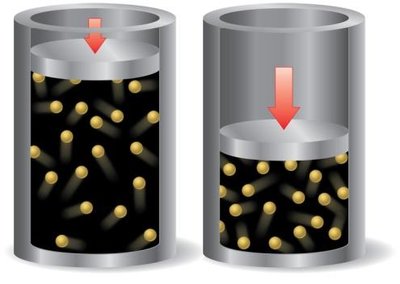
Changes in pressure or volume affect equilibrium only for reactions involving gases. The system responds by shifting toward the side with fewer or more moles of gas, depending on the disturbance.
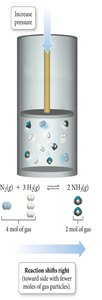
Compression (Increase Pressure, Decrease Volume): Equilibrium shifts toward the side with fewer moles of gas.
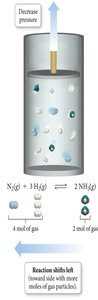
Expansion (Decrease Pressure, Increase Volume): Equilibrium shifts toward the side with more moles of gas.
Special Case: If the number of moles of gas is the same on both sides (), pressure/volume changes have no effect.
Example: For , increasing pressure shifts equilibrium right (toward fewer moles of gas).
Effect of Catalysts on Equilibrium
Catalysts lower the activation energy for both the forward and reverse reactions, increasing the rate at which equilibrium is reached. However, they do not affect the equilibrium position or the value of the equilibrium constant.
Effect: Faster attainment of equilibrium, no change in equilibrium concentrations.
Problem Solving Strategies for Chemical Equilibrium
Equilibrium problems often require calculation of equilibrium concentrations or partial pressures using initial values and the equilibrium constant (Kc or Kp). The ICE (Initial, Change, Equilibrium) table is a systematic method for solving these problems.
Step 1: Set up an ICE table for all reactants and products.
Step 2: Express changes in concentration or pressure using a variable (usually x) and stoichiometric coefficients.
Step 3: Write the equilibrium constant expression and substitute equilibrium values.
Step 4: Solve for x using algebra or quadratic equations as needed.
Example ICE Table:
Species | Initial | Change | Equilibrium |
|---|---|---|---|
[HI] | 1.00 | -2x | 1.00 - 2x |
[H2] | 0 | +x | x |
[I2] | 0 | +x | x |
Equilibrium constant expression:
Quadratic equation example:
Summary Table: Effects of Disturbances on Equilibrium
Change | [C2H4] | [Cl2] | [C2H4Cl2] | Kc | Shift |
|---|---|---|---|---|---|
Add C2H4 | D | D | I | S | → |
Remove C2H4Cl2 | D | D | I | S | → |
Decrease T | D | D | I | I | → |
Increase V | I | I | D | S | ← |
Increase P | D | D | I | S | → |
Key: I = Increase, D = Decrease, S = Same, → = Shift right, ← = Shift left
Additional info:
ICE tables are essential for equilibrium calculations, especially when initial concentrations and equilibrium constants are given.
Quadratic equations may be required to solve for equilibrium concentrations when the equilibrium constant expression leads to a second-degree equation.
