 Back
BackChemical Equilibrium: Principles and the Equilibrium Constant
Study Guide - Smart Notes
 Tailored notes based on your materials, expanded with key definitions, examples, and context.
Chemical Equilibrium
Dynamic Equilibrium
Chemical equilibrium is a dynamic state in which the rates of the forward and reverse reactions are equal, resulting in constant concentrations of all reactants and products over time. This does not mean the concentrations are equal, but rather that their values remain unchanged as long as the system is undisturbed.
Reversible Reaction: A reaction that can proceed in both the forward and reverse directions.
Dynamic Equilibrium: The condition where the forward and reverse reaction rates are equal, and the system's composition remains constant.
Key Point: At equilibrium, both reactants and products are present, and their concentrations do not change with time.
Example:
Distinguishing Features of Equilibrium
Equal Rates ≠ Equal Concentrations: The rates of the forward and reverse reactions are equal, but the concentrations of reactants and products are not necessarily equal.
Dynamic vs. Static Equilibrium: In dynamic equilibrium, reactions continue to occur in both directions; in static equilibrium, no molecular change occurs (rare in chemistry).
The Equilibrium Constant (K)
Definition and Law of Mass Action
The equilibrium constant, K, quantifies the ratio of product and reactant concentrations at equilibrium, each raised to the power of their stoichiometric coefficients. This relationship is known as the Law of Mass Action.
General Form: For the reaction :
Products over Reactants: Always place products in the numerator and reactants in the denominator.
Equilibrium Concentrations: Only use concentrations measured at equilibrium.
Magnitude of K and Position of Equilibrium
The value of K indicates whether products or reactants are favored at equilibrium:
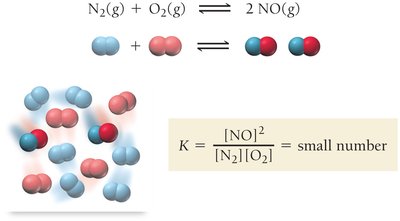
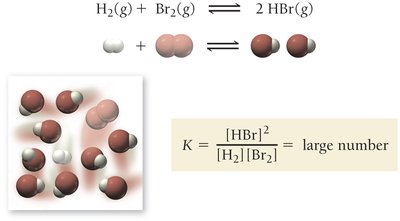
K >> 1: Products are favored; equilibrium lies to the right.
K << 1: Reactants are favored; equilibrium lies to the left.
K ≈ 1: Neither side is strongly favored; significant amounts of both reactants and products are present.
Reaction | K Value | Equilibrium Position |
|---|---|---|
Large | Favors products | |
Small | Favors reactants |
Initial and Equilibrium Concentrations
Equilibrium can be established from different starting concentrations, but the ratio defined by K remains constant at a given temperature. For example, in the reaction , different initial concentrations will yield different equilibrium concentrations, but the value of K will be the same.
Relationships Between K and Chemical Equations
Manipulating Chemical Equations
Reversing the Equation: Inverts K. If the reaction is reversed, .
Multiplying the Equation by n: Raises K to the nth power. If the coefficients are multiplied by n, .
Adding Equations: Multiplies their K values. If two reactions are added, the overall K is the product of the individual Ks.
Expressing K in Terms of Pressure (Kp)
Equilibrium Constant for Gaseous Reactions
For reactions involving gases, the equilibrium constant can also be expressed in terms of partial pressures, Kp:
Relationship between Kc and Kp:
Where
R = 0.08206 L·atm/(mol·K), T in Kelvin
Units of the Equilibrium Constant
Kc: Use molarity (M) for all concentrations.
Kp: Use atmospheres (atm) for all partial pressures.
Standard Definition: K is often made unitless by dividing each concentration or pressure by a standard reference value (1 M or 1 atm).
Heterogeneous Equilibrium
Exclusion of Pure Solids and Liquids
In reactions involving pure solids or liquids, their concentrations are not included in the equilibrium constant expression because their concentrations remain constant during the reaction.
Example: (if CO2 is a gas, only gases are included in K)
Example: (H2O is not included in K)
Effect of Temperature on K
The value of the equilibrium constant K depends on temperature. Changing the temperature will shift the position of equilibrium and alter the value of K.
Visualizing Equilibrium Mixtures
Comparing Equilibrium at Different Temperatures
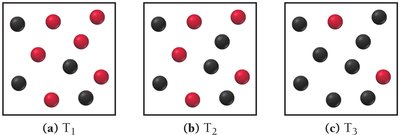
Visual representations of equilibrium mixtures at different temperatures can help determine at which temperature the equilibrium constant is largest or smallest. The mixture with the highest proportion of products corresponds to the largest K value.
Summary Table: Key Relationships for K
Operation on Equation | Effect on K |
|---|---|
Reverse equation | Take reciprocal () |
Multiply equation by n | Raise K to nth power () |
Add equations | Multiply K values () |
Take-Home Points
Reversible reactions can reach dynamic equilibrium, where forward and reverse rates are equal.
The equilibrium constant K expresses the ratio of product to reactant concentrations at equilibrium, raised to their stoichiometric coefficients.
Kc uses concentrations (M), Kp uses partial pressures (atm).
Pure solids and liquids are not included in K expressions.
The value of K indicates whether products or reactants are favored at equilibrium.
