 Back
BackChemical Equilibrium: Principles, Calculations, and Applications
Study Guide - Smart Notes
 Tailored notes based on your materials, expanded with key definitions, examples, and context.
Chapter 16: Chemical Equilibrium
The Equilibrium Condition
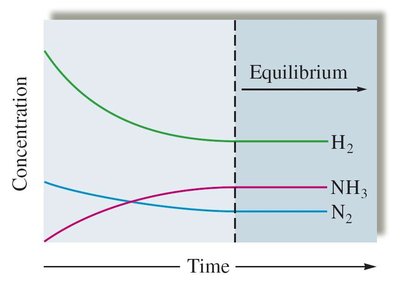
Chemical equilibrium occurs when the rates of the forward and reverse reactions are equal, resulting in constant concentrations of reactants and products over time. This state is dynamic, meaning that reactions continue to occur, but there is no net change in the concentrations.
Dynamic Equilibrium: Both forward and reverse reactions proceed at the same rate.
Constant Concentrations: The concentrations of all species remain unchanged once equilibrium is reached.
Example: For the reaction N2 + 3 H2 → 2 NH3, equilibrium is established when the rates of ammonia formation and decomposition are equal.
The Equilibrium Constant (K)
The equilibrium constant, K, quantifies the ratio of product and reactant concentrations at equilibrium for a given reaction at a specific temperature. It is derived from the balanced chemical equation.
General Expression: For a reaction jA + kB → lC + mD:
Interpretation: A large K (K >> 1) means products are favored; a small K (K << 1) means reactants are favored.
Unitless: Equilibrium constants are considered unitless by dividing by a reference concentration (1.0 M).
Example Calculation: If [NH3] = 2.3 M, [N2] = 0.34 M, [H2] = 0.14 M at equilibrium:
Properties of the Equilibrium Constant
The value and expression for K depend on how the chemical equation is written.
Reversing the Reaction: Inverts the value of K.
Multiplying the Equation: Raises K to the corresponding power.
Adding Reactions: Multiply the K values of the individual reactions to get the overall K.
Equilibrium Expressions Involving Pressures (Kp)
For reactions involving gases, equilibrium can also be expressed in terms of partial pressures (Kp).
Expression: For N2 + 3 H2 → 2 NH3:
Conversion: where is the change in moles of gas.
Heterogeneous Equilibria
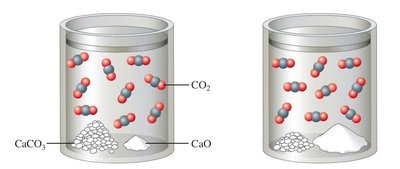
Heterogeneous equilibria involve reactants and products in different phases. Pure solids and liquids are not included in the equilibrium expression.
Example: For CaCO3(s) → CaO(s) + CO2(g):
The equilibrium pressure of CO2 does not depend on the amount of solid present.
The Reaction Quotient (Q)
The reaction quotient, Q, is calculated using the same expression as K but with initial (not equilibrium) concentrations or pressures. Comparing Q to K predicts the direction the reaction will proceed to reach equilibrium.
If Q = K: The system is at equilibrium.
If Q < K: The reaction proceeds forward (toward products).
If Q > K: The reaction proceeds in reverse (toward reactants).
Solving Equilibrium Problems: ICE Tables
ICE tables (Initial, Change, Equilibrium) are used to organize and solve for unknown equilibrium concentrations or pressures.
Steps:
Write the balanced equation and K expression.
Set up the ICE table with initial values.
Express changes in terms of x.
Write equilibrium values in terms of x.
Solve for x using the K expression.
Small x Approximation: If K is very small, changes in concentration may be negligible for reactants.
Le Chatelier’s Principle
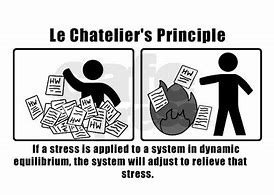
Le Chatelier’s Principle states that if a system at equilibrium is disturbed, it will shift to counteract the disturbance and re-establish equilibrium.
Adding Reactant/Product: Shifts equilibrium to consume the added substance.
Removing Reactant/Product: Shifts equilibrium to replace the removed substance.
Changing Volume/Pressure: For gases, decreasing volume (increasing pressure) shifts equilibrium toward the side with fewer moles of gas.
Changing Temperature: Increasing temperature favors the endothermic direction; decreasing temperature favors the exothermic direction.
Applications and Complex Equilibria
Le Chatelier’s Principle can be applied to more complex systems, such as those involving acids, bases, or common ions. Predicting the effect of adding substances or changing conditions is essential for understanding chemical processes.
Example: Adding HCl to a solution containing Mg(OH)2 will shift equilibrium by reacting with OH– ions, reducing their concentration and dissolving more Mg(OH)2.
Summary Table: Key Concepts in Chemical Equilibrium
Concept | Description | Key Equation |
|---|---|---|
Equilibrium Constant (K) | Ratio of product to reactant concentrations at equilibrium | |
Reaction Quotient (Q) | Same form as K, but with initial values | Compare Q to K to predict direction |
ICE Table | Organizes initial, change, and equilibrium values | Used to solve for unknowns |
Le Chatelier’s Principle | System shifts to counteract disturbances | N/A |
Kp and K | Equilibrium constants for pressures and concentrations |
Practice and Application
Write equilibrium constant expressions for any reaction.
Use ICE tables to solve for equilibrium concentrations.
Apply Le Chatelier’s Principle to predict shifts in equilibrium.
Convert between K and Kp as needed.
