 Back
BackChemical Equilibrium: Principles, Calculations, and Applications
Study Guide - Smart Notes
 Tailored notes based on your materials, expanded with key definitions, examples, and context.
Chemical Equilibrium
Introduction to Chemical Equilibrium
Chemical equilibrium is a fundamental concept in general chemistry, describing the state in which the concentrations of reactants and products remain constant over time. This occurs when the forward and reverse reactions proceed at equal rates. Understanding equilibrium is essential for predicting the behavior of chemical systems and for quantitative analysis in laboratory and industrial settings.
Dynamic Equilibrium: At equilibrium, reactions continue in both directions, but there is no net change in concentrations.
Reversible Reactions: Most chemical reactions are reversible, meaning they can proceed in both forward and reverse directions.
Equilibrium Constant (K): The ratio of product concentrations to reactant concentrations, each raised to the power of their stoichiometric coefficients.
Example: For the reaction , the equilibrium constant expression is:
Types of Equilibrium
Homogeneous Equilibrium: All reactants and products are in the same phase (e.g., all gases or all solutions).
Heterogeneous Equilibrium: Reactants and products are in different phases (e.g., solids and gases).
Equilibrium Expressions and Calculations
Equilibrium expressions are used to calculate the concentrations of reactants and products at equilibrium. The equilibrium constant can be expressed in terms of concentration () or partial pressure ().
Concentration-based Equilibrium Constant ():
Pressure-based Equilibrium Constant ():
Relationship between and : where is the change in moles of gas, is the gas constant, and is temperature in Kelvin.
Le Châtelier's Principle
Le Châtelier's Principle predicts how a system at equilibrium responds to disturbances such as changes in concentration, temperature, or pressure.
Change in Concentration: Adding or removing reactants/products shifts equilibrium to counteract the change.
Change in Temperature: Increasing temperature favors the endothermic direction; decreasing temperature favors the exothermic direction.
Change in Pressure: Increasing pressure favors the side with fewer moles of gas; decreasing pressure favors the side with more moles of gas.
Example: For , increasing pressure shifts equilibrium toward ammonia ().
Reaction Quotient (Q) and Comparison to K
The reaction quotient () is calculated using initial concentrations or pressures. Comparing $Q$ to determines the direction in which the reaction will proceed to reach equilibrium.
If : The reaction proceeds forward (toward products).
If : The reaction proceeds in reverse (toward reactants).
If : The system is at equilibrium.
ICE Tables and Equilibrium Calculations
ICE (Initial, Change, Equilibrium) tables are used to organize and solve equilibrium problems. They help track the changes in concentration or pressure as the system moves toward equilibrium.
Steps:
Write the balanced equation.
Set up the ICE table with initial concentrations.
Define changes using variables (e.g., , ).
Express equilibrium concentrations in terms of .
Substitute into the equilibrium expression and solve for .
Example: For , if initial concentrations are given, use the ICE table to find equilibrium concentrations.
Factors Affecting Equilibrium
Temperature: Changes in temperature alter the value of .
Catalysts: Catalysts speed up the attainment of equilibrium but do not affect the position of equilibrium or the value of .
Inert Gases: Addition of inert gases at constant volume does not affect equilibrium.
Graphical Representation of Equilibrium
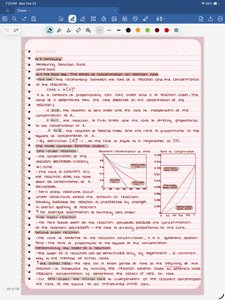
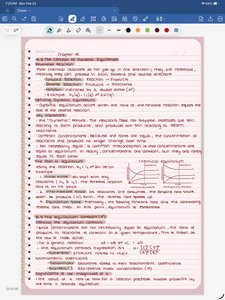
Graphs are used to illustrate how concentrations of reactants and products change over time and how equilibrium is established.
Summary Table: Effects of Changes on Equilibrium
Change | Effect on Equilibrium |
|---|---|
Increase Reactant | Shifts toward products |
Increase Product | Shifts toward reactants |
Increase Temperature (Endothermic) | Shifts toward products |
Increase Temperature (Exothermic) | Shifts toward reactants |
Increase Pressure | Shifts toward fewer moles of gas |
Add Catalyst | No effect on equilibrium position |
Sample Equilibrium Calculations
Example Problem: Given initial concentrations and , calculate equilibrium concentrations using ICE tables and quadratic equations if necessary.
Example Calculation: If M, M, M, calculate .
Additional info:
These notes cover Chapter 15: Chemical Equilibrium, which is directly relevant to general chemistry.
All equations are provided in LaTeX format for clarity and academic rigor.
Graphs included are directly relevant to the explanation of equilibrium and its graphical representation.
