 Back
BackChemical Equilibrium: Principles, Constants, and Applications
Study Guide - Smart Notes
 Tailored notes based on your materials, expanded with key definitions, examples, and context.
Chemical Equilibrium
Dynamic Equilibrium
Chemical equilibrium is a state in which the rates of the forward and reverse reactions are equal, resulting in no net change in the concentrations of reactants and products. This condition can occur in both physical and chemical processes.
Dynamic equilibrium: Opposing processes occur simultaneously at the same rate.
Physical changes (e.g., melting and freezing of ice) and chemical changes can both reach equilibrium.
At equilibrium, concentrations of all species remain constant over time, though the reactions continue at the molecular level.
Double-sided arrows (⇌) are used to indicate equilibrium in chemical equations.
Example: The melting and freezing of ice in water at 0 °C and 1 atm is a classic example of physical equilibrium, where the rate of melting equals the rate of freezing.
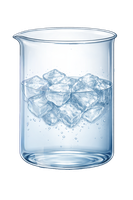
Chemical Equilibrium
In chemical equilibrium, the concentrations of reactants and products become stable, and the forward and reverse reaction rates are equal.
Equilibrium can be established in closed systems for reversible reactions.
Different initial amounts of reactants and products can lead to the same equilibrium ratio.
The Equilibrium Constant
Definition and Expression
The equilibrium constant (Kc) quantifies the ratio of product and reactant concentrations at equilibrium. It is calculated using molar concentrations (M) and is typically unitless because concentrations are divided by a standard concentration.
Kc is often written as "products over reactants" in the balanced chemical equation.
If Kc > 1, products are favored at equilibrium; if Kc < 1, reactants are favored.
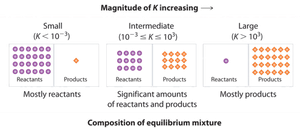
Examples of Equilibrium Expressions
Example 1:
Example 2:
Example 3:
Calculating the Equilibrium Constant
To determine Kc, measure the equilibrium concentrations of all species and substitute them into the equilibrium expression.
Multiple experiments with different starting concentrations will yield the same Kc value for a given reaction at a fixed temperature.
The ratio of products to reactants at equilibrium is constant for a given reaction and temperature.
Sample Problem
Given: , , Find: at equilibrium.
Equilibrium Constant for Gases: Kp
Definition
For reactions involving gases, the equilibrium constant can be expressed in terms of partial pressures (Kp), measured in atmospheres (atm).
Kp is usually not equal to Kc unless the change in the number of moles of gas is zero.
Relationship between Kp and Kc:
where is the change in moles of gas, is the gas constant, and is temperature in Kelvin.
Example Problem
For at 700 K, , . Find .
Manipulating Equilibrium Constants
Effect of Reaction Direction
If a reaction is reversed, the equilibrium constant is inverted (reciprocal).
If reactions are added, their equilibrium constants are multiplied:
If a reaction is multiplied by a factor , the equilibrium constant is raised to the $n$th power:
Multiple Equilibria
When multiple equilibria occur simultaneously, the overall equilibrium constant is the product of the individual constants for each step.
Heterogeneous Equilibria
Definition and Application
Heterogeneous equilibrium involves reactants and products in different phases (solid, liquid, gas, aqueous). The concentrations of pure solids and pure liquids are constant and are omitted from the equilibrium expression.
Example:
The concentration of solid Ni is constant and not included in the equilibrium expression.
Summary Table: Manipulating Equilibrium Constants
Operation | Effect on Kc |
|---|---|
Reverse reaction | Take reciprocal: |
Add reactions | Multiply constants: |
Multiply reaction by n | Raise to power: |
