 Back
BackChapter 16 lecture 1
Study Guide - Smart Notes
 Tailored notes based on your materials, expanded with key definitions, examples, and context.
Chemical Equilibrium
Reversible Chemical Reactions
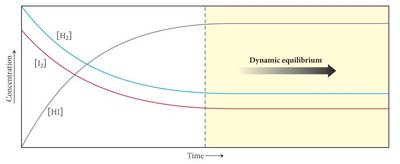
Most chemical reactions are reversible, meaning they can proceed in both the forward and reverse directions. Initially, reactants convert to products, but as products accumulate, they can react to regenerate reactants. Eventually, the system reaches a state called dynamic chemical equilibrium.
Dynamic equilibrium occurs when the rates of the forward and reverse reactions are equal.
At equilibrium, the concentrations of all species remain constant over time.
The reaction does not stop; both forward and reverse reactions continue at equal rates.
Example: For the reaction H2(g) + I2(g) ↔ 2 HI(g), equilibrium is reached when the rate of formation of HI equals the rate of its decomposition.
The Equilibrium Constant, Kc
The equilibrium constant, Kc, quantifies the ratio of product to reactant concentrations at equilibrium for a given reaction. It is derived from the Law of Mass Action:
For a general reaction: aA + bB ↔ cC + dD
The equilibrium constant expression is:
Kc is always positive and depends on temperature.
The value of Kc is independent of initial concentrations.
Example: For CO(g) + 3H2(g) ↔ CH4(g) + H2O(g):
Equilibrium Constant Based on Partial Pressures: Kp
For gas-phase reactions, it is often convenient to use partial pressures instead of concentrations. The equilibrium constant in terms of partial pressures is:
For aA(g) + bB(g) ↔ cC(g) + dD(g):
P = partial pressure in atmospheres.
Relationship Between Kp and Kc
Kp and Kc are related by the equation:
Where R is the gas constant (0.08206 L·atm·mol-1·K-1), T is temperature in Kelvin, and Δn is the change in moles of gas (products minus reactants).
Example: For CaCO3(s) ↔ CaO(s) + CO2(g), Δn = 1 - 0 = 1.
Interpreting Equilibrium Constants
The magnitude of the equilibrium constant provides insight into the composition of the equilibrium mixture:
If K >> 1 (e.g., K > 102): equilibrium favors products.
If K << 1 (e.g., K < 10-2): equilibrium favors reactants.
If K is intermediate (between 10-2 and 102): significant amounts of both reactants and products are present.
Important: The value of K is not related to the speed of reaching equilibrium; it is determined by thermodynamic properties (ΔGº).
Manipulating Equilibrium Constant Expressions
Three cases affect the equilibrium constant:
Reversing the reaction: The new equilibrium constant is the reciprocal.
Multiplying coefficients by a factor j: The new constant is the original raised to the jth power.
Adding reactions: The net equilibrium constant is the product of the individual constants.
The Reaction Quotient, Q
The reaction quotient, Q, is calculated using the same expression as K, but with concentrations or partial pressures at any point in the reaction (not necessarily at equilibrium):
Q = 0 if only reactants are present; Q = ∞ if only products are present.
Predicting Reaction Direction Using Q
By comparing Q to K, the direction in which the reaction will proceed can be predicted:
If Q < K: Reaction shifts right (toward products).
If Q > K: Reaction shifts left (toward reactants).
If Q = K: System is at equilibrium; no net change.


Heterogeneous Equilibrium
When reactants and products are in different phases, the system is in heterogeneous equilibrium. The concentrations of pure solids and liquids are not included in the equilibrium constant expression because they remain constant.
Example: CaCO3(s) ↔ CaO(s) + CO2(g) and
Example: PCl5(s) ↔ PCl3(l) + Cl2(g) and
Important Notes on Equilibrium Calculations
Concentrations in solution are expressed in mol/L.
For gases, either mol/L or atm can be used for Kc and Kp.
Both Kc and Kp are unitless quantities.
