 Back
BackChemical Equilibrium: Principles, Expressions, and Applications
Study Guide - Smart Notes
 Tailored notes based on your materials, expanded with key definitions, examples, and context.
Chemical Equilibrium
Introduction to Chemical Equilibrium
Chemical equilibrium is a fundamental concept in chemistry describing the state in which the rates of the forward and reverse reactions are equal, resulting in constant concentrations of reactants and products. This chapter explores the principles, mathematical expressions, and real-world applications of equilibrium.
Hemoglobin and Oxygen Equilibrium
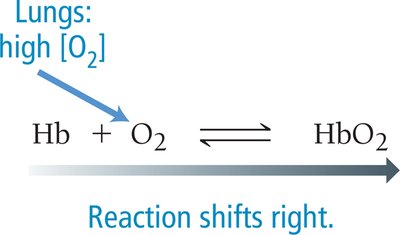
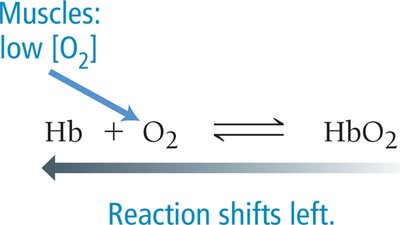
Hemoglobin (Hb) is a protein in red blood cells that binds with oxygen (O2), facilitating oxygen transport in the bloodstream. The reaction between hemoglobin and oxygen is an example of a dynamic equilibrium:
Dynamic Equilibrium: The process is reversible, and the concentrations of Hb, O2, and HbO2 are interdependent.
Equilibrium Constant (K): The relative amounts of reactants and products at equilibrium are described by the equilibrium constant, K.
Shifting Equilibrium: Changes in O2 concentration shift the equilibrium position.
Example: In the lungs (high O2), the equilibrium shifts right, forming more HbO2. In muscles (low O2), the equilibrium shifts left, releasing O2.
Reaction Dynamics and Dynamic Equilibrium
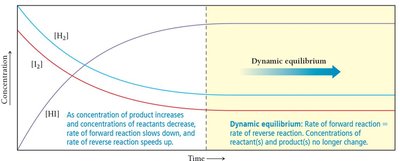
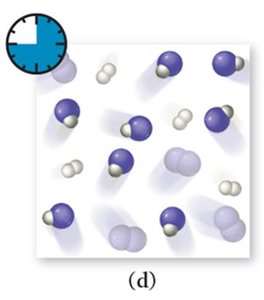
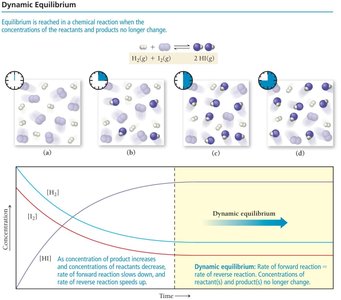
Reactions begin with reactants being consumed and products formed. As reactant concentration decreases, the forward reaction slows, while the reverse reaction accelerates as product concentration increases. When both rates become equal, dynamic equilibrium is established.
Reversible Reactions: Both forward and reverse reactions occur simultaneously.
Constant Concentrations: At equilibrium, concentrations of all species remain constant.
Reaching Equilibrium: Example with Hydrogen and Iodine
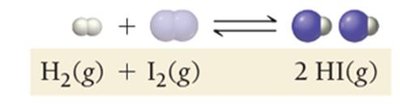
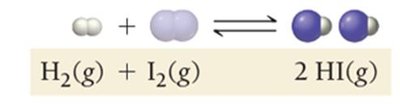
The reaction between hydrogen and iodine to form hydrogen iodide illustrates the approach to equilibrium:
At time 0: Only reactants present.
At intermediate times: Both reactants and products present; both reactions occur.
At equilibrium: Concentrations remain constant.
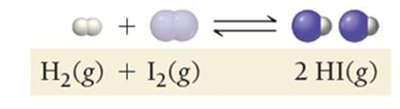
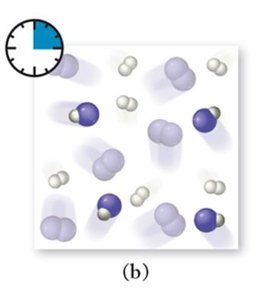
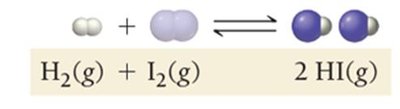
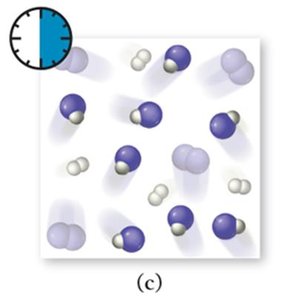
Equilibrium Does Not Mean Equal Concentrations
At equilibrium, the rates of the forward and reverse reactions are equal, but the concentrations of reactants and products are not necessarily equal. The position of equilibrium may favor products or reactants depending on the value of K.
Product-favored: Most reactants are converted to products.
Reactant-favored: Most reactants remain unconverted.
The Equilibrium Constant and the Law of Mass Action
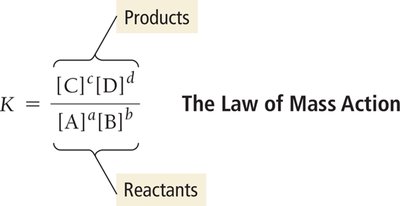
The equilibrium constant (K) quantifies the relationship between reactant and product concentrations at equilibrium. The law of mass action provides the mathematical expression for K:
General Form: For a reaction , the equilibrium constant is:
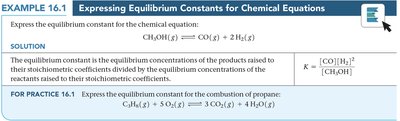
Example: Expressing Equilibrium Constants
For the reaction :
Interpreting the Value of K
The magnitude of K indicates the position of equilibrium:
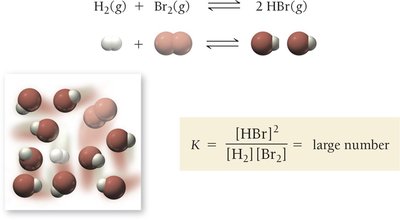
K >> 1: Product-favored; high concentration of products at equilibrium.
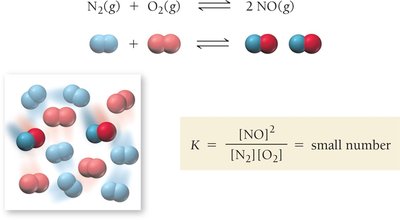
K << 1: Reactant-favored; high concentration of reactants at equilibrium.
Temperature and Equilibrium Constant
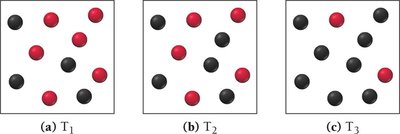
The equilibrium constant can vary with temperature. Visual representations of equilibrium mixtures at different temperatures show how the ratio of products to reactants changes.
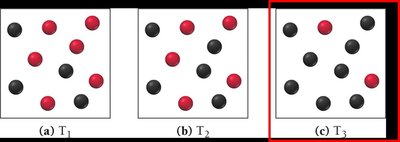
Equilibrium Constants for Gaseous Reactions
For reactions involving gases, equilibrium constants can be expressed in terms of concentrations (Kc) or partial pressures (Kp):
Kc: Uses molar concentrations.
Kp: Uses partial pressures in atm.
Relationship: , where is the change in moles of gas.
Units of the Equilibrium Constant
Although concentrations and partial pressures are measured in M and atm, equilibrium constants are unitless. This is achieved by dividing each concentration or pressure by its standard value (1 M or 1 atm).
Heterogeneous Equilibria
In reactions involving solids or pure liquids, their concentrations do not change and are omitted from the equilibrium constant expression. Only substances in solution (aq) or gaseous state (g) are included.
Example:
K expression:
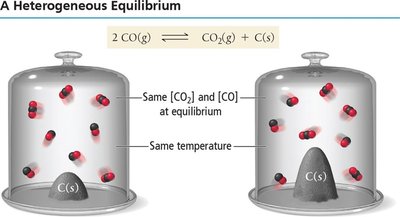
Summary Table: Types of Equilibrium Constants
Type | Expression | Units |
|---|---|---|
Kc | Concentration (M) | Unitless |
Kp | Partial Pressure (atm) | Unitless |
Heterogeneous | Only (aq) and (g) included | Unitless |
Key Concepts and Definitions
Dynamic Equilibrium: State where forward and reverse reaction rates are equal.
Equilibrium Constant (K): Ratio of product to reactant concentrations at equilibrium.
Law of Mass Action: Mathematical relationship for K.
Heterogeneous Equilibrium: Equilibrium involving more than one phase.
