 Back
BackChemical Equilibrium: Principles, Expressions, and Effects of Changes
Study Guide - Smart Notes
 Tailored notes based on your materials, expanded with key definitions, examples, and context.
Chemical Equilibrium
Introduction to Equilibrium
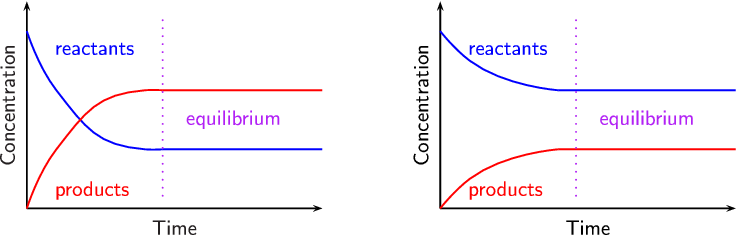
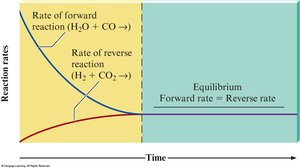
Chemical equilibrium occurs when the rates of the forward and reverse reactions are equal, resulting in constant concentrations of reactants and products over time. Although the amounts remain constant, the system is dynamic at the molecular level, with ongoing conversion between reactants and products.
Dynamic equilibrium: Reactants and products are continuously interconverted.
Macroscopic properties: Observable properties (color, volume, etc.) remain unchanged at equilibrium.
Original amounts: The initial concentrations do not affect the final equilibrium ratio.
Equilibrium Constant Expressions
The equilibrium constant (K) quantifies the ratio of product and reactant concentrations at equilibrium for a given reaction. It is derived from the balanced chemical equation and only includes species in the gas or aqueous phase.
General form: For a reaction aA + bB → cC + dD, the equilibrium constant expression is:
Square brackets: Indicate molar concentrations at equilibrium.
Solids and liquids: Omitted from the expression because their concentrations are constant.
Examples of Equilibrium Constant Expressions
Ammonia synthesis: N2(g) + 3H2(g) → 2NH3(g)
Expression:
Heterogeneous example: TiCl4(g) + O2(g) → TiO2(s) + 2Cl2(g)
Expression:
Homogeneous vs. Heterogeneous Equilibria
Equilibria can involve species in the same phase (homogeneous) or different phases (heterogeneous).
Homogeneous equilibrium: All reactants and products are in the same phase (e.g., all gases or all aqueous).
Heterogeneous equilibrium: Reactants and products are in different phases (e.g., solids and gases).
Solids and liquids: Their concentrations are constant and omitted from equilibrium expressions.
Le Châtelier's Principle: Effects of Changes on Equilibrium
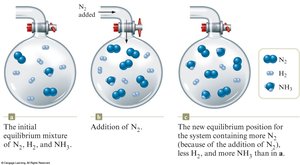
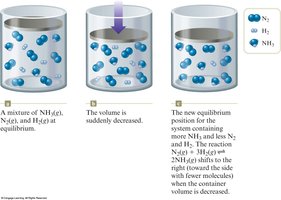
If a change (stress) is imposed on a system at equilibrium, the system shifts to counteract that change. The three main stresses are changes in concentration, pressure (for gases), and temperature.
Change in concentration: Adding a reactant or product shifts equilibrium away from that component; removing shifts toward it.
Change in pressure: For gaseous systems, decreasing volume (increasing pressure) shifts equilibrium toward the side with fewer gas molecules.
Change in temperature: For exothermic reactions, adding heat shifts equilibrium to the left; for endothermic, to the right.
Quantitative Examples and Calculations
Equilibrium constant values can be calculated from equilibrium concentrations. The magnitude of K indicates the extent of the reaction:
K > 1: Equilibrium lies to the right (mostly products).
K < 1: Equilibrium lies to the left (mostly reactants).
Example: For N2O4(g) → 2NO2(g) with [N2O4] = 0.055 M and [NO2] = 0.060 M:
Reaction Quotient (Q) and Predicting Direction
The reaction quotient (Q) is calculated like K but with current concentrations. Comparing Q to K predicts the direction the reaction will shift:
Q < K: Reaction shifts right (toward products).
Q > K: Reaction shifts left (toward reactants).
Q = K: System is at equilibrium.
Summary Table: Effects of Stresses on Equilibrium
Stress | Effect on Equilibrium |
|---|---|
Add reactant | Shifts right (toward products) |
Remove reactant | Shifts left (toward reactants) |
Decrease volume (increase pressure) | Shifts toward fewer gas molecules |
Increase temperature (exothermic) | Shifts left (toward reactants) |
Increase temperature (endothermic) | Shifts right (toward products) |
Key Terms and Definitions
Equilibrium: State where forward and reverse reaction rates are equal.
Equilibrium constant (K): Ratio of product to reactant concentrations at equilibrium.
Le Châtelier's Principle: System shifts to counteract imposed changes.
Reaction quotient (Q): Ratio calculated with current concentrations, used to predict direction.
