 Back
Chemical Equilibrium: Principles, Types, and Effects
Study Guide - Smart Notes
 Tailored notes based on your materials, expanded with key definitions, examples, and context.
Chemical Equilibrium
General Concepts of Chemical Equilibrium
Chemical equilibrium is a fundamental concept in chemistry describing the state in which the rates of the forward and reverse reactions are equal, resulting in constant concentrations of reactants and products. Although reactions may proceed nearly to completion, they never go entirely in one direction; instead, they reach a dynamic equilibrium.
The Rate Concept and Law of Mass Action
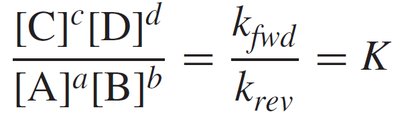
The law of mass action, formulated by Guldberg and Waage in 1863, states that the rate of a chemical reaction is proportional to the "active masses" (concentrations or pressures) of the reactants. At equilibrium, the rates of the forward and reverse reactions are equal.
Forward Reaction Rate:
Reverse Reaction Rate:
Equilibrium Condition:
Equilibrium Constant:
Dynamic Nature of Equilibrium
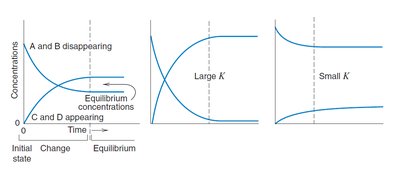
At equilibrium, the concentrations of reactants and products remain constant, but the reactions continue to occur in both directions at equal rates. This is known as dynamic equilibrium.
Initial Reaction: Forward rate is high due to high reactant concentrations; reverse rate is low.
Progression: Reactant concentrations decrease, product concentrations increase; forward rate decreases, reverse rate increases.
Equilibrium: Both rates become equal; concentrations stabilize.
Magnitude of Equilibrium Constant
The value of the equilibrium constant (K) indicates the extent to which a reaction proceeds:
Large K: Reaction favors products; equilibrium lies to the right.
Small K: Reaction favors reactants; equilibrium lies to the left.

Types of Equilibria
Classification of Equilibria
Equilibrium constants can be written for various types of chemical processes. Common types include acid-base dissociation, solubility, complex formation, redox reactions, and phase distribution.
Equilibrium | Reaction | Equilibrium Constant |
|---|---|---|
Acid–base dissociation | HA + H2O ⇌ H3O+ + A− | Ka, acid dissociation constant |
Solubility | MA ⇌ Mn+ + Am− | Ksp, solubility product |
Complex formation | Mn+ + aL ⇌ MLan+ | Kf, formation constant |
Reduction–oxidation | Ared + Box ⇌ Aox + Bred | Keq, reaction equilibrium constant |
Phase distribution | AH2O ⇌ Aorganic | KD, distribution coefficient |

Le Châtelier’s Principle
Principle and Application
Le Châtelier’s principle predicts how a system at equilibrium responds to disturbances. If a variable (concentration, pressure, temperature) is changed, the equilibrium shifts to counteract the change.
Concentration: Adding/removing reactants or products shifts equilibrium to consume/produce them.
Pressure: Increasing pressure favors the side with fewer moles of gas; decreasing favors more moles.
Temperature: Increasing temperature favors the endothermic direction; decreasing favors exothermic.
Effects of Temperature, Pressure, and Concentration
Temperature Effects
Temperature affects both the equilibrium constant and the rates of reactions:
Endothermic Reaction: Increasing temperature shifts equilibrium to the right (more products).
Exothermic Reaction: Increasing temperature shifts equilibrium to the left (more reactants).
Rate: Higher temperature increases collision frequency and energy, speeding up attainment of equilibrium.
Pressure Effects
Pressure changes mainly affect gaseous equilibria:
Increase in Pressure: Shifts equilibrium toward fewer moles of gas.
Decrease in Pressure: Shifts equilibrium toward more moles of gas.
Liquids: Pressure changes have negligible effect due to incompressibility.
Concentration Effects
While the equilibrium constant is independent of concentration, the position of equilibrium is affected by changes in concentration, as predicted by Le Châtelier’s principle.
Example: In the reaction , adding more Fe2+ shifts equilibrium to the left.
Catalysts and Equilibrium
Role of Catalysts
Catalysts increase the rate at which equilibrium is reached by affecting both forward and reverse reaction rates equally. They do not alter the equilibrium constant or the position of equilibrium.
Completeness of Reactions
Extent of Reaction
If equilibrium lies far to the right, the reaction is said to go to completion. If not, Le Châtelier’s principle can be used to drive the reaction further by manipulating reactant or product concentrations.
Methods to Increase Product Formation: Allowing gaseous products to escape, precipitating products, forming stable complexes, or preferential extraction.
Equilibrium Constants for Dissociating or Combining Species
Electrolytes and Solubility
Substances in water may dissociate or ionize completely (strong electrolytes) or partially (weak electrolytes). Slightly soluble substances ionize completely but have limited solubility.
Example: Acetic acid is a weak electrolyte; hydrochloric acid is a strong electrolyte.
General Equilibrium Constant for Dissociation
For a dissociating species AB:
Reaction:
Equilibrium Constant:
Interpretation: Larger means greater dissociation; for acids, larger $K_{eq}$ means stronger acid.
Stepwise Dissociation
Some compounds dissociate in steps, each with its own equilibrium constant. Successive constants are usually smaller due to increased difficulty in removing additional protons or ions.
Example: Diprotic acids like oxalic acid (HOOCCOOH) have .
Reverse Reaction: The equilibrium constant for the reverse reaction is the inverse of the forward constant.
Calculations Using Equilibrium Constants
Composition at Equilibrium
To calculate equilibrium concentrations, use the equilibrium constant expression and initial amounts:
Example: For ,
Given: , mol A, mol B in L
Calculation: Set up an ICE (Initial, Change, Equilibrium) table and solve for equilibrium concentrations.
Additional info: For very large equilibrium constants (e.g., ), the reaction goes nearly to completion, and the equilibrium concentrations of reactants will be very small.
