 Back
BackChemistry: Chapter 15 lecture notes part 2
Study Guide - Smart Notes
 Tailored notes based on your materials, expanded with key definitions, examples, and context.
Chemical Equilibrium and the Reaction Quotient
Understanding the Reaction Quotient (Q) and Equilibrium Constant (Kc)
Chemical equilibrium occurs when the rates of the forward and reverse reactions are equal, resulting in constant concentrations of reactants and products. The reaction quotient (Q) and the equilibrium constant (Kc) are essential for predicting the direction in which a reaction will proceed to reach equilibrium.
Kc is the equilibrium constant, calculated using equilibrium concentrations at a specific temperature. It is constant for a given reaction at a given temperature.
Q is the reaction quotient, calculated using current (not necessarily equilibrium) concentrations. Q can have any value.
For a general reaction: aA + bB ↔ cC + dD, the reaction quotient is given by:
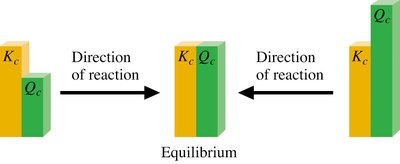
Comparing Q and Kc predicts the direction of the reaction:
If Q < Kc, the reaction proceeds forward (to the right) to form more products.
If Q > Kc, the reaction proceeds in reverse (to the left) to form more reactants.
If Q = Kc, the system is at equilibrium.
Calculating the Reaction Quotient and Predicting Shifts
Example: COCl2 Decomposition
Given the reaction: COCl2(g) ↔ CO(g) + Cl2(g), with Kc = 2.19 × 10⁻¹⁰ at 373 K, determine if the following mixtures are at equilibrium:
Case a: [COCl2] = 5.00 × 10⁻² M, [CO] = 3.31 × 10⁻² M, [Cl2] = 3.31 × 10⁻⁶ M
Calculate Q:
Q = 2.19 × 10⁻⁶ > Kc
Since Q > Kc, the reaction shifts left (toward COCl2).
Case b: [COCl2] = 1.45 M, [CO] = 1.56 × 10⁻⁶ M, [Cl2] = 1.56 × 10⁻⁶ M
Calculate Q:
Compare Q to Kc to determine direction (see multiple choice in original notes).
Calculating Equilibrium Concentrations
General Strategy for Equilibrium Calculations
When only partial information about concentrations is known, use the equilibrium constant and stoichiometry to solve for unknowns:
Write the equilibrium expression for the reaction.
Create a table of initial concentrations.
Indicate changes in concentration with a variable (usually x).
Relate changes using stoichiometry.
Add changes to initial values to get equilibrium concentrations.
Substitute equilibrium concentrations into the equilibrium expression.
Solve for x using algebra.
Calculate all equilibrium concentrations.
Example: Water-Gas Shift Reaction
CO(g) + H2O(g) ↔ CO2(g) + H2(g), Kc = 4.06 at 500 °C. Initial: [CO] = [H2O] = 0.100 M, [CO2] = [H2] = 0.
Let x = amount of CO2 and H2 formed at equilibrium.
Equilibrium concentrations: [CO] = [H2O] = 0.100 - x, [CO2] = [H2] = x
Substitute into Kc expression:
Solve for x: x = 0.0668 M
Equilibrium: [CO] = [H2O] = 0.033 M, [CO2] = [H2] = 0.0668 M
Example: Dinitrogen Tetroxide Equilibrium
N2O4(g) ↔ 2 NO2(g), Kc = 4.50. Initial: [N2O4] = 0.150 M, [NO2] = 0.
Let x = amount of N2O4 dissociated.
Equilibrium: [N2O4] = 0.150 - x, [NO2] = 2x
Substitute into Kc:
Solve quadratic equation for x: x = 0.134 M
Equilibrium: [NO2] = 0.268 M, [N2O4] = 0.016 M
Using Approximations in Equilibrium Calculations
When Kc is very small, the change in concentration (x) is often negligible compared to initial concentrations. This simplifies calculations.
Example: 2 N2(g) + O2(g) ↔ 2 N2O(g), Kc = 2.0 × 10-37
Assume x is very small: [N2] ≈ initial, [O2] ≈ initial
Solve for x, check that x is less than 5% of initial values to validate the assumption.
Le Chatelier’s Principle
Principle and Types of Disturbances
Le Chatelier’s Principle states that if a system at equilibrium is disturbed, it will shift to counteract the disturbance and reestablish equilibrium. Disturbances include changes in concentration, temperature, and pressure.
Adding/removing components: The system shifts to consume added substances or replace removed ones.
Changing temperature:
For exothermic reactions (ΔH < 0), increasing temperature shifts equilibrium left (toward reactants).
For endothermic reactions (ΔH > 0), increasing temperature shifts equilibrium right (toward products).
Changing pressure/volume: Increasing pressure (by decreasing volume) shifts equilibrium toward the side with fewer moles of gas.
Adding a catalyst: Does not affect equilibrium position; only increases the rate at which equilibrium is reached.
Examples of Le Chatelier’s Principle
Component Change: For 2 NO(g) + 2 H2(g) ↔ N2(g) + 2 H2O(g):
Adding H2: Reaction shifts right, producing more N2 and H2O.
Removing H2: Reaction shifts left, producing more NO and H2.
Using Q to Predict Shifts: For C(s) + 2 H2(g) ↔ CH4(g), if Q > Kp, the reaction shifts left (CH4 decreases, H2 increases).
Temperature Change:
CaC2(s) + 2 H2O(l) ↔ Ca(OH)2(s) + C2H2(g), ΔH = -127 kJ/mol (exothermic): Increasing T shifts left.
Ca(OH)2(aq) ↔ CaO(s) + H2O(l), ΔH = +82 kJ/mol (endothermic): Increasing T shifts right.
Pressure Change: For N2O4(g) ↔ 2 NO2(g): Decreasing volume (increasing pressure) shifts equilibrium toward fewer moles of gas (left).
Summary Table: Direction of Reaction Based on Q and Kc
Condition | Direction of Reaction |
|---|---|
Q < Kc | Forward (right, forms products) |
Q > Kc | Reverse (left, forms reactants) |
Q = Kc | At equilibrium (no net change) |
