Back
BackChemical Kinetics and Gases: Core Concepts and Applications
Study Guide - Smart Notes
 Tailored notes based on your materials, expanded with key definitions, examples, and context.
Chapter 14: Chemical Kinetics
Introduction to Chemical Kinetics
Chemical kinetics is the study of the rate at which chemical processes occur and the mechanisms by which reactions proceed. Understanding kinetics provides insight into how quickly reactions happen and the molecular steps involved in transforming reactants into products.
Reaction Rate: The speed at which reactants are converted to products, typically measured as the change in concentration over time.
Reaction Mechanism: The stepwise sequence of elementary reactions by which overall chemical change occurs.

Factors Affecting Reaction Rates
Several factors influence how fast a chemical reaction proceeds:
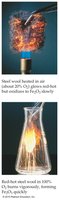
Physical State of Reactants: Homogeneous reactions (all reactants in the same phase) are generally faster. For heterogeneous reactions, increasing surface area (e.g., using a powder instead of a solid chunk) increases the rate.
Reactant Concentrations: Higher concentrations typically lead to higher reaction rates due to increased collision frequency.
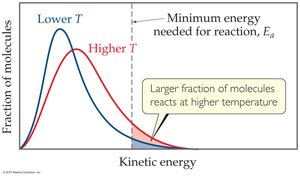
Temperature: Raising the temperature increases molecular kinetic energy, leading to more frequent and energetic collisions.
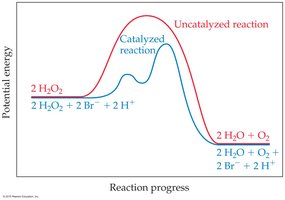
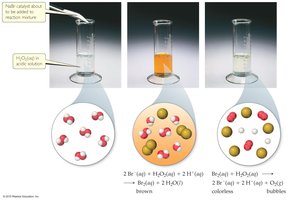
Catalysts: Substances that increase reaction rate by providing an alternative pathway with lower activation energy, without being consumed in the reaction.
Measuring Reaction Rates
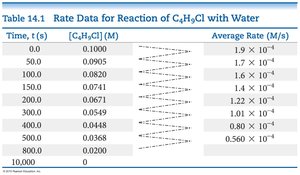
Reaction rates are determined by monitoring the concentration of a reactant or product over time. Rates can be expressed as average, instantaneous, or initial rates.
Average Rate: Change in concentration over a specific time interval.
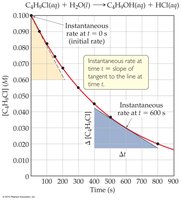
Instantaneous Rate: The rate at a particular moment, given by the slope of the concentration vs. time curve at that point.
Initial Rate: The instantaneous rate at the very start of the reaction (t = 0).
Rate Laws and Reaction Order
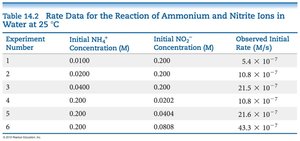
The rate law expresses the relationship between the rate of a reaction and the concentration of its reactants. The general form is:
Rate Law:
Order of Reaction: The exponents x and y indicate the order with respect to each reactant; the overall order is the sum of these exponents.
Rate Constant (k): A proportionality constant specific to the reaction and temperature.
Integrated Rate Laws
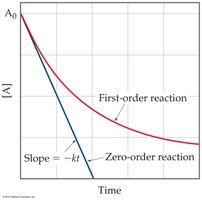
Integrated rate laws relate reactant concentration to time and differ for zero, first, and second order reactions.
First Order:
Second Order:
Zero Order:
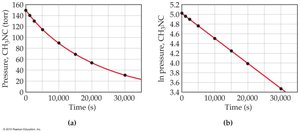
![Second order reaction: ln[NO2] and 1/[NO2] vs. time](https://static.studychannel.pearsonprd.tech/study_guide_files/general-chemistry/sub_images/505c369b_image_10.png)
Half-Life of Reactions
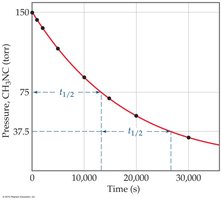
The half-life () is the time required for half of a reactant to be consumed.
First Order: (independent of concentration)
Second Order: (depends on initial concentration)
Temperature and Reaction Rate
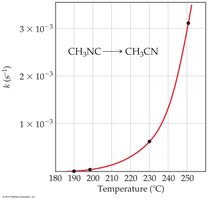
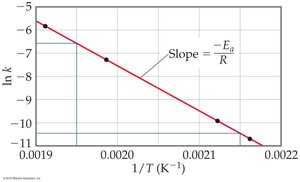
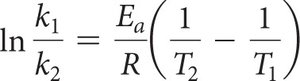
Reaction rates generally increase with temperature. The Arrhenius equation quantifies this relationship:
Arrhenius Equation:
Linear Form:
The Collision Model and Activation Energy
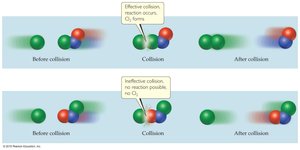
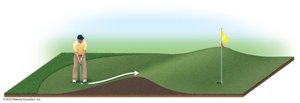
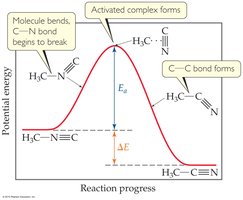
For a reaction to occur, molecules must collide with sufficient energy and proper orientation. The minimum energy required is the activation energy (Ea).
Transition State: The highest energy arrangement of atoms during a reaction, also called the activated complex.
Reaction Mechanisms and Molecularity
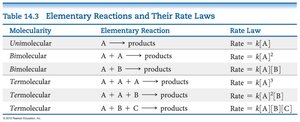
Reaction mechanisms describe the stepwise process by which reactants become products. Each step is an elementary reaction, classified by molecularity:
Molecularity | Elementary Reaction | Rate Law |
|---|---|---|
Unimolecular | A → products | Rate = k[A] |
Bimolecular | A + A → products | Rate = k[A]2 |
Bimolecular | A + B → products | Rate = k[A][B] |
Termolecular | A + A + A → products | Rate = k[A]3 |
Termolecular | A + B + C → products | Rate = k[A][B][C] |
Catalysis
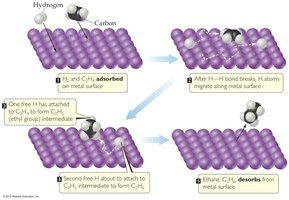
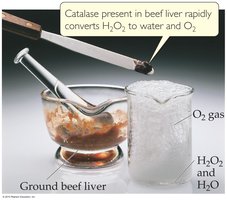
Catalysts increase reaction rates by lowering activation energy and providing alternative reaction pathways. They are not consumed in the reaction.
Homogeneous Catalysts: Catalyst and reactants are in the same phase.
Heterogeneous Catalysts: Catalyst is in a different phase than the reactants, often a solid surface for a gas-phase reaction.
Enzymes: Biological catalysts with specific active sites for substrate binding.
Chapter 10: Gases
Characteristics and Properties of Gases
Gases are composed mainly of nonmetallic elements with simple formulas and low molar masses. They expand to fill their containers, are highly compressible, and have low densities. Gases mix homogeneously in any proportion.
Variables Defining the State of a Gas
The state of a gas is defined by four variables:
Temperature (T)
Pressure (P)
Volume (V)
Amount (n, in moles)
Pressure and Its Measurement
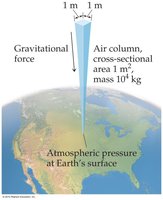
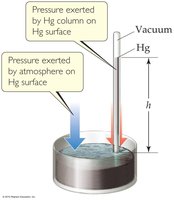
Pressure is the force exerted per unit area. Atmospheric pressure is the weight of air above a given area on Earth's surface.
SI Unit: Pascal (Pa), where 1 Pa = 1 N/m2
Other Units: 1 atm = 760 torr = 101.325 kPa
Gas Laws
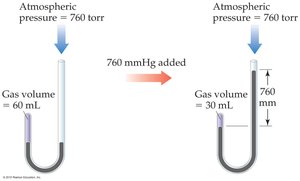
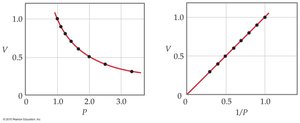
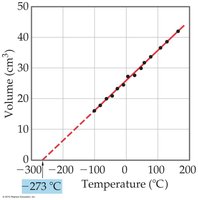
Gas laws describe the relationships between pressure, volume, temperature, and amount of gas.
Boyle’s Law: (at constant T and n; pressure and volume are inversely related)
Charles’s Law: (at constant P and n; volume and temperature are directly related)
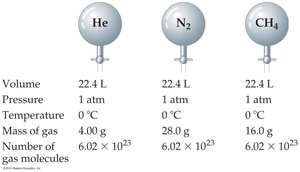
Avogadro’s Law: (at constant P and T; volume and moles are directly related)
The Ideal Gas Law
The ideal gas law combines the individual gas laws into a single equation:
Ideal Gas Law:
R is the gas constant, 0.0821 L·atm/(mol·K)
Density and Molar Mass of Gases
The density of a gas can be calculated using the ideal gas law:
, where M is molar mass
Molar mass can be found from measured mass, volume, temperature, and pressure:
Dalton’s Law of Partial Pressures
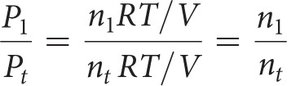
In a mixture of non-reacting gases, the total pressure is the sum of the partial pressures of each gas:
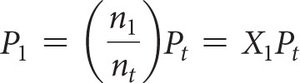
Mole Fraction (χ):
Partial pressure:
Kinetic-Molecular Theory of Gases
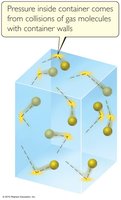
This theory explains the observed gas laws by describing the behavior of gas molecules:
Gases consist of particles in constant, random motion.
The volume of individual molecules is negligible compared to the total volume.
There are no significant intermolecular forces.
Collisions are elastic, and average kinetic energy is proportional to temperature.
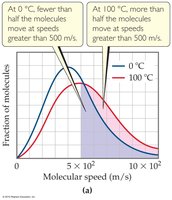
Root-Mean-Square Speed and Molecular Mass
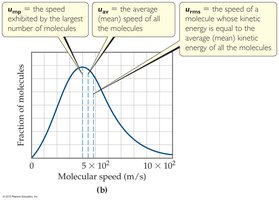
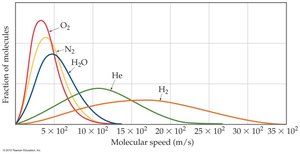
The root-mean-square (rms) speed of gas molecules is related to temperature and molar mass:
Lighter molecules move faster at a given temperature.
Effusion and Diffusion
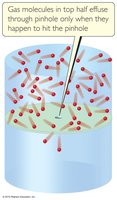
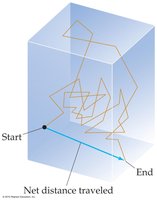
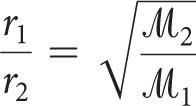
Effusion is the escape of gas through a small hole; diffusion is the mixing of gases. Graham’s Law relates rates of effusion/diffusion to molar mass:
Real Gases and Deviations from Ideal Behavior
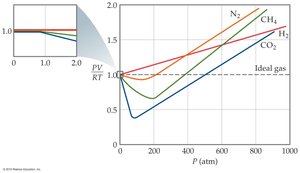
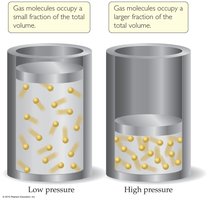
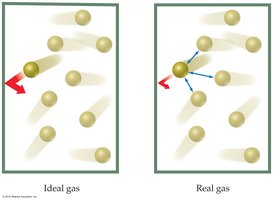
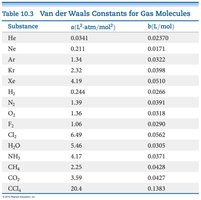
Real gases deviate from ideal behavior at high pressures and low temperatures due to intermolecular forces and finite molecular volume. The van der Waals equation corrects for these deviations:
a corrects for intermolecular attractions; b corrects for molecular volume.