 Back
BackChemical Kinetics II: Rate Laws, Integrated Rate Laws, and Activation Energy
Study Guide - Smart Notes
 Tailored notes based on your materials, expanded with key definitions, examples, and context.
Chemical Kinetics II
Reaction Rate and Differential Rate Laws
Chemical kinetics studies how fast chemical reactions occur and the factors that affect their rates. The reaction rate is defined as the change in concentration of a reactant or product per unit time. The differential rate law expresses how the rate depends on the concentration of reactants.
General form: For a reaction aA → bB, the rate is given by:
Rate law: where k is the rate constant and n is the order of the reaction.
Reaction order:
Zero order:
First order:
Second order:
Integrated Rate Laws
The integrated rate law relates the concentration of reactants to time, allowing calculation of concentrations at any point during the reaction.
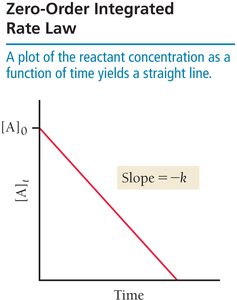
Zero order:
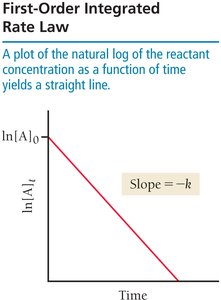
First order:
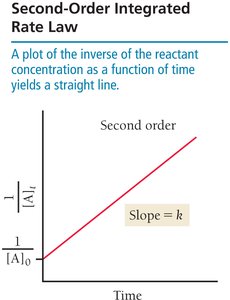
Second order:
Each order produces a characteristic plot:
Zero order: [A] vs. t is a straight line with slope = -k.
First order: ln[A] vs. t is a straight line with slope = -k.
Second order: 1/[A] vs. t is a straight line with slope = k.
Example: First-Order Reaction Calculation
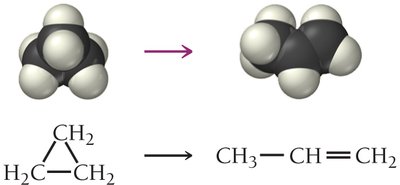
Consider the gas-phase rearrangement of cyclopropane (A) to propene (B), a first-order reaction:
Rate constant:
Initial concentration:
Time:
Final concentration:
Derivation of Integrated Rate Laws
Integrated rate laws are derived by solving ordinary differential equations (ODEs) for each reaction order. For first-order reactions:
Start with:
Separate variables and integrate:
Result:
Exponentiate:
Half-Life of Reactions
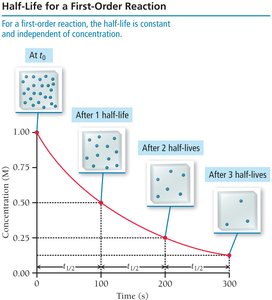
The half-life () is the time required for the concentration of a reactant to decrease to half its initial value. The half-life depends on the reaction order:
First order: (independent of )
Zero order:
Second order:
Activation Energy and the Arrhenius Equation
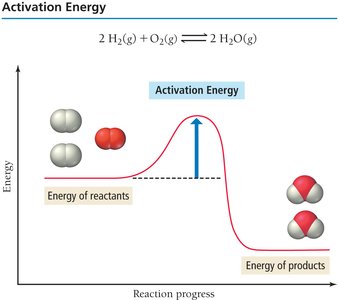
For a reaction to occur, molecules must overcome an activation energy barrier (). The Arrhenius equation relates the rate constant to activation energy and temperature:
A is the frequency factor, R is the gas constant, T is temperature in Kelvin.
Higher means a slower reaction; higher T means a faster reaction.
Transition State Theory
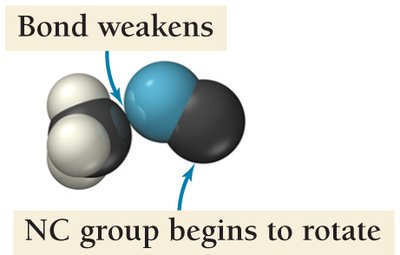
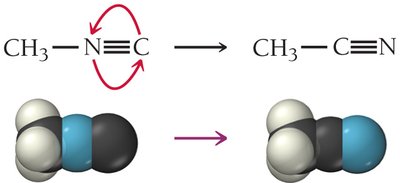
The transition state (or activated complex) is a high-energy, unstable arrangement of atoms that exists momentarily as reactants are converted to products. Bonds are partially broken and formed in this state.
Example: Isomerization of methyl isocyanide to acetonitrile.
Arrhenius Equation: Data Analysis
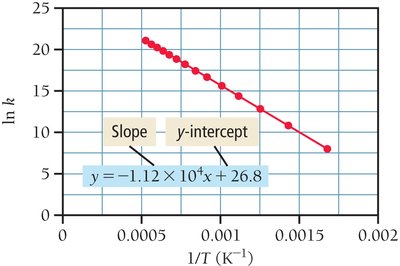
The logarithmic form of the Arrhenius equation allows determination of and A from experimental data:
A plot of vs. yields a straight line with slope and intercept .
Summary Table: Integrated Rate Laws and Half-Lives
Order | Differential Rate Law | Integrated Rate Law | Half-Life Expression |
|---|---|---|---|
Zero | |||
First | |||
Second |
Key Points and Warnings
First-order half-life is independent of initial concentration.
Zero- and second-order half-lives depend on initial concentration.
Rate constant increases with temperature and decreases with higher activation energy.

TL;DR Summary
Integrated rate law gives concentration as a function of time.
Half-life is the time for [A] to decrease to 1/2 * [A]_0.
Rate constant obeys the Arrhenius equation: .
Higher activation energy → lower rate; higher temperature → higher rate.
