 Back
BackChemical Kinetics III: Reaction Mechanisms and Catalysis
Study Guide - Smart Notes
 Tailored notes based on your materials, expanded with key definitions, examples, and context.
Kinetics III: Reaction Mechanisms and Catalysis
Rate Laws and Reaction Progress
Chemical kinetics studies the speed of chemical reactions and the factors that affect them. Rate laws describe how the concentration of reactants influences the reaction rate, and can be expressed in two main forms:
Differential rate law: Shows how the reaction rate depends on reactant concentration. For a general reaction, rate = k[A]n.
Integrated rate law: Describes how reactant concentration changes over time. For a first-order reaction:
Half-life (t1/2): The time required for the concentration of a reactant to decrease to half its initial value. For first-order reactions:
The Arrhenius equation relates the rate constant to temperature and activation energy:
Activation energy (Ea): Minimum energy required for a reaction to occur.
Higher temperature increases the rate constant, while higher activation energy decreases it.
Reaction Mechanisms
A reaction mechanism is the sequence of elementary steps that make up the overall reaction. Most reactions occur through multiple steps, not a single event.
Elementary step: A single, indivisible reaction event.
Reaction intermediate: A species formed in one step and consumed in another; it does not appear in the overall reaction equation.
Example: Hydrogen gas reacts with iodine monochloride:
Overall: H2 (g) + 2 ICl (g) → 2 HCl (g) + I2 (g)
Step 1: H2 (g) + ICl (g) → HI (g) + HCl (g)
Step 2: HI (g) + ICl (g) → HCl (g) + I2 (g)
Each step must add up to the overall reaction.

Molecularity and Rate Laws for Elementary Steps
Elementary steps are classified by their molecularity, which determines the rate law:
Unimolecular: One reactant particle; rate = k[A] (first-order)
Bimolecular: Two reactant particles; rate = k[A]2 or k[A][B] (second-order)
Termolecular: Three reactant particles; very rare due to low probability of simultaneous collision.
Example: For the mechanism above:
Step 1: rate1 = k1[H2][ICl]
Step 2: rate2 = k2[HI][ICl]
Rate-Determining Step and Overall Rate Law
In multi-step reactions, the slowest step is the rate-determining step, controlling the overall reaction rate. The overall rate law is often approximated by the rate law of this step.
Valid mechanisms must reproduce the experimental rate law.
Example: For NO2 + CO → NO + CO2, the rate-determining step is NO2 + NO2 → NO3 + NO (slow), so rate = k[NO2]2.

Energy Diagrams and Reaction Steps
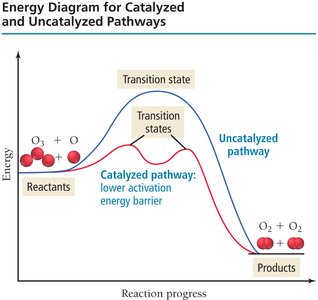
Energy diagrams illustrate the energy changes during a reaction. Each step has its own activation energy and transition state. The step with the highest activation energy is usually the rate-determining step.
: Overall enthalpy change
Transition states: High-energy configurations between reactants and products
Catalysis
A catalyst is a substance that increases the rate of a reaction without being consumed. Catalysts work by providing an alternative pathway with lower activation energy.
Homogeneous catalysis: Catalyst and reactants are in the same phase (e.g., gas-phase Cl atoms in ozone depletion).
Heterogeneous catalysis: Catalyst is in a different phase, often a solid surface (e.g., metal surfaces in hydrogenation).
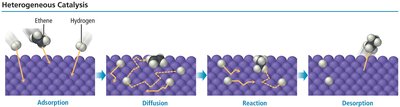
Heterogeneous Catalysis: Surface Reactions
Surface catalysis involves adsorption of reactants onto a solid catalyst, diffusion, reaction, and desorption of products. Transition metals like Pt, Pd, and Ni are commonly used.
Adsorption: Reactants bind to the catalyst surface.
Diffusion: Reactants move across the surface.
Reaction: Reactants are converted to products.
Desorption: Products leave the surface.
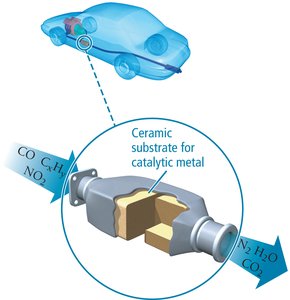
Applications of Catalysis
Catalysis is essential in industrial and environmental processes:
Three-way catalyst (TWC): Used in vehicles to convert toxic gases (NO, CO, hydrocarbons) into non-toxic products (N2, CO2, H2O).
Haber–Bosch process: Synthesizes ammonia (NH3) from N2 and H2 using iron-based catalysts.
Enzymes: Biological Catalysts
Enzymes are specialized proteins that catalyze biochemical reactions. They are highly effective and selective, often accelerating reactions by factors of 1017 or more.
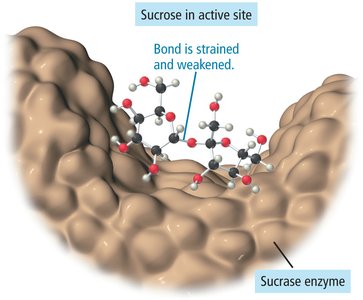
Example: Sucrase catalyzes the hydrolysis of sucrose into glucose and fructose.
Without sucrase, the reaction is extremely slow at body temperature.
With sucrase, the reaction occurs in seconds to minutes.
Enzyme Mechanism: Lock-and-Key Model
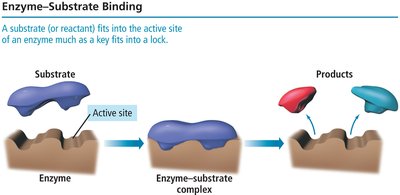
The lock-and-key model explains enzyme specificity. The enzyme's active site (lock) matches the shape of the substrate (key), forming an enzyme–substrate complex that facilitates the reaction.
Enzymes are selective, catalyzing only specific substrates.
Binding strains and weakens bonds in the substrate, lowering activation energy.
Summary Table: Molecularity and Rate Laws
Molecularity | Elementary Step | Rate Law | Reaction Order |
|---|---|---|---|
Unimolecular | A → Products | rate = k[A] | First-order |
Bimolecular | A + A → Products | rate = k[A]2 | Second-order |
Bimolecular | A + B → Products | rate = k[A][B] | Second-order |
Key Takeaways:
Reaction mechanisms reveal the steps behind overall reactions.
Elementary steps have rate laws determined by molecularity.
Valid mechanisms must match the overall reaction and experimental rate law.
Catalysts accelerate reactions without being consumed, via homogeneous, heterogeneous, or enzyme-based mechanisms.
