 Back
BackChemical Kinetics: Principles, Rate Laws, Mechanisms, and Catalysis
Study Guide - Smart Notes
 Tailored notes based on your materials, expanded with key definitions, examples, and context.
Chemical Kinetics
Introduction to Chemical Kinetics
Chemical kinetics is the study of the speed (rate) at which chemical reactions occur and the factors that influence these rates. Understanding kinetics is crucial for controlling reactions in industrial processes, food preservation, and environmental chemistry.
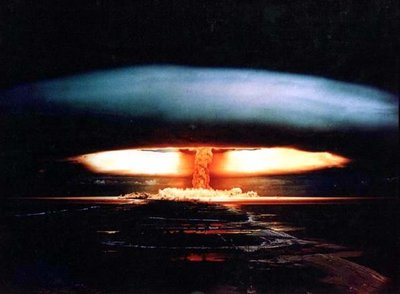
Explosion: Near-instantaneous reactions, such as nuclear detonations, demonstrate extremely fast kinetics.
Rust Formation: Extremely slow reactions, like the oxidation of iron, illustrate slow kinetics.
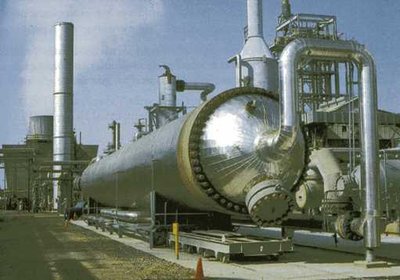
Industrial Applications: Increasing reaction rates is vital in chemical manufacturing, while slowing rates is important for preservation.

Extent of Reaction (Reaction Advancement)
The extent of reaction (denoted as \(\xi\)) quantifies how far a reaction has progressed. It is calculated based on the change in moles of reactants and products, normalized by their stoichiometric coefficients.
Definition: \(\xi = \frac{n_i - n_{i0}}{\nu_i}\), where \(n_{i0}\) is the initial amount and \(\nu_i\) is the stoichiometric coefficient.
Sign Convention: Negative for reactants, positive for products.
Interpretation: \(\xi = 0\) means no reaction; \(\xi > 0\) means forward reaction; \(\xi < 0\) means reverse reaction.
Quantitative Reaction: The reaction is considered total when the limiting reactant is consumed.
Additional info: The extent of reaction per unit volume is \(\xi/V\) (mol L-1).
Simultaneous Reactions
When multiple reactions occur in the same medium, the composition of the system is determined by the extent of each reaction. The number of moles of each species is updated according to the stoichiometry and the advancement of each reaction.
Reaction Rate
Definitions and Expressions
The reaction rate is the change in the extent of reaction with respect to time. It can be expressed as:
Instantaneous Rate: \(v = \frac{d\xi}{dt}\)
Average Rate: \(v = \frac{\xi_2 - \xi_1}{t_2 - t_1}\)
Reaction Volume Rate: \(v = \frac{1}{V} \frac{d\xi}{dt}\) (mol L-1 s-1)
Rates can be defined for the disappearance of reactants or the formation of products:
\(v = -\frac{1}{\alpha} \frac{d[A]}{dt} = \frac{1}{\gamma} \frac{d[C]}{dt}\)
Example: Ammonia Synthesis
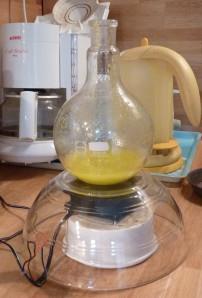
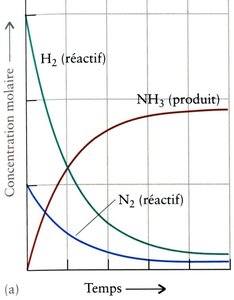
For the reaction \(\mathrm{N_2 + 3H_2 \rightarrow 2NH_3}\):
\(v = -\frac{1}{1} \frac{d[N_2]}{dt} = -\frac{1}{3} \frac{d[H_2]}{dt} = \frac{1}{2} \frac{d[NH_3]}{dt}\)
Measurement of Reaction Rates
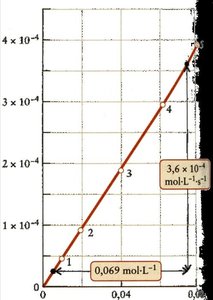
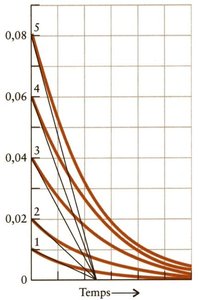
Reaction rates are often determined by monitoring concentration changes over time. The instantaneous rate is the slope of the tangent to the concentration-time curve at a given point.
Rate Laws
General Form and Order
A rate law expresses the reaction rate as a function of reactant concentrations:
\(v = k [A]^{q_a} [B]^{q_b}\)
\(k\) is the rate constant, \(q_a\) and \(q_b\) are partial orders.
The overall order is the sum of partial orders.
The unit of \(k\) depends on the overall order.
Examples of Rate Laws
2 NO2(g) → 2 NO(g) + O2(g): \(v = k[NO_2]^2\) (second order)
CO(g) + Cl2(g) → COCl2(g): \(v = k[CO][Cl_2]^{3/2}\) (order 2.5)
H2(g) + Br2(g) → 2 HBr(g): Complex rate law, no defined order.
Experimental Determination of Rate Laws
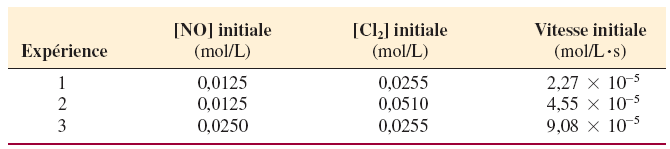
Initial rates from experiments are used to determine the rate law and reaction order.
Expérience | [NO] initiale (mol/L) | [Cl2] initiale (mol/L) | Vitesse initiale (mol/L·s) |
|---|---|---|---|
1 | 0,0125 | 0,0255 | 2,27 × 10⁻⁵ |
2 | 0,0125 | 0,0510 | 4,55 × 10⁻⁵ |
3 | 0,0250 | 0,0255 | 9,08 × 10⁻⁵ |
Reaction Mechanisms
Macroscopic vs. Microscopic View
The macroscopic equation shows the overall stoichiometry, but the actual reaction occurs via a sequence of elementary steps (reaction mechanism).
Elementary Reaction: Involves a single molecular event (collision).
Molecularity: Number of entities involved in an elementary step (unimolecular, bimolecular, trimolecular).
Complex Reactions and Intermediates
Complex reactions proceed through several elementary steps, often involving reaction intermediates—species formed and consumed during the mechanism.
Series Reaction: Intermediate formed in one step, consumed in the next.
Chain Reaction: Intermediate acts as a transmitter, leading to further intermediates.
Example: Nucleophilic Substitution (SN1 and SN2)
Nucleophilic substitution on halogenated alkanes can proceed via two mechanisms:
SN2: One-step, second order, no intermediate.
SN1: Three-step, involves a carbocation intermediate.
Reaction Profile and Activation Energy
Energy Diagram and Transition State
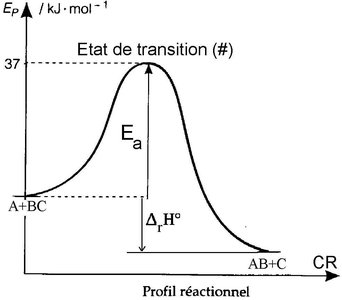
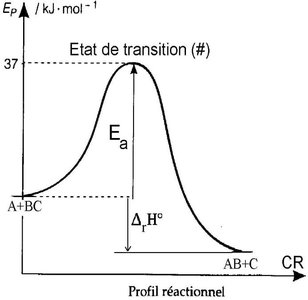
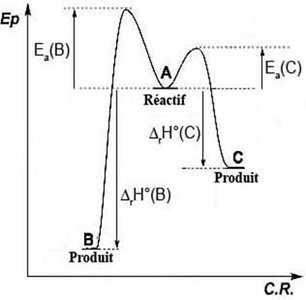
The reaction profile plots potential energy versus reaction coordinate. The activation energy (Ea) is the energy barrier between reactants and products, with the transition state at the peak.
Only collisions with energy ≥ Ea lead to product formation.
Reaction intermediates are real, short-lived species; transition states are not isolable.
Kinetic vs. Thermodynamic Control
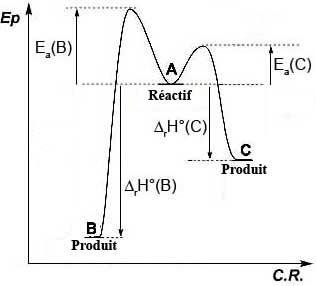
Reactions can yield different products depending on conditions:
Kinetic Product: Forms fastest, via pathway with lowest activation energy.
Thermodynamic Product: Most stable, lowest final energy.
Short reaction time or low temperature favors kinetic product; long time or high temperature favors thermodynamic product (if reversible).
Temperature and Rate Laws
Arrhenius Law
Temperature strongly influences reaction rates. The Arrhenius equation relates the rate constant to temperature:
Where A is the pre-exponential factor (collision frequency), Ea is activation energy, R is the gas constant, and T is temperature.
Knowing Ea and k at one temperature allows calculation of k at another temperature:
Catalysis
Introduction to Catalysis
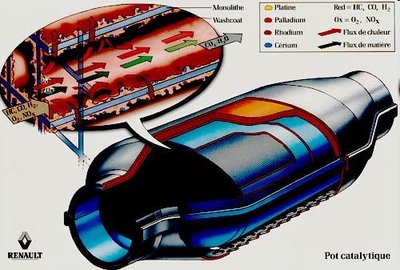
A catalyst accelerates a reaction by lowering the activation energy, without being consumed. Catalysts do not appear in the overall reaction equation.
Heterogeneous Catalysts: Different phase from reactants (e.g., solid catalyst in gas reaction).
Homogeneous Catalysts: Same phase as reactants (e.g., acid catalyst in liquid esterification).
Catalysts modify the reaction mechanism, but not the thermodynamic quantities.
Thermodynamically unfavorable reactions remain so, even with a catalyst.
Example: Hydrogen Peroxide Dismutation
A catalyst reduces the activation energy from 76 kJ/mol to 8 kJ/mol, increasing the rate by a factor of 1015 at 25°C.
Example: Esterification
Acetic acid reacts with ethanol in the presence of sulfuric acid (homogeneous catalyst) to form ethyl acetate and water. The catalyst protonates the carbonyl group, lowering activation energy.
Additional info: These notes cover the fundamental principles of chemical kinetics, including rate laws, reaction mechanisms, energy profiles, temperature effects, and catalysis, suitable for general chemistry students.
