 Back
BackChemical Kinetics: Rates, Mechanisms, and Factors Affecting Reactions
Study Guide - Smart Notes
 Tailored notes based on your materials, expanded with key definitions, examples, and context.
Chemical Kinetics
Introduction to Chemical Kinetics
Chemical kinetics is the branch of chemistry that studies the speed (rate) of chemical reactions and the factors that influence these rates. Understanding kinetics is essential for controlling reactions in industrial, biological, and environmental contexts.
Reaction Rate: The rate of a reaction measures how quickly reactants are converted to products.
Importance: Controlling reaction rates is crucial in chemical manufacturing, biological systems, and environmental processes.
Example: Ectothermic animals, such as lizards, experience slower bodily reactions at lower temperatures, leading to lethargy.
Defining Reaction Rate
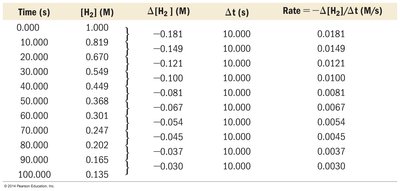
The reaction rate is typically expressed as the change in concentration of a reactant or product per unit time. For reactants, a negative sign is used to indicate consumption.
General Formula: $\text{Rate} = -\frac{\Delta[\text{H}_2]}{\Delta t} = -\frac{[\text{H}_2]_{t_2} - [\text{H}_2]_{t_1}}{t_2 - t_1}$
Units: Typically M/s (molarity per second).
Example: The speed of a car (mi/hr) is analogous to reaction rate.

Visualizing Reaction Rates
Reaction rates can be fast or slow, depending on the nature of the reactants and conditions. Visual representations help illustrate the difference in product formation over time.
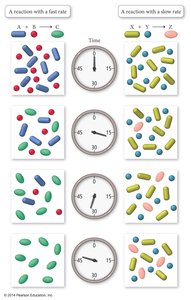
Experimental Data and Rate Calculations
Reaction rates are often determined from experimental data showing concentration changes over time.
Table Example: Shows time, concentration, and calculated rate for H2.
Graphical Representation of Reaction Rate
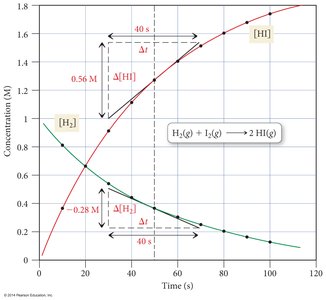
Graphs of concentration versus time allow for calculation of average and instantaneous rates.
Average Rate: Linear approximation over a time interval.
Instantaneous Rate: Slope of the tangent at a specific point (first derivative).
Stoichiometry and Reaction Rate
Reaction rates must account for stoichiometric coefficients in balanced equations. The rate is normalized by dividing by the coefficient for each species.
General Formula: $\text{Rate} = -\frac{1}{a} \frac{\Delta[\text{A}]}{\Delta t} = -\frac{1}{b} \frac{\Delta[\text{B}]}{\Delta t} = +\frac{1}{c} \frac{\Delta[\text{C}]}{\Delta t} = +\frac{1}{d} \frac{\Delta[\text{D}]}{\Delta t}$

Measuring Reaction Rates
Continuous Monitoring and Sampling
Reaction rates can be measured by continuously monitoring concentration or by sampling at specific times.
Continuous Monitoring: Useful for fast reactions.
Sampling: Used for slower reactions; often involves quenching the sample.
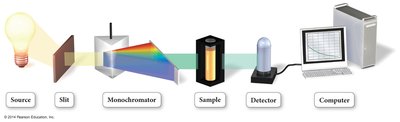
Spectrophotometry
Spectrophotometry measures the absorbance of light by a sample to determine concentration changes over time.
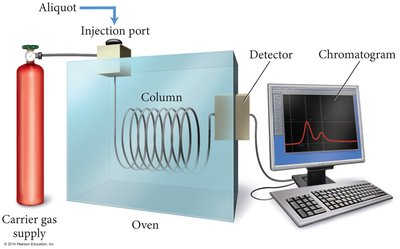
Gas Chromatography
Gas chromatography separates volatile components and measures their concentrations.
Factors Affecting Reaction Rate
Nature of Reactants
The physical and chemical properties of reactants influence reaction rates.
Small molecules react faster than large ones.
Gases react faster than liquids, which react faster than solids.
Powdered solids are more reactive due to greater surface area.
Ions react faster than molecules because no bonds need to be broken.
Temperature
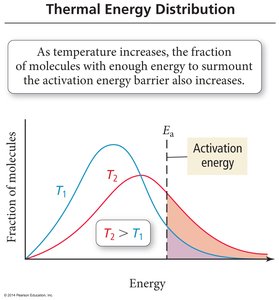
Increasing temperature generally increases reaction rate by raising the kinetic energy of molecules.
Concentration
Higher concentration of reactants increases the frequency of collisions, thus increasing the reaction rate.
Catalysts
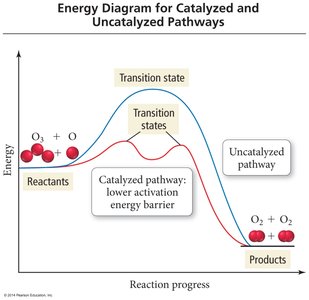
Catalysts speed up reactions by providing an alternative pathway with lower activation energy. They are not consumed in the reaction.
Homogeneous Catalysts: Same phase as reactants.
Heterogeneous Catalysts: Different phase from reactants.
The Rate Law
Mathematical Expression of Rate Law
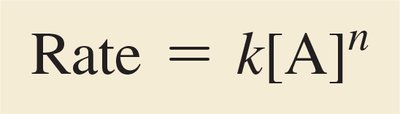
The rate law relates the reaction rate to the concentrations of reactants, each raised to a power (order).
General Form: $\text{Rate} = k[\text{A}]^n$
Order: The exponent n is the order with respect to A.
Rate Constant (k): A proportionality constant specific to the reaction.
Reaction Order
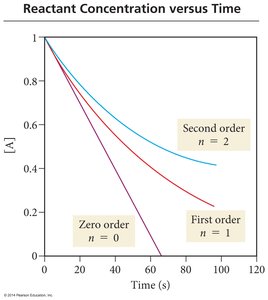
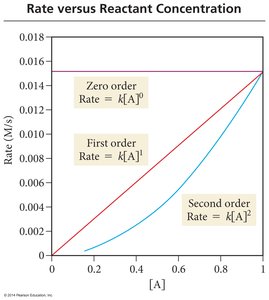
The overall order of a reaction is the sum of the exponents in the rate law. Different orders produce different concentration-time profiles.
Determining Rate Law from Experimental Data
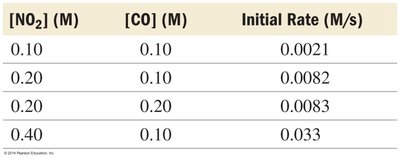
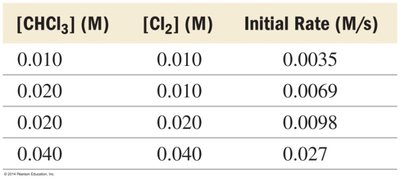
Initial rate experiments allow determination of the rate law by varying reactant concentrations and measuring the effect on rate.
Tables of initial concentrations and rates are used to deduce the order with respect to each reactant.
Integrated Rate Laws and Half-Life
Integrated Rate Laws
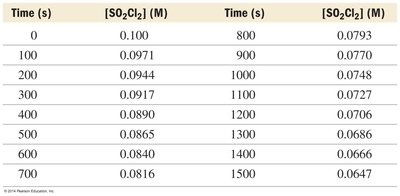
Integrated rate laws relate reactant concentration to time for zero, first, and second order reactions.
First Order: $\ln[\text{A}]_t = -kt + \ln[\text{A}]_{\text{initial}}$
Second Order: $\frac{1}{[\text{A}]_t} = kt + \frac{1}{[\text{A}]_{\text{initial}}}$
Zero Order: $[\text{A}]_t = -kt + [\text{A}]_{\text{initial}}$
Graphical Analysis
Plotting concentration, ln(concentration), or 1/concentration versus time helps determine reaction order.
Linear plot of ln[A] vs time indicates first order.
Linear plot of 1/[A] vs time indicates second order.
Linear plot of [A] vs time indicates zero order.
![Graph of ln[SO2Cl2] vs time](https://static.studychannel.pearsonprd.tech/study_guide_files/general-chemistry/sub_images/d6ca9194_image_15.png)
![Graph of ln[NO2] vs time](https://static.studychannel.pearsonprd.tech/study_guide_files/general-chemistry/sub_images/d6ca9194_image_17.png)
![Graph of 1/[NO2] vs time](https://static.studychannel.pearsonprd.tech/study_guide_files/general-chemistry/sub_images/d6ca9194_image_18.png)
Half-Life
The half-life (t1/2) is the time required for the concentration of a reactant to decrease to half its initial value. It depends on reaction order.
First Order: $t_{1/2} = \frac{0.693}{k}$ (constant half-life)
Second Order: $t_{1/2} = \frac{1}{k[\text{A}]_0}$
Zero Order: $t_{1/2} = \frac{[\text{A}]_0}{2k}$
Temperature and Reaction Rate
Arrhenius Equation
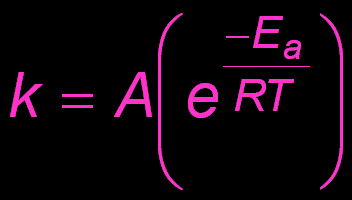
The Arrhenius equation describes how the rate constant (k) depends on temperature and activation energy (Ea).
Equation: $k = A \left( e^{\frac{-E_a}{RT}} \right)$
A: Frequency factor (related to collision frequency and orientation).
Ea: Activation energy (energy barrier for reaction).
Arrhenius Plots and Activation Energy
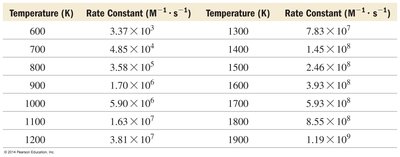
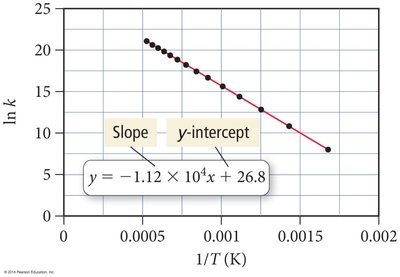
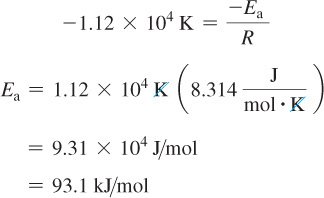
Plotting ln(k) versus 1/T yields a straight line whose slope is related to activation energy.
Equation: $\ln k = -\frac{E_a}{R} \left( \frac{1}{T} \right) + \ln A$
Slope: $-E_a/R$
Collision Theory
Effective Collisions
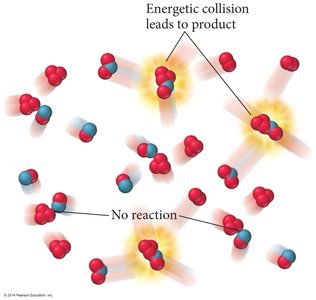
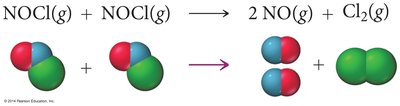
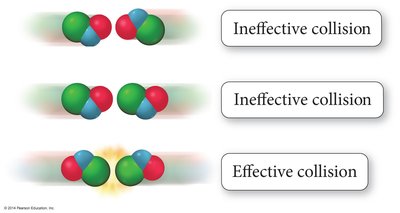
For a reaction to occur, molecules must collide with sufficient energy and proper orientation.
Activation Energy: Minimum energy required for reaction.
Activated Complex: High-energy, unstable intermediate formed during collision.
Reaction Mechanisms
Elementary Steps and Molecularity
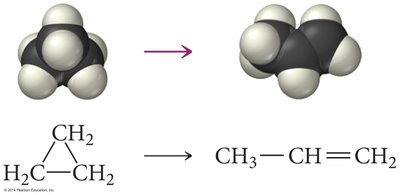
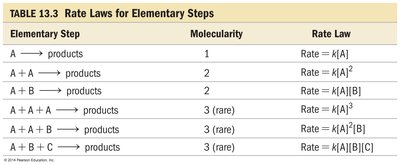
Most reactions occur via a series of elementary steps, each with its own rate law and molecularity.
Unimolecular: One reactant particle.
Bimolecular: Two reactant particles.
Termolecular: Three reactant particles (rare).
Elementary Step | Molecularity | Rate Law |
|---|---|---|
A → products | 1 | Rate = k[A] |
A + A → products | 2 | Rate = k[A]2 |
A + B → products | 2 | Rate = k[A][B] |
A + A + A → products | 3 (rare) | Rate = k[A]3 |
A + A + B → products | 3 (rare) | Rate = k[A]2[B] |
A + B + C → products | 3 (rare) | Rate = k[A][B][C] |
Rate Determining Step
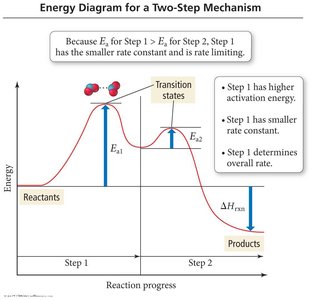
The slowest step in a reaction mechanism determines the overall reaction rate and rate law.
Catalysts and Reaction Pathways
Effect of Catalysts
Catalysts provide an alternative pathway with lower activation energy, increasing reaction rate without being consumed.
Types of Catalysts
Homogeneous: Same phase as reactants (e.g., Cl(g) in O3 destruction).
Heterogeneous: Different phase (e.g., solid catalytic converter).
Enzymes
Enzymes are biological catalysts that bind substrates at an active site, facilitating reaction by proper orientation and lowering activation energy.
Summary Table: Key Equations and Concepts
Concept | Equation (LaTeX) | Description |
|---|---|---|
Reaction Rate | $\text{Rate} = -\frac{\Delta[\text{H}_2]}{\Delta t}$ | Change in concentration per unit time |
Rate Law | $\text{Rate} = k[\text{A}]^n$ | Relates rate to reactant concentration |
First Order Integrated | $\ln[\text{A}]_t = -kt + \ln[\text{A}]_{\text{initial}}$ | Concentration vs time for first order |
Second Order Integrated | $\frac{1}{[\text{A}]_t} = kt + \frac{1}{[\text{A}]_{\text{initial}}}$ | Concentration vs time for second order |
Zero Order Integrated | $[\text{A}]_t = -kt + [\text{A}]_{\text{initial}}$ | Concentration vs time for zero order |
Arrhenius Equation | $k = A \left( e^{\frac{-E_a}{RT}} \right)$ | Rate constant dependence on temperature |
Half-Life (First Order) | $t_{1/2} = \frac{0.693}{k}$ | Time for concentration to halve |
