 Back
BackChemical Kinetics: Rates, Mechanisms, and Factors Affecting Reactions
Study Guide - Smart Notes
 Tailored notes based on your materials, expanded with key definitions, examples, and context.
Chemical Kinetics
Introduction to Chemical Kinetics
Chemical kinetics is the study of the rates at which chemical processes occur and the factors that influence these rates. Understanding kinetics allows chemists to predict how quickly reactions will proceed and how to control them for desired outcomes.
Rate of Reaction: The rate is defined as the change in concentration of reactants or products per unit time.
Formula:
Example: Speed in physics is analogous:
Thermodynamics vs. Kinetics
Thermodynamics determines whether a reaction is possible (spontaneous or not), while kinetics determines how fast the reaction occurs. Even if a reaction is thermodynamically favorable, it may proceed slowly if the kinetic barriers are high.
Collision Theory
Requirements for Successful Molecular Reactions
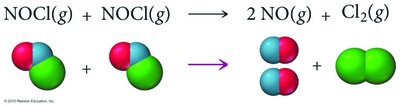
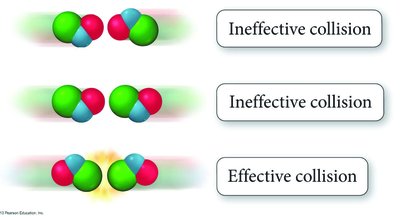
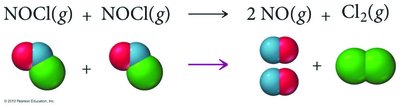
For a chemical reaction to occur, molecules must collide with sufficient energy and proper orientation. Only collisions that meet these criteria are effective and lead to product formation.
Collision: Reactant molecules must physically collide.
Sufficient Energy: Collisions must have enough energy to overcome the activation energy barrier ().
Correct Orientation: Molecules must be aligned properly for bonds to break and form.
Effective Collision: When all conditions are met, reactants convert to products.
Activation Energy
Definition and Role in Reactions
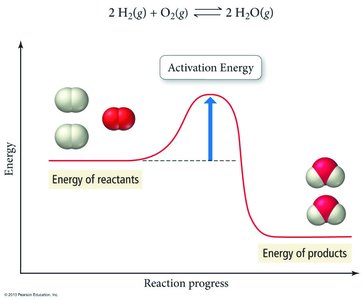
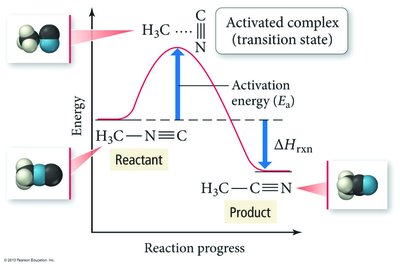
Activation energy () is the minimum energy required for a reaction to proceed. It represents the energy barrier that must be overcome for reactants to transform into products.
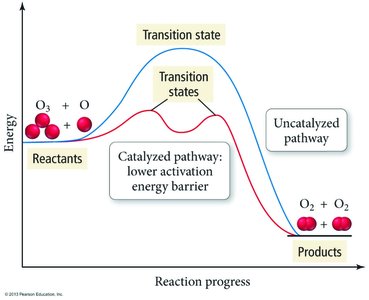
Energy Profile: The activation energy is depicted as the peak in an energy diagram between reactants and products.
Transition State: The highest energy point corresponds to the transition state or activated complex.
Activation Energy & Temperature
Effect of Temperature on Reaction Rate
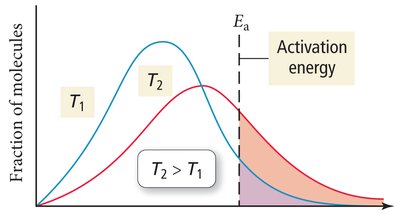
Increasing temperature increases the kinetic energy of molecules, making it more likely that collisions will have enough energy to overcome the activation energy barrier. This results in a higher reaction rate.
Energetic Molecules: Higher temperature means more molecules have energy greater than .
Collision Frequency: Molecules move faster and collide more often.
Factors Affecting Reaction Rate
Temperature
Temperature is a key factor affecting reaction rates. As temperature increases, both the fraction of effective collisions and the frequency of collisions increase.
Fraction of Effective Collisions: More molecules have sufficient energy.
Frequency of Collisions: Molecules move faster and collide more often.
Catalysts
A catalyst increases the rate of a reaction by providing an alternative mechanism with a lower activation energy. Catalysts are not consumed in the reaction.
Homogeneous Catalysts: Exist in the same phase as reactants.
Heterogeneous Catalysts: Exist in a different phase than reactants.
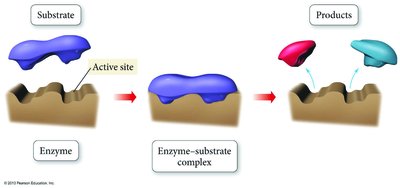
Enzymes: Biological catalysts that speed up biochemical reactions.
Concentration
Increasing the concentration of reactants increases the frequency of collisions, thus increasing the reaction rate. Only concentrations featured in the rate law impact the rate.
Physical State
The physical state of reactants affects how easily molecules can collide. For gases, increasing pressure increases collision frequency; for solids, increasing surface area increases reaction rate.
Rate Laws & Effect of Concentration
Rate Law Expression
The rate law expresses the reaction rate as a function of reactant concentrations, each raised to an experimentally determined exponent (order).
General Form:
Rate Constant (k): A proportionality constant specific to the reaction and temperature.
Order: The exponent for each reactant; determined experimentally, not from stoichiometry.
Reaction Order
Each reactant has an individual order, and the overall reaction order is the sum of all exponents in the rate law.
Zero Order: Rate does not depend on the concentration of that reactant.
First Order: Rate is directly proportional to concentration.
Second Order: Rate is proportional to the square of concentration.
Overall Order: Sum of all individual orders.
Experimental Determination of Rate Law
Reactant orders are determined by varying concentrations in controlled experiments and observing the effect on reaction rate.
EXPT | [NO]i (M) | [Br2]i (M) | Initial Rate of NOBr formation (M/sec) |
|---|---|---|---|
1 | 0.10 | 0.10 | 0.0012 |
2 | 0.20 | 0.10 | 0.0096 |
3 | 0.10 | 0.20 | 0.0012 |
By comparing experiments where only one reactant concentration changes, the order with respect to each reactant can be determined.
Multi-Step Reaction Mechanisms
Reaction Mechanisms and Rate-Determining Step
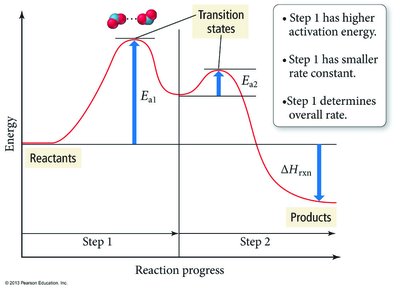
Most reactions proceed via a series of steps called a mechanism. The slowest step (rate-determining step) limits the overall reaction rate. Only reactants involved in this step appear in the rate law.
Elementary Steps: Each step in a mechanism is an elementary reaction.
Types: Unimolecular, bimolecular, termolecular (rare).
Reactive Intermediates: Species formed in one step and consumed in another.
Temperature and the Rate Constant
The Arrhenius Equation
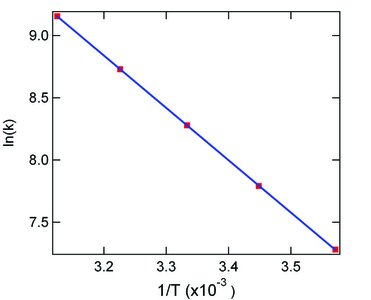
The Arrhenius equation relates the rate constant () to temperature () and activation energy ():
Equation:
A: Frequency factor (related to collision frequency and orientation)
R: Gas constant ()
T: Temperature in Kelvin
As temperature increases, increases, leading to a faster reaction rate.
Linear Forms of the Arrhenius Equation
Point-Slope Form:
Two-Point Form:
Summary Table: Factors Affecting Reaction Rate
Factor | Effect on Rate | Mechanism |
|---|---|---|
Temperature | Increases rate | More energetic collisions, higher frequency |
Catalyst | Increases rate | Lowers activation energy |
Concentration | Increases rate | More collisions per unit time |
Physical State | Varies | Facilitates molecular contact |
