 Back
BackChemical Kinetics: Rates, Mechanisms, and Factors Affecting Reaction Speed
Study Guide - Smart Notes
 Tailored notes based on your materials, expanded with key definitions, examples, and context.
Chemical Kinetics
Introduction to Chemical Kinetics
Chemical kinetics is the branch of chemistry that studies the speed or rate at which chemical reactions occur and the factors that influence these rates. Unlike thermodynamics, which predicts whether a reaction is spontaneous, kinetics focuses on how fast a reaction proceeds and the steps involved in the transformation from reactants to products.
Spontaneity: Indicates if a reaction can occur, but not how fast it will proceed.
Mechanism: The sequence of molecular events (bond breaking and forming) that leads to product formation. The slowest step in the mechanism is called the rate-determining step.

Factors Affecting Reaction Rate
The rate of a chemical reaction can be influenced by several factors:
Concentration of Reactants: Higher concentrations lead to more frequent collisions and faster reactions.
Temperature: Increasing temperature raises the average kinetic energy of molecules, resulting in more energetic and frequent collisions.
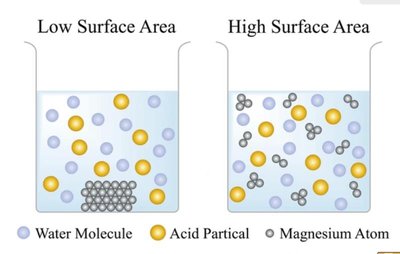
Surface Area: Greater surface area allows more collisions to occur, especially in heterogeneous reactions.
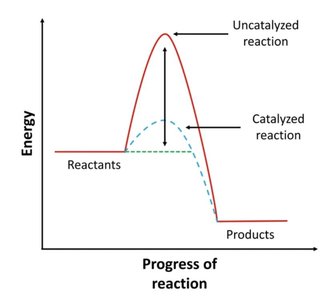
Catalysts: Substances that increase reaction rate by lowering the activation energy without being consumed in the reaction.
Transition State Theory and Activation Energy
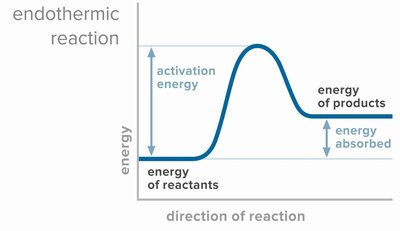
According to transition state theory, reactants must overcome an energy barrier, known as the activation energy (E_a), to form products. The transition state is a high-energy, unstable arrangement of atoms that exists momentarily as bonds are breaking and forming.
Activation Energy (E_a): The minimum energy required for a reaction to occur.
Relationship to Temperature: Higher temperatures increase the number of molecules with sufficient energy to overcome E_a.
Catalysts and Enzymes
Catalysts speed up reactions by providing an alternative pathway with a lower activation energy. Enzymes are biological catalysts that are highly specific for their substrates.
Heterogeneous Catalyst: In a different phase than the reactants.
Homogeneous Catalyst: In the same phase as the reactants.
Enzymes: Protein catalysts in biological systems.
Reaction Rates and Rate Laws
Defining Reaction Rate
The rate of a reaction is the change in concentration of a reactant or product per unit time. It can be expressed as:
Rate = \( \frac{\Delta [\text{concentration}]}{\Delta t} \)
For reactants, the rate is negative (disappearance); for products, it is positive (appearance).
Rate Law Expressions
The rate law relates the rate of reaction to the concentrations of reactants (and sometimes catalysts), each raised to a power (the order of the reaction with respect to that species). The general form is:
\( \text{Rate} = k[A]^m[B]^n[C]^p \)
k: Rate constant (depends on temperature)
m, n, p: Reaction orders (must be determined experimentally)
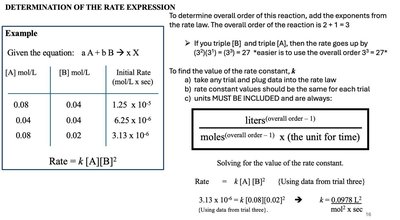
The overall order is the sum of the exponents.
Determining Reaction Order
Reaction order with respect to each reactant is found by examining how changes in concentration affect the rate. Common orders:
Zero Order: Rate is independent of concentration (\( \text{Rate} = k \)).
First Order: Rate is directly proportional to concentration (\( \text{Rate} = k[A] \)).
Second Order: Rate is proportional to the square of concentration or to two reactants (\( \text{Rate} = k[A]^2 \) or \( k[A][B] \)).
Experimental Determination of Rate Laws
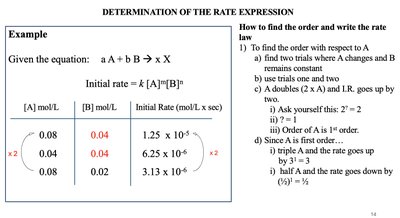
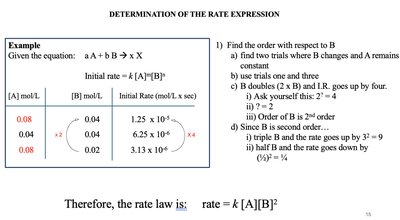
To determine the rate law, initial rates are measured for different concentrations of reactants. The order with respect to each reactant is found by comparing how the rate changes when only one reactant's concentration is varied.
Integrated Rate Laws and Graphical Methods
Integrated Rate Laws
Integrated rate laws relate the concentration of reactants to time and are useful for determining reaction order from experimental data.
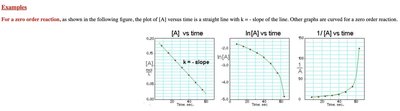
Zero Order: \( [A] = [A]_0 - kt \)
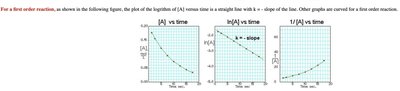
First Order: \( \ln[A] = -kt + \ln[A]_0 \)
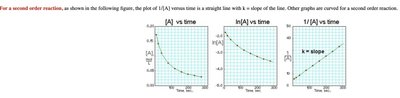
Second Order: \( \frac{1}{[A]} = kt + \frac{1}{[A]_0} \)
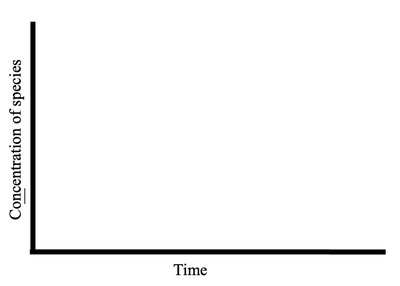
Graphical methods can be used to determine reaction order:
Plotting [A] vs. time: Straight line for zero order.
Plotting ln[A] vs. time: Straight line for first order.
Plotting 1/[A] vs. time: Straight line for second order.
Half-Life of Reactions
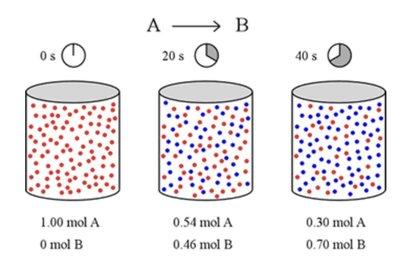
The half-life (\( t_{1/2} \)) is the time required for the concentration of a reactant to decrease by half. For a first-order reaction:
\( t_{1/2} = \frac{0.693}{k} \)
For zero and second order reactions, the half-life depends on the initial concentration.
Collision Theory and Reaction Mechanisms
Collision Theory
Collision theory states that molecules must collide with sufficient energy and proper orientation to react. The frequency and effectiveness of collisions determine the reaction rate.
Higher concentration and temperature increase collision frequency and energy.
Proper molecular orientation is essential for a successful reaction.
Reaction Mechanisms and Rate-Determining Step
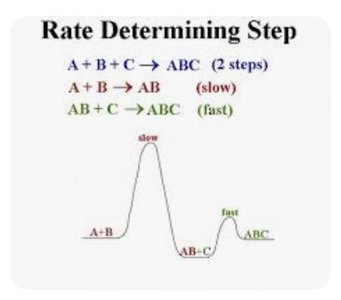
A reaction mechanism is the sequence of elementary steps by which a chemical change occurs. The slowest step in the mechanism is the rate-determining step, which controls the overall reaction rate. Intermediates are species produced in one step and consumed in another; they do not appear in the overall rate law.
Summary Table: Factors Affecting Reaction Rate
Factor | Effect on Rate | Explanation |
|---|---|---|
Concentration | Increases | More particles lead to more collisions |
Temperature | Increases | Particles move faster, more energetic collisions |
Surface Area | Increases | More area for collisions to occur |
Catalyst | Increases | Lowers activation energy, provides alternative pathway |
Practice Example
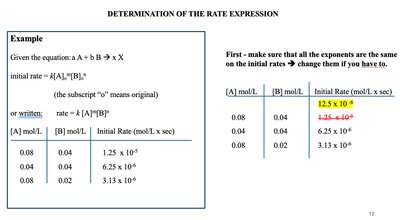
Given the reaction: \( aA + bB \rightarrow xX \), and the following data:
[A] (mol/L) | [B] (mol/L) | Initial Rate (mol/L·s) |
|---|---|---|
0.08 | 0.04 | 1.25 × 10^{-5} |
0.04 | 0.04 | 6.25 × 10^{-6} |
0.08 | 0.02 | 3.13 × 10^{-6} |
By comparing the rates, you can determine the order with respect to each reactant and write the rate law.
Additional info: This guide covers the core concepts of chemical kinetics, including rate laws, reaction mechanisms, and the factors that affect reaction rates, as required for a General Chemistry college course.
