 Back
BackLesson 6.1: Chemical Kinetics: Reaction Rates and Measurement Methods
Study Guide - Smart Notes
 Tailored notes based on your materials, expanded with key definitions, examples, and context.
Chemical Kinetics
Introduction to Reaction Rates
Chemical kinetics is the branch of chemistry that studies the rates at which chemical reactions occur. The reaction rate is defined as the change in concentration of a reactant or product per unit time. Different reactions proceed at different rates, ranging from fractions of a second to years.
Reaction rate: The change in concentration of a reactant or product per unit time.
Chemical kinetics: The study of reaction rates and the factors affecting them.
Example: Combustion of propane is rapid, while oxidation of silver is slow.
Measuring Reaction Rates
To determine reaction rates, chemists monitor changes in measurable properties such as gas volume, colour, mass, pH, or electrical conductivity. The chosen method should not interfere with the reaction and should be simple to carry out.
Gas volume: Measured by displacement of water or changes in pressure.
Colour change: Tracked using a spectrophotometer, which measures light absorption at specific wavelengths.
Mass: Used when a gas escapes from an open vessel, causing a decrease in mass.
pH: Monitored with pH meters, pH paper, or indicators.
Conductivity: Measured with a conductivity meter when ions are produced during the reaction.
Example: The reaction of calcium metal with water produces hydrogen gas, which can be measured by the volume of water displaced.
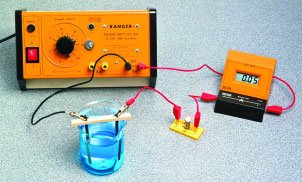
Conductivity Measurement in Reaction Rate Analysis
When a reaction produces ions, the conductivity of the solution increases. A conductivity meter can be used to measure this change over time, providing information about the reaction rate.
Example: Hydrolysis of 2-methyl-2-chloropropane produces ions, increasing solution conductivity.
Calculating Average Reaction Rates
The average reaction rate is calculated by measuring the change in concentration of a reactant or product over a specified time interval. The formula is:
Formula:
Delta notation:
Concentration: represents concentration in mol/L.
For reactants, the rate is negative (consumption), and for products, it is positive (formation). Rates are conventionally reported as positive values.
Example Calculations
Decomposition of NO2:
Average rate for disappearance of NO2 over first 50 s:
Conventionally,
Graphical Determination of Reaction Rates
Reaction rates can also be determined from concentration vs. time graphs. The slope of a secant line between two points gives the average rate, while the slope of a tangent at a single point gives the instantaneous rate.
Average rate: Slope of secant line ()
Instantaneous rate: Slope of tangent line at a specific time
Stoichiometric Rate Relationships
Rates of consumption and formation are related by the stoichiometry of the balanced chemical equation. The coefficients must be included in the denominator to equate rates.
General formula: For :
Example: For :
Summary of Key Points
Chemists monitor changes in pressure, volume, colour, mass, pH, or conductivity to determine reaction rates.
Reaction rates change as the reaction proceeds.
Average rate is the change in concentration over a time interval; instantaneous rate is at a specific instant.
Rates are always expressed as positive values.
Stoichiometric relationships in balanced equations relate rates of reactants and products.
