 Back
BackChemical Kinetics: Reaction Rates and Rate Laws
Study Guide - Smart Notes
 Tailored notes based on your materials, expanded with key definitions, examples, and context.
Chemical Kinetics
Introduction to Reaction Rates
Chemical kinetics is the study of the speed at which chemical reactions occur and the factors that affect these rates. Understanding reaction rates is essential for predicting how quickly products form and reactants are consumed.
Reaction rate is defined as the change in concentration of a reactant or product per unit time.
Factors affecting rate include reactant concentration, temperature, and presence of catalysts.
Factors Affecting Reaction Rate: Reactant Concentration
The concentration of reactants often influences the rate of a reaction.
Higher concentration generally increases the rate due to more frequent collisions between molecules.
The rate law relates the rate of reaction to the concentration of reactants.
The Rate Law
The rate law expresses the relationship between the rate of a reaction and the concentration of reactants, each raised to a specific power.
General form:
k is the rate constant, and n is the order of the reaction with respect to A.
Reaction Order
The exponent on each reactant in the rate law is the order with respect to that reactant.
The sum of the exponents is the overall order of the reaction.
Example: is second order in NO, first order in O2, and third order overall.
Effect of Reaction Order on Rate
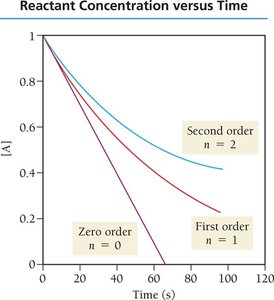
Zero order: Rate is independent of reactant concentration.
First order: Rate is directly proportional to concentration.
Second order: Rate is proportional to the square of concentration.
Experimental Determination of Rate Laws
Rate laws must be determined experimentally, often using the method of initial rates.
By varying the concentration of reactants and measuring initial rates, the order with respect to each reactant can be deduced.
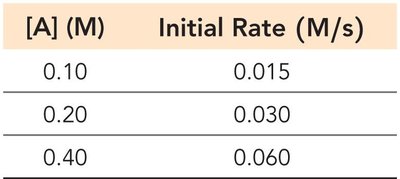
Example Data Table: First Order
[A] (M) | Initial Rate (M/s) |
|---|---|
0.10 | 0.015 |
0.20 | 0.030 |
0.40 | 0.060 |
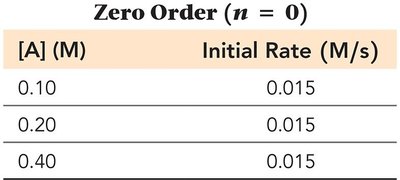
Example Data Table: Zero Order
[A] (M) | Initial Rate (M/s) |
|---|---|
0.10 | 0.015 |
0.20 | 0.015 |
0.40 | 0.015 |
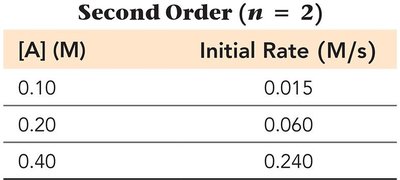
Example Data Table: Second Order
[A] (M) | Initial Rate (M/s) |
|---|---|
0.10 | 0.015 |
0.20 | 0.060 |
0.40 | 0.240 |
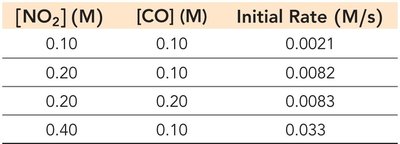
Example Data Table: Multiple Reactants
[NO2] (M) | [CO] (M) | Initial Rate (M/s) |
|---|---|---|
0.10 | 0.10 | 0.0021 |
0.20 | 0.10 | 0.0082 |
0.20 | 0.20 | 0.0083 |
0.40 | 0.10 | 0.033 |
Integrated Rate Laws
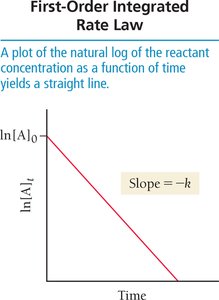
First-Order Integrated Rate Law
The integrated rate law relates concentration to time for a given reaction order. For first-order reactions:
Rate law:
Integrated form:
A plot of versus time yields a straight line with slope .
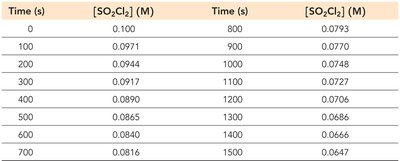
Example: Decomposition of SO2Cl2
Time (s) | [SO2Cl2] (M) | Time (s) | [SO2Cl2] (M) |
|---|---|---|---|
0 | 0.100 | 800 | 0.0793 |
100 | 0.0971 | 900 | 0.0770 |
200 | 0.0944 | 1000 | 0.0748 |
300 | 0.0917 | 1100 | 0.0727 |
400 | 0.0890 | 1200 | 0.0706 |
500 | 0.0865 | 1300 | 0.0686 |
600 | 0.0840 | 1400 | 0.0666 |
700 | 0.0816 | 1500 | 0.0647 |
![First-order plot of ln[SO2Cl2] versus time](https://static.studychannel.pearsonprd.tech/study_guide_files/general-chemistry/sub_images/30adaed8_image_9.png)
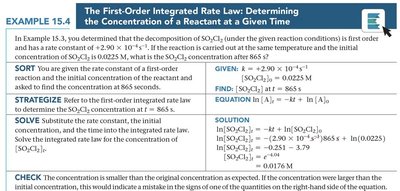
Worked Example: First-Order Integrated Rate Law
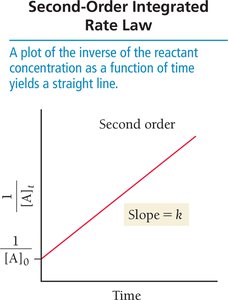
Second-Order Integrated Rate Law
For second-order reactions:
Rate law:
Integrated form:
A plot of versus time yields a straight line with slope .
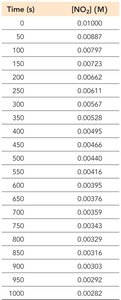
Example Data Table: Second Order
Time (s) | [NO2] (M) |
|---|---|
0 | 0.01000 |
50 | 0.00887 |
100 | 0.00797 |
150 | 0.00723 |
200 | 0.00662 |
300 | 0.00567 |
400 | 0.00495 |
500 | 0.00416 |
600 | 0.00376 |
700 | 0.00339 |
800 | 0.00329 |
900 | 0.00303 |
1000 | 0.00282 |
![First-order plot of ln[NO2] versus time](https://static.studychannel.pearsonprd.tech/study_guide_files/general-chemistry/sub_images/30adaed8_image_13.png)
![Second-order plot of 1/[NO2] versus time](https://static.studychannel.pearsonprd.tech/study_guide_files/general-chemistry/sub_images/30adaed8_image_14.png)
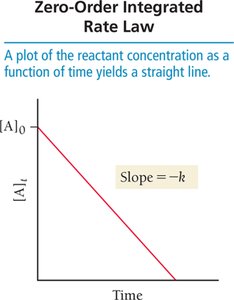
Zero-Order Integrated Rate Law
For zero-order reactions:
Rate law:
Integrated form:
A plot of versus time yields a straight line with slope .
Half-Life of Reactions
Definition and Calculation
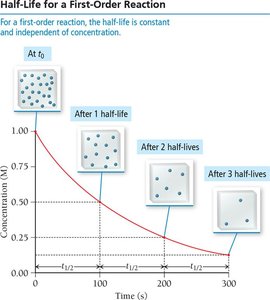
The half-life () is the time required for the concentration of a reactant to decrease by half.
For first-order reactions, half-life is constant and independent of concentration:
For second-order and zero-order reactions, half-life depends on initial concentration.
Summary Table: Rate Laws and Integrated Rate Laws
Order | Rate Law | Integrated Rate Law | Straight-Line Plot | Half-Life Expression |
|---|---|---|---|---|
Zero | Rate = k | [A] vs. time | ||
First | Rate = k[A] | ln[A] vs. time | ||
Second | Rate = k[A]^2 | 1/[A] vs. time |
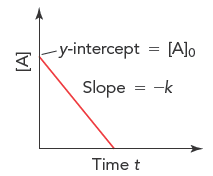
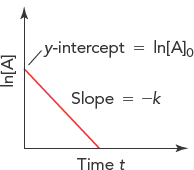
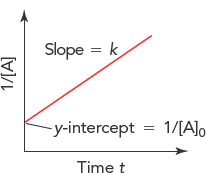
The Effect of Temperature on Rate
Arrhenius Equation
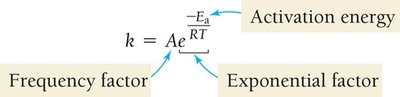
The rate constant is temperature dependent, described by the Arrhenius equation:
A is the frequency factor (number of times reactants approach the activation barrier per unit time).
Ea is the activation energy (minimum energy needed to start the reaction).
R is the gas constant (8.314 J/mol·K).
T is the temperature in Kelvin.
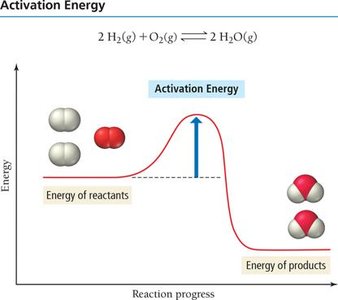
Reaction Energy Profile and Activation Energy
Activation energy is the energy barrier that must be overcome for a reaction to proceed.
The activated complex (transition state) is a high-energy species formed during the reaction.
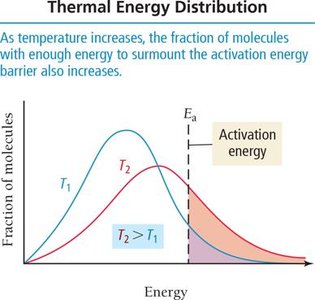
Thermal Energy Distribution
As temperature increases, more molecules have enough energy to overcome the activation energy barrier.
The exponential factor in the Arrhenius equation represents the fraction of molecules with sufficient energy.
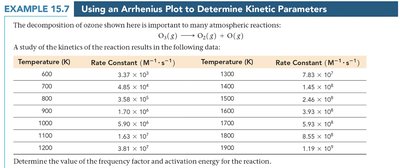
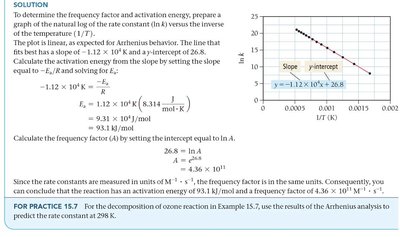
Arrhenius Plots
Plotting versus yields a straight line with slope and intercept .
This allows determination of activation energy and frequency factor from experimental data.
Arrhenius Equation: Two-Point Form
If only two (T, k) data points are available, the two-point form can be used: 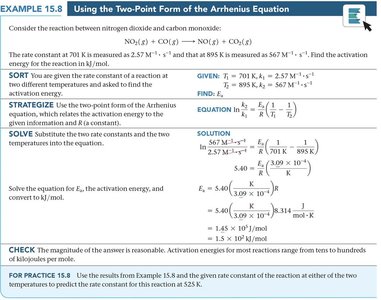
Key Terms and Concepts
Rate law: Mathematical relationship between reaction rate and reactant concentrations.
Order of reaction: Exponent in the rate law indicating dependence on concentration.
Integrated rate law: Equation relating concentration to time for a given order.
Half-life: Time for reactant concentration to decrease by half.
Activation energy: Minimum energy required for a reaction to occur.
Arrhenius equation: Describes temperature dependence of rate constant.
Additional info: The notes include worked examples, conceptual questions, and summary tables to reinforce understanding of chemical kinetics and its mathematical treatment.
