 Back
BackChemical Kinetics: Reaction Rates and Rate Laws
Study Guide - Smart Notes
 Tailored notes based on your materials, expanded with key definitions, examples, and context.
Chemical Kinetics and Reaction Rates
Introduction to Chemical Kinetics
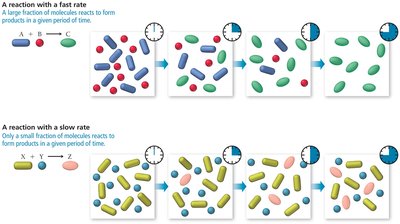
Chemical kinetics is the study of the speed at which chemical reactions occur and the factors that affect these rates. Unlike thermodynamics, which determines whether a reaction can occur and its equilibrium position, kinetics focuses on how quickly equilibrium is reached.
Thermodynamics: Determines the extent of reaction completion (equilibrium).
Kinetics: Determines how fast a reaction proceeds toward equilibrium.
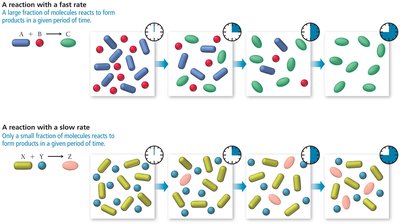
Reaction rate: The change in concentration of reactants or products per unit time.
Importance of Reaction Rates
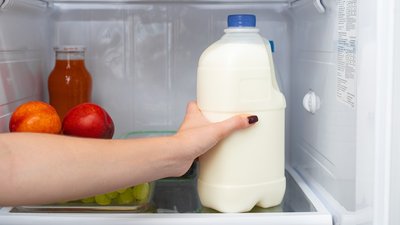
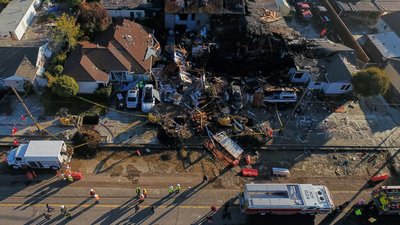
The rate of a chemical reaction has practical implications in everyday life and industry. For example, storing milk in a refrigerator slows down spoilage by decreasing the reaction rate, while gas detectors are used to prevent explosions by monitoring reaction rates of hazardous gases.
Slower rates: Preserve food longer (e.g., refrigeration).
Faster rates: Can lead to dangerous situations (e.g., gas explosions).

Factors Affecting Reaction Rates
Concentration
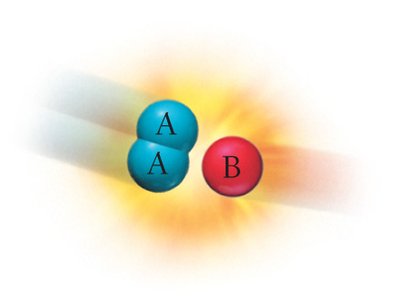
Reaction rates generally increase with higher concentrations of reactants. This is because more molecules are present, leading to more frequent collisions and a greater likelihood of reaction.
For gases: Higher pressure increases concentration and rate.
For solutions: Concentration depends on solute-to-solvent ratio (molarity, molality).
For solids: Surface area is key; powdered solids react faster than blocks.
Temperature
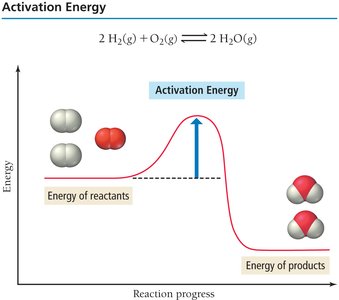
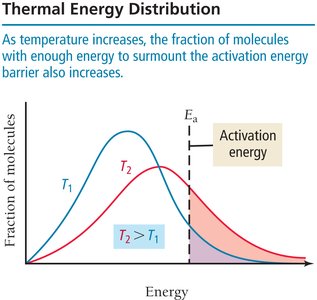
Increasing temperature generally increases reaction rates. Higher temperatures provide more energy to molecules, helping them overcome the activation energy barrier required for reaction.
Activation energy: The minimum energy needed for a reaction to occur.
At higher temperatures: More molecules have sufficient energy to react.
Structure and Orientation
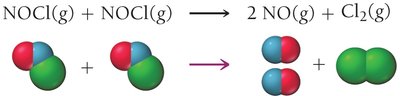
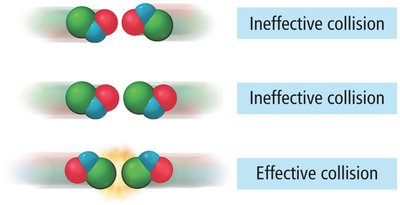
Not all collisions lead to reactions, even if the molecules have enough energy. The orientation of the molecules during collision must be correct for the reaction to occur.
Effective collisions: Proper orientation and sufficient energy.
Ineffective collisions: Incorrect orientation or insufficient energy.
Defining Reaction Rates
Average and Instantaneous Rate
The reaction rate can be defined as the change in concentration of a reactant or product over a period of time. The average rate is calculated over a time interval, while the instantaneous rate is the rate at a specific moment.
Average rate:
Instantaneous rate:
Units: M/s (molarity per second)
For reactants: Rate is negative (concentration decreases).
For products: Rate is positive (concentration increases).
General Rate Definition
For a general reaction , the rate can be defined using stoichiometric coefficients:
Negative sign for reactants, positive for products.
Prefactors account for stoichiometry.
The Rate Law
Effect of Concentration on Rate
The rate law expresses the relationship between the reaction rate and the concentrations of reactants. It must be determined experimentally and is not necessarily related to the reaction's stoichiometry.
General form: for a single reactant.
For multiple reactants:
k: Rate constant (depends on temperature).
n, m: Reaction orders (can be fractional).
Overall order: Sum of individual orders ().
Reaction Orders
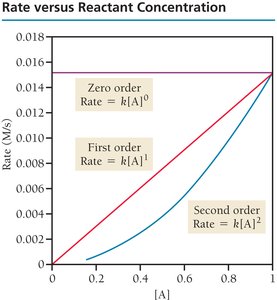
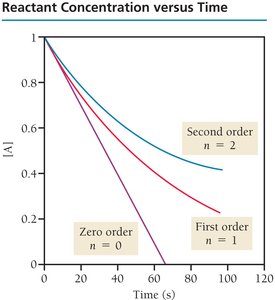
Common reaction orders are zero, first, and second. The order determines how the rate depends on reactant concentration.
Zero order: (rate independent of [A])
First order: (rate proportional to [A])
Second order: (rate proportional to [A] squared)
Examples and Applications
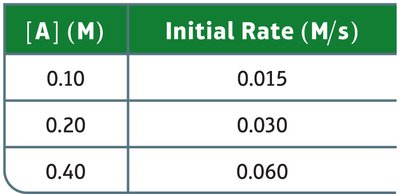
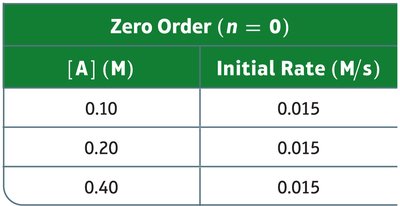
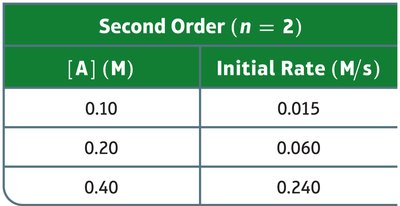
Experimental data can be used to determine reaction order and rate constant. For example, doubling the concentration of a reactant and observing the change in rate helps identify the order.
First order: Doubling [A] doubles the rate.
Zero order: Doubling [A] does not change the rate.
Second order: Doubling [A] quadruples the rate.
Fractional Reaction Orders
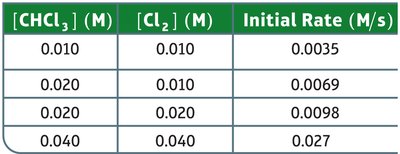
Some reactions exhibit fractional orders, which can be determined using logarithmic relationships between rate and concentration.
Example:
Experimental data can yield (first order in CHCl3) and (half order in Cl2).
Summary of Key Concepts
Chemical kinetics studies reaction rates and their dependence on concentration, temperature, and molecular orientation.
Reaction rate is defined as the change in concentration per unit time.
Rate law relates rate to reactant concentrations and must be determined experimentally.
Reaction order can be zero, first, second, or fractional, affecting how rate changes with concentration.
