 Back
BackChemical Kinetics: Reaction Rates and Rate Laws
Study Guide - Smart Notes
 Tailored notes based on your materials, expanded with key definitions, examples, and context.
Chemical Kinetics
Introduction to Chemical Kinetics
Chemical kinetics is the branch of chemistry that studies the rates at which chemical reactions occur, the factors that influence these rates, and the mechanisms by which reactions proceed. Understanding kinetics is essential for controlling reactions in industrial, laboratory, and biological settings.
Chemical kinetics: The study of reaction rates and the factors affecting them.
Reaction mechanism: The sequence of elementary steps by which a chemical reaction occurs.
Rate of reaction: The speed at which reactants are converted to products, typically expressed as the change in concentration over time (e.g., mol/L·s).
Analogy: Reaction rate can be compared to speed (miles/hour) or fuel consumption (gallons/time).
Factors Affecting Reaction Rate
The rate of a chemical reaction is influenced by several key factors:
Nature of reactants (Physical state): The physical state (solid, liquid, gas) and surface area of reactants affect how quickly they interact. For example, powdered substances react faster than large chunks due to increased surface area.
Concentration of reactants: Increasing the concentration of reactants generally increases the reaction rate, as more particles are available to collide and react.
Temperature: Higher temperatures typically increase reaction rates by providing reactant molecules with more kinetic energy, leading to more frequent and energetic collisions.
Catalyst/enzyme: Catalysts and enzymes accelerate reactions without being consumed, often by lowering the activation energy required for the reaction to proceed.
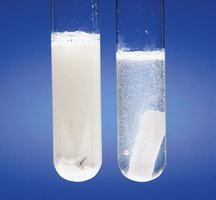
Example: The image above shows two test tubes: one with powdered reactant and one with a solid chunk. The powdered reactant reacts faster due to greater surface area.
Expressing Reaction Rate
Rate Expressions
The rate of a reaction can be expressed in terms of the change in concentration of reactants or products over time. For a general reaction:
The rate is negative for reactants (as they are consumed) and positive for products (as they are formed).
Example: For , the rate can be written as:
Reaction Order and Rate Laws
Types of Reaction Orders
Reaction order describes how the rate depends on the concentration of reactants. The rate law must be determined experimentally.
Zero Order: (rate is independent of [A])
First Order: (rate is directly proportional to [A])
Second Order: (rate is proportional to the square of [A])
Example: For , if the rate is proportional to , doubling increases the rate by a factor of four.
Determining Reaction Order from Rate Law
The order with respect to each reactant is found by observing how changes in concentration affect the reaction rate. The overall order is the sum of the orders for each reactant.
Example: If doubling [A] doubles the rate, the reaction is first order in A. If doubling [A] quadruples the rate, it is second order in A.
For a reaction: , if the rate law is , the reaction is second order in A, zero order in B, and first order in C (overall third order).
Calculating the Rate Constant (k)
The rate constant, k, is a proportionality constant in the rate law. Its value is determined experimentally and depends on temperature and the presence of a catalyst, but not on reactant concentrations or time.
Units of k depend on the overall reaction order.
For a first-order reaction: , units of k are .
For a second-order reaction: , units of k are .
Experimental Determination of Rate Laws
Rate laws cannot be predicted from the balanced chemical equation; they must be determined by experiment. The rate law relates the rate to the concentrations of reactants, each raised to a power (the order).
Check the value of k for different experiments to confirm the correct rate law.
Use changes in concentration and observed rates to solve for the order of each reactant and the value of k.
Summary Table: Factors Affecting Reaction Rate
Factor | Effect on Rate | Example/Explanation |
|---|---|---|
Physical State | Increased surface area increases rate | Powdered reactant reacts faster than a solid chunk |
Concentration | Higher concentration increases rate | More particles available for collisions |
Temperature | Higher temperature increases rate | Particles move faster, collide more energetically |
Catalyst/Enzyme | Increases rate without being consumed | Lowers activation energy |
Key Points to Remember
Reaction rates and rate laws must be determined experimentally.
The rate constant (k) is specific to each reaction and depends on temperature and catalysts.
Units of k vary with reaction order.
Rate law expressions are also called rate equations or rate expressions.
Additional info: In practice, chemists use initial rates and varying concentrations to deduce the order of reaction for each reactant. The method of initial rates is a common experimental approach.
