 Back
BackChemical Kinetics: Reaction Rates, Mechanisms, and Catalysis
Study Guide - Smart Notes
 Tailored notes based on your materials, expanded with key definitions, examples, and context.
Chapter 15: Chemical Kinetics
Introduction to Kinetics
Chemical kinetics is the study of reaction rates and the factors that affect how quickly chemical reactions occur. Understanding kinetics allows chemists to control and optimize reactions in laboratory and industrial settings.
Reaction Rate: The change in concentration of a reactant or product per unit time.
Key Questions: How fast does a reaction proceed? What factors influence the speed?
Example: Combustion of methane: CH4(g) + 2 O2(g) → CO2(g) + 2 H2O(g)
Kinetics vs. Thermodynamics
Thermodynamics tells us if a reaction is spontaneous (favorable), but kinetics determines how fast it occurs. Some spontaneous reactions require an input of energy (e.g., a spark) to proceed due to slow kinetics.
Reaction Rates and Rate Laws
Defining Reaction Rate
The rate of a reaction is measured by the change in concentration of reactants or products over time. For a general reaction A → B:
Rate =
For instantaneous rate:
Stoichiometry and Rate
For reactions with coefficients, the rate must account for stoichiometry. For example, for 2A → B + 3C:
If M/s, then M/s (since 2 moles of A are consumed for every 1 mole of B produced).
Rate Laws
The rate law expresses the rate as a function of reactant concentrations:
General form: Rate =
k: Rate constant (depends on temperature)
n: Order of reaction (determined experimentally; can be integer, fraction, or negative)
Determining Rate Laws from Data
Experimental data is used to determine the order of reaction with respect to each reactant and the value of the rate constant.
Example: For 2 HI → H2 + I2, doubling [HI] doubles the rate, so the reaction is first order in HI.
Overall Reaction Order
The overall order is the sum of the exponents in the rate law. For Rate = , the overall order is 4.
Units of the Rate Constant
The units of k depend on the overall order of the reaction. For Rate = , k has units of M-3/2 s-1.
Integrated Rate Laws
First Order Reactions
For a first order reaction (A → Products):
Integrated rate law:
Linear form:
A plot of vs. t yields a straight line with slope -k.
First Order Half-Life
The half-life () is the time required for half of the reactant to be consumed:
(independent of concentration)
Second Order Reactions
For a second order reaction (A → Products):
Integrated rate law:
A plot of vs. t yields a straight line with slope k.
Half-life: (depends on initial concentration)
Zero Order Reactions
For a zero order reaction (A → Products):
Integrated rate law:
A plot of [A] vs. t yields a straight line with slope -k.
Half-life:
Summary Table: Integrated Rate Laws
Order | Integrated Rate Law | Straight Line Plot | Slope | Half-life () |
|---|---|---|---|---|
0 | [A] vs t | -k | ||
1 | ln[A] vs t | -k | ||
2 | 1/[A] vs t | k |
Collision Theory and Activation Energy
Collision Theory
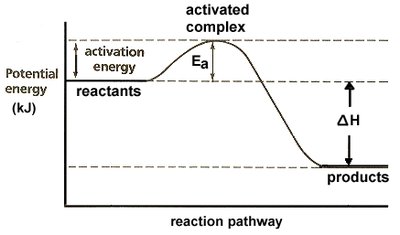
For a reaction to occur, molecules must collide with sufficient energy (greater than or equal to the activation energy, ) and proper orientation.
Activation Energy (): The minimum energy required for a reaction to proceed.
Activated Complex: A high-energy, unstable arrangement of atoms at the peak of the energy barrier.
Effect of Temperature and the Arrhenius Equation
Increasing temperature increases the average kinetic energy of molecules, leading to more collisions with energy greater than , thus increasing the rate constant k.
Arrhenius equation:
Linear form:
Determining Activation Energy Experimentally
By measuring the rate constant at two temperatures, can be calculated:
Reaction Mechanisms
Elementary and Complex Reactions
Most reactions occur in a series of steps called a mechanism. Each step may be elementary (single collision) or complex (multiple steps).
Elementary Step: Rate law can be written directly from stoichiometry.
Overall Reaction: The sum of all elementary steps.
Intermediate: Produced in one step and consumed in another; does not appear in the overall reaction.
Rate-Determining Step
The slowest step in a mechanism determines the overall reaction rate and the observed rate law.
Example: NO2 + CO → NO + CO2
Experimental rate law: Rate =
Mechanism must be consistent with both the overall reaction and the observed rate law.
Catalysts and Reaction Rate
Role of Catalysts
A catalyst increases the rate of a reaction by providing an alternative pathway with a lower activation energy. Catalysts are not consumed in the reaction and appear unchanged at the end.
Example: Decomposition of H2O2 is sped up by KI, FeCl3, or catalase.
Catalysts appear as reactants in one step and are regenerated as products in another.
Effect of a Catalyst on Energy Diagram
The catalyzed pathway has a lower activation energy, resulting in a faster reaction rate.
Summary of Key Concepts
Difference between spontaneity (thermodynamics) and reaction speed (kinetics)
How to draw and interpret potential energy diagrams
How to write and determine rate laws and reaction order from experimental data
Use of integrated rate laws for zero, first, and second order reactions
Understanding collision theory and the effect of temperature and catalysts on reaction rates
How to analyze reaction mechanisms, identify intermediates and catalysts, and derive rate laws for multi-step reactions
