 Back
BackChemical Kinetics: Reaction Rates, Mechanisms, and Rate Laws
Study Guide - Smart Notes
 Tailored notes based on your materials, expanded with key definitions, examples, and context.
Chemical Kinetics
Introduction to Chemical Kinetics
Chemical kinetics is the study of the rates at which chemical reactions occur, the factors that affect these rates, and the mechanisms by which reactions proceed. Understanding kinetics is essential for predicting how fast a reaction will occur and for controlling industrial and biological processes.
Reaction mechanism: The sequence of molecular steps by which a chemical reaction occurs.
Rate of reaction: The speed at which reactants are converted to products, typically measured as the change in concentration per unit time.
Factors Affecting Reaction Rate
Physical state of reactants: Reactions occur faster when reactants are in the same phase or are well mixed (e.g., gaseous gasoline reacts faster than liquid gasoline).
Concentration of reactants: Higher concentrations generally increase reaction rates due to more frequent collisions.
Temperature: Increasing temperature typically increases reaction rates by providing more energy for collisions.
Presence of a catalyst: Catalysts accelerate reactions by lowering activation energy and are not consumed in the process.
Expressing and Determining Reaction Rates
Rate Laws and Reaction Order
The rate law expresses the relationship between the rate of a reaction and the concentration of its reactants. The general form for a reaction aA + bB → cC + dD is:
Zero order: (rate is independent of reactant concentration)
First order: (rate is directly proportional to [A])
Second order: (rate is proportional to the square of [A])
The overall reaction order is the sum of the exponents in the rate law. The rate law must be determined experimentally unless the reaction is elementary.
Units of the Rate Constant (k)
Zero order:
First order:
Second order:
Experimental Determination of Rate Laws
To determine the order of a reactant, compare experiments where only the concentration of that reactant changes while others remain constant. The change in rate is related to the change in concentration by the order:
Set up the ratio:
Solve for the order x.
Summary of Reaction Orders
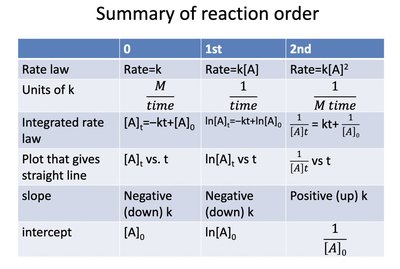
The following table summarizes the characteristics of zero, first, and second order reactions, including their rate laws, units, integrated rate laws, and graphical analysis:
Order | Rate Law | Units of k | Integrated Rate Law | Straight Line Plot | Slope | Intercept |
|---|---|---|---|---|---|---|
0 | Rate = k | M/time | vs. t | Negative (down) k | ||
1 | Rate = k[A] | 1/time | vs. t | Negative (down) k | ||
2 | Rate = k[A]^2 | 1/(M·time) | vs. t | Positive (up) k |
Collision Theory and Reaction Mechanisms
Collision Theory
Reactant molecules must collide to react.
Collisions must have sufficient energy to break and form bonds (activation energy).
Collisions must have the correct orientation.
More complex molecules have lower effective collision rates due to orientation requirements.
Arrhenius Equation
The Arrhenius equation relates the rate constant to temperature and activation energy:
As temperature increases, the rate constant and reaction rate increase.
Reaction rate approximately doubles for every 10°C rise in temperature.
Transition State Theory
Reactants must acquire enough energy to reach a high-energy transition state (activated complex).
The activation energy () is the energy difference between reactants and the transition state.
The enthalpy change () for the reaction is the difference between the final and initial energies.
Reaction Mechanisms and Rate-Determining Step
The reaction mechanism is the sequence of elementary steps that make up the overall reaction.
The slowest step is the rate-determining step; its rate law determines the overall reaction rate.
Elementary steps can be unimolecular, bimolecular, or termolecular (rare).
Unimolecular: One reactant molecule; rate =
Bimolecular: Two reactant molecules; rate =
Termolecular: Three reactant molecules; rate = (rare due to low probability of simultaneous collision)
Catalysts
Catalysts lower the activation energy, increasing reaction rate without being consumed.
Homogeneous catalysts: Same phase as reactants.
Heterogeneous catalysts: Different phase than reactants (e.g., solid catalyst in a gas reaction).
Example: Determining Reaction Order from Experimental Data
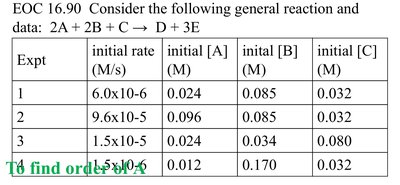
Given experimental data for the reaction 2A + 2B + C → D + 3E, the order with respect to each reactant can be determined by comparing experiments where only one reactant's concentration changes:
Identify experiments where [A] changes but [B] and [C] remain constant.
Set up the ratio:
Solve for x to find the order with respect to A.
Repeat for B and C to determine the complete rate law.
Additional info: The process of determining reaction order is fundamental for understanding how changes in concentration affect reaction rates and for elucidating reaction mechanisms.
