 Back
BackChapter 15 lecture 1
Study Guide - Smart Notes
 Tailored notes based on your materials, expanded with key definitions, examples, and context.
Chemical Kinetics
Introduction to Chemical Kinetics
Chemical kinetics is the branch of chemistry that studies the rates at which chemical reactions occur and the factors that influence these rates. Understanding kinetics is essential for elucidating reaction mechanisms, optimizing industrial processes, and assessing environmental impacts.
Reaction Mechanism: The step-by-step molecular pathway from reactants to products.
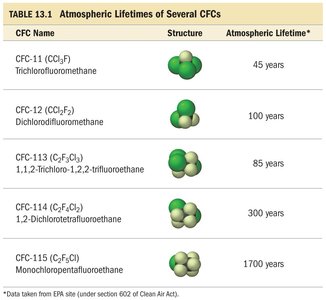
Applications: Drug design (pharmacokinetics), industrial synthesis, and environmental chemistry (e.g., CFC removal from the atmosphere).
Elimination Half-life: The time required for the concentration of a substance (e.g., drug) to decrease by half.
Example: The slow removal of chlorofluorocarbons (CFCs) from the atmosphere impacts ozone depletion.
Factors Affecting Reaction Rates
The rate of a chemical reaction depends on several key factors:
Concentration of Reactants: Higher concentrations generally increase reaction rates.
Temperature: Raising temperature typically increases the rate by providing more kinetic energy to molecules.
Physical State: Reactions proceed faster when reactants are in the same phase or finely divided.
Catalysts: Catalysts speed up reactions without being consumed.
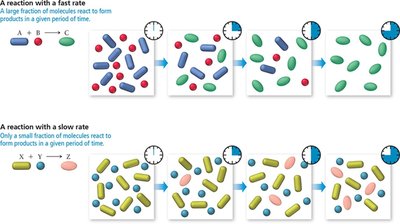
Example: Comparing fast and slow reactions visually demonstrates how the fraction of molecules reacting changes over time.
Defining Reaction Rates
Average and Instantaneous Reaction Rates
The reaction rate is the change in concentration of a reactant or product per unit time. It can be expressed as either the appearance of products or the disappearance of reactants.
Units: or
Average Rate: Calculated over a time interval.
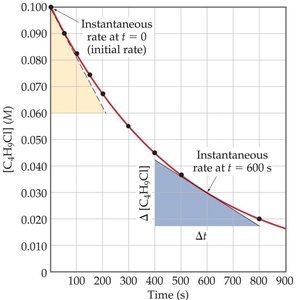
Instantaneous Rate: Determined at a specific moment, often from the slope of a concentration vs. time graph.
Example: For the reaction :
Average rate of product formation:
Average rate of reactant disappearance:
Instantaneous Rate: The slope of the tangent to the concentration-time curve at a given point.
Reaction Rates and Stoichiometry
Unique Average Reaction Rate
For reactions with non-1:1 stoichiometry, the rate of disappearance of reactants and appearance of products must be adjusted by their stoichiometric coefficients to ensure consistency.
General Rate Expression: For :
Application: Knowing the rate for one species allows calculation for others using stoichiometry.
Example: For , the rate of formation of B is half the rate of disappearance of A.
The Rate Law, Rate Constant, and Reaction Order
Differential Rate Law
The rate law relates the reaction rate to the concentrations of reactants, each raised to a power (the reaction order), and multiplied by a rate constant.
k: Rate constant (temperature dependent)
m, n, p: Reaction orders (experimentally determined, not necessarily equal to stoichiometric coefficients)
Overall Order:
Experimental Determination of the Rate Law
Determining Reaction Orders
Reaction orders are determined by varying the concentration of one reactant at a time and measuring the effect on the reaction rate. The exponents in the rate law are found by comparing rates from different experiments.
Steps:
Vary initial concentration of one reactant, keep others constant.
Measure average rates.
Compare rates to calculate reaction orders.
Establish the rate law and calculate the rate constant.
Example: For the reaction , a series of experiments yields:
Exp. | [A], M | [B], M | [C], M | Rate, M/s |
|---|---|---|---|---|
1 | 0.010 | 0.010 | 0.00050 | 1.40×10⁻⁶ |
2 | 0.020 | 0.010 | 0.00050 | 2.88×10⁻⁶ |
3 | 0.010 | 0.020 | 0.00050 | 2.95×10⁻⁶ |
4 | 0.010 | 0.010 | 0.00100 | 1.45×10⁻⁶ |
By comparing experiments, the reaction is found to be first order in A, first order in B, and zeroth order in C:
Calculation of Rate Constant:
Overall Order: 2 (since 1 + 1 + 0 = 2)
Summary Table: Atmospheric Lifetimes of CFCs
The following table summarizes the atmospheric lifetimes of several chlorofluorocarbons (CFCs), illustrating the environmental impact of slow reaction rates in atmospheric chemistry.
CFC Name | Structure | Atmospheric Lifetime |
|---|---|---|
CFC-11 (CCl3F) Trichlorofluoromethane | See molecular model | 45 years |
CFC-12 (CCl2F2) Dichlorodifluoromethane | See molecular model | 100 years |
CFC-113 (C2F3Cl3) 1,1,2-Trichloro-1,2,2-trifluoroethane | See molecular model | 85 years |
CFC-114 (C2F4Cl2) 1,2-Dichlorotetrafluoroethane | See molecular model | 300 years |
CFC-115 (C2F5Cl) Monochloropentafluoroethane | See molecular model | 1700 years |
Additional info: The long atmospheric lifetimes of CFCs highlight the importance of chemical kinetics in environmental chemistry, as slow reaction rates lead to prolonged environmental persistence and impact.
