 Back
BackChemical Kinetics: Study Guide for General Chemistry
Study Guide - Smart Notes
 Tailored notes based on your materials, expanded with key definitions, examples, and context.
Chemical Kinetics
Introduction to Chemical Kinetics
Chemical kinetics is the branch of chemistry that studies the rates of chemical reactions and the factors that affect these rates. Understanding reaction rates is crucial for controlling chemical processes in both laboratory and industrial settings.
Reaction Rate: The speed at which reactants are converted to products, typically measured as the change in concentration per unit time.
Importance: Controlling reaction rates is essential in fields such as pharmaceuticals, materials science, and biochemistry.
Example: Ectothermic animals, like lizards, experience slower metabolic reactions at lower temperatures, leading to lethargy.
Defining Reaction Rate
The rate of a chemical reaction is measured by the change in concentration of reactants or products over time. For reactants, the rate is negative because their concentration decreases.
General Formula: for a reaction
Units: Typically M/s (molarity per second)
Average Rate: Change in concentration over a finite time interval
Instantaneous Rate: Rate at a specific moment, determined by the slope of the tangent to the concentration vs. time curve
Reaction Rate and Stoichiometry
Reaction rates are related to the stoichiometry of the balanced chemical equation. The rate of change for each substance is proportional to its coefficient in the equation.
Example: For , the rate of disappearance of and is equal, and the rate of appearance of is twice as fast.
Measuring Reaction Rate
Reaction rates can be measured using various techniques, depending on the nature of the reaction and the reactants involved.
Polarimetry: Measures changes in optical rotation.
Spectrophotometry: Measures absorbance of light at specific wavelengths.
Pressure Measurement: Monitors changes in total pressure for gas-phase reactions.
Sampling: Aliquots are withdrawn and analyzed by titration, gravimetric analysis, or gas chromatography.
Factors Affecting Reaction Rate
The rate of a reaction depends on several factors, including reactant concentration, temperature, and the presence of catalysts.
Reactant Concentration: Higher concentrations generally increase the rate.
Temperature: Higher temperatures increase the rate constant.
Catalysts: Catalysts provide alternative pathways with lower activation energy.
Rate Laws and Reaction Order
The Rate Law
The rate law expresses the relationship between the rate of a reaction and the concentrations of reactants. It is determined experimentally.
General Form:
Order: The exponent for each reactant is its order; the sum is the overall order.
Rate Constant (k): A proportionality constant specific to the reaction and temperature.
Reaction Order
Reaction order describes how the rate depends on reactant concentrations.
Zero Order: Rate is independent of concentration.
First Order: Rate is directly proportional to concentration.
Second Order: Rate is proportional to the square of concentration.
Example: Doubling [A] in a first-order reaction doubles the rate; in a second-order reaction, it quadruples the rate.
Determining Reaction Order
Reaction order is determined by the method of initial rates, comparing how changes in concentration affect the initial rate.
Multiple Reactants: Vary one reactant at a time to determine individual orders.
Overall Order: Sum of individual orders.
Integrated Rate Laws
Integrated Rate Laws
Integrated rate laws relate reactant concentration to time, allowing calculation of concentrations at any point during the reaction.
First Order:
Second Order:
Zero Order:
Graphical determination of reaction order is possible by plotting concentration, natural log, or inverse concentration versus time.
Zero Order: [A] vs. time is linear (
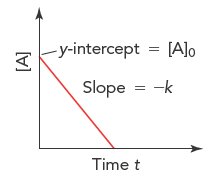 )
)First Order: ln[A] vs. time is linear (
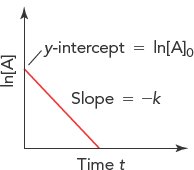 )
)Second Order: 1/[A] vs. time is linear (
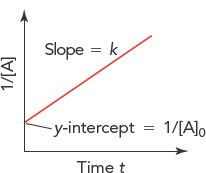 )
)
Half-Life
The half-life () is the time required for the concentration of a reactant to decrease by half. The half-life depends on the reaction order.
First Order: (independent of initial concentration)
Second Order:
Zero Order:
Temperature and Reaction Rate
Arrhenius Equation
The Arrhenius equation describes how the rate constant (k) depends on temperature and activation energy.
Equation:
Variables: = activation energy, = gas constant, = temperature in Kelvin, = frequency factor
Effect: Increasing temperature increases k, making reactions faster.
Activation Energy and Reaction Energy Profile
Activation energy is the minimum energy required for a reaction to occur. The reaction energy profile shows the energy changes during the reaction, including the formation of the activated complex (transition state).
Activated Complex: A high-energy, unstable species formed during the reaction.
Frequency Factor: Number of times reactants approach the activation barrier per unit time.
Exponential Factor: Fraction of molecules with enough energy to react.
Collision Theory
Collision Theory
Collision theory states that molecules must collide with sufficient energy and proper orientation to react.
Effective Collisions: Collisions that result in product formation.
Orientation Factor (p): Probability that molecules are correctly oriented during collision.
Complexity: More complex molecules have lower orientation factors.
Reaction Mechanisms
Reaction Mechanisms
A reaction mechanism is the sequence of elementary steps that make up the overall reaction. Each step has its own rate law and activation energy.
Elementary Steps: Cannot be broken down further; involve direct interaction of molecules.
Intermediates: Species produced in one step and consumed in another; do not appear in the overall equation.
Molecularity: Number of reactant particles in an elementary step (unimolecular, bimolecular, termolecular).
Rate-Determining Step: The slowest step in the mechanism; determines the overall rate law.
Validating Mechanisms
To validate a proposed mechanism, the sum of elementary steps must match the overall reaction, and the predicted rate law must agree with experimental data.
Catalysts and Enzymes
Catalysts
Catalysts increase reaction rates by providing alternative pathways with lower activation energy. They are not consumed in the reaction.
Homogeneous Catalysts: Same phase as reactants.
Heterogeneous Catalysts: Different phase from reactants.
Example: Catalytic converters in cars reduce pollutants.
Enzymes
Enzymes are biological catalysts, typically proteins, that speed up reactions by binding substrates at an active site and orienting them for reaction.
Lock and Key Mechanism: Substrate fits into enzyme's active site.
Example: Enzymatic hydrolysis of sucrose.
Additional info: The study notes above expand on the provided lecture slides and textbook excerpts, adding academic context, definitions, formulas, and examples for completeness. The included images (image_3, image_4, image_5) are directly relevant to the graphical determination of reaction order and integrated rate laws.
