 Back
BackChemical Kinetics: The Key to Understanding Reaction Speed
Study Guide - Smart Notes
 Tailored notes based on your materials, expanded with key definitions, examples, and context.
Chemical Kinetics
Introduction to Chemical Kinetics
Chemical kinetics is the branch of chemistry that studies the speed or rate at which chemical reactions occur and the factors that influence these rates. Unlike thermodynamics, which tells us whether a reaction is possible and the energy changes involved, kinetics focuses on how fast a reaction proceeds and the steps it follows.
Reaction Rate: Defined as the change in concentration of a reactant or product per unit time. Common units are mol/L/s.
Importance: Understanding reaction rates is crucial for industrial processes, food preservation, pharmaceuticals, and environmental science.
Key Factors Affecting Rate: Nature of reactants, concentration, temperature, pressure, catalysts, and reaction order.
Effect of Concentration on Reaction Rate
Collision Theory and Concentration
For a chemical reaction to occur, reactant molecules must collide with sufficient energy and proper orientation. Increasing the concentration of reactants increases the number of molecules per unit volume, leading to a higher probability of collisions and, therefore, a faster reaction rate.
Collision Frequency: More molecules mean more frequent collisions.
Activated Complex: Collisions must have enough energy to form an activated complex (transition state) before forming products.
Example: In the experiment, varying the concentration of ascorbic acid and iodine-iodide solution demonstrates how reaction speed changes with concentration.
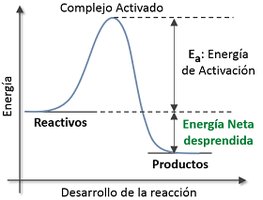
Figure 1. Typical energy profile of a chemical reaction, showing the formation of the activated complex and the activation energy (Ea).
Effect of Temperature on Reaction Rate
Temperature and Activation Energy
Temperature has a significant effect on reaction rates. As temperature increases, the kinetic energy of molecules increases, resulting in more molecules having energy equal to or greater than the activation energy (Ea). This leads to more effective collisions and a faster reaction rate. Typically, the rate of a reaction doubles for every 10ºC increase in temperature.
Activation Energy (Ea): The minimum energy required for a reaction to occur.
Practical Example: Food is stored at low temperatures to slow down degradation reactions.
General Rule: Higher temperature or concentration increases the reaction rate.
Redox Clock Reaction: Experimental Study
Redox Reactions and Agents
Redox reactions involve the transfer of electrons between species. The substance that gains electrons is the oxidizing agent, and the one that loses electrons is the reducing agent.
Ascorbic Acid (C6H8O6): Acts as a reducing agent in the experiment.
Iodine (I2): Acts as an oxidizing agent.
Hydrogen Peroxide (H2O2): Also participates as an oxidizing agent in a subsequent reaction.
Key Reactions:
Reaction 1: C6H8O6 + I3- → C6H6O6 + 3 I- + 2 H+
Reaction 2: H2O2 + 3 I- + 2 H+ → I3- + 2 H2O
In the experiment, the disappearance of the reddish-brown color of the iodine-iodide solution upon addition of ascorbic acid indicates the reduction of iodine to iodide.
Experimental Procedure Overview
Studying the Effect of Concentration and Temperature
The experiment is divided into two main parts: investigating the effect of concentration and temperature on the rate of a redox clock reaction.
Effect of Concentration: Vary the amount of distilled water and reactant solutions in a series of beakers, mix, and measure the time until a color change occurs.
Effect of Temperature: Perform the reaction at different temperatures using water baths (warmer and cooler than room temperature) and record the reaction times.
Data Analysis and Calculations
Calculating Concentrations and Reaction Rates
Concentration Calculations: Use the dilution formula to determine the final concentrations of reactants in each experiment.
Reaction Rate: Calculated as where is the remaining concentration at the time of color change.
Results Interpretation
Graphical Analysis
Time vs. [Ascorbic Acid] Remaining: Shows how the time to color change depends on the concentration of ascorbic acid.
Reaction Velocity vs. [Ascorbic Acid] Remaining: Illustrates the relationship between reaction rate and ascorbic acid concentration.
In both cases, increasing the concentration of ascorbic acid generally decreases the time to reaction and increases the reaction rate, consistent with collision theory.
Safety and Waste Management
Safe Handling and Disposal
Personal Protective Equipment: Always use appropriate safety gear when handling chemicals.
Waste Disposal: Solutions containing iodine should be collected and treated with ascorbic acid before disposal. Other solutions can be safely discarded with running water.
Summary Table: Key Experimental Materials
Material/Reagent | Purpose |
|---|---|
Ascorbic acid solution | Reducing agent in redox reaction |
Iodine-iodide solution | Oxidizing agent, color indicator |
Hydrogen peroxide (H2O2) | Oxidizing agent in secondary reaction |
Starch solution | Color indicator for iodine |
Distilled water | Solvent and for dilution |
Beakers, pipettes, chronometer | Standard laboratory equipment |
Conclusion
This experiment demonstrates the fundamental principles of chemical kinetics by showing how concentration and temperature affect the rate of a redox clock reaction. The results support the collision theory and the importance of activation energy in chemical reactions. Understanding these concepts is essential for controlling reaction rates in both laboratory and industrial settings.
