 Back
BackChemical Quantities in Reactions: Law of Conservation of Mass, Mole Relationships, and Mass Calculations
Study Guide - Smart Notes
 Tailored notes based on your materials, expanded with key definitions, examples, and context.
Chemical Quantities in Reactions
Law of Conservation of Mass
The Law of Conservation of Mass states that in an ordinary chemical reaction, matter cannot be created or destroyed. This principle ensures that the total mass of reactants equals the total mass of products in a chemical reaction.
No change in total mass occurs during a reaction.
The mass of the products is equal to the mass of the reactants.
Example: The reaction of silver (Ag) with sulfur (S) to form silver sulfide (Ag2S) demonstrates this law.
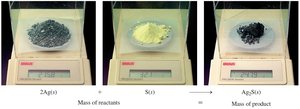
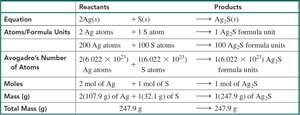
In the reaction: 2Ag(s) + S(s) → Ag2S(s), the mass of the reactants (Ag and S) is the same as the mass of the product (Ag2S).
Equation | Reactants | Products |
|---|---|---|
Atoms/Formula Units | 2 Ag atoms + 1 S atom | 1 Ag2S formula unit |
Avogadro's Number of Atoms | 2 × 6.022 × 1023 Ag atoms + 1 × 6.022 × 1023 S atoms | 1 × 6.022 × 1023 Ag2S formula units |
Moles | 2 mol Ag + 1 mol S | 1 mol Ag2S |
Mass (g) | 2 × 107.9 g Ag + 1 × 32.1 g S | 1 × 247.9 g Ag2S |
Total Mass (g) | 247.9 g | 247.9 g |
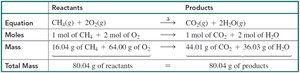
Example: Combustion of methane (CH4) with oxygen produces carbon dioxide and water. The total mass of reactants equals the total mass of products.
Equation | Reactants | Products |
|---|---|---|
Moles | 1 mol CH4 + 2 mol O2 | 1 mol CO2 + 2 mol H2O |
Mass (g) | 16.04 g CH4 + 64.00 g O2 | 44.01 g CO2 + 36.03 g H2O |
Total Mass (g) | 80.04 g | 80.04 g |
Mole Relationships in Chemical Equations
Balanced chemical equations provide quantitative relationships between reactants and products. The coefficients in a balanced equation represent the number of moles of each substance involved.
Mole–Mole Factor: A ratio of the moles of two substances in a balanced equation, used to convert between moles of different substances.
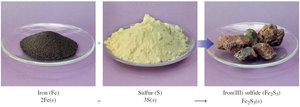
Example: In the reaction 2Fe(s) + 3S(s) → Fe2S3(s), the mole–mole factor between Fe and S is 2:3.
Sample Problem: How many moles of sulfur are needed to react with 1.42 moles of iron?
Given | Need | Connect |
|---|---|---|
1.42 mol Fe | moles of S | mole–mole factor |

Plan: Convert moles of Fe to moles of S using the mole–mole factor.

Mole–Mole Factors:
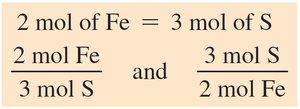
Calculation:
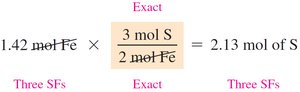
1.42 mol Fe × (3 mol S / 2 mol Fe) = 2.13 mol S
Calculating Moles of a Product
Propane (C3H8) reacts with oxygen to produce carbon dioxide and water. The mole–mole factor from the balanced equation allows calculation of product moles.
Given | Need | Connect |
|---|---|---|
2.25 mol C3H8 | moles of CO2 | mole–mole factor |
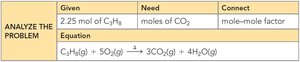
Plan: Convert moles of C3H8 to moles of CO2 using the mole–mole factor.

Mole–Mole Factors:
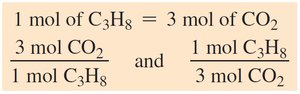
Calculation:
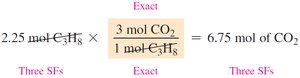
2.25 mol C3H8 × (3 mol CO2 / 1 mol C3H8) = 6.75 mol CO2
Mass Calculations for Chemical Reactions
Given the mass of a substance in a chemical reaction, the mass of another substance can be calculated using molar masses and mole–mole factors.
Convert mass of substance A to moles using its molar mass.
Use the mole–mole factor from the balanced equation to convert moles of A to moles of B.
Convert moles of B to mass using its molar mass.

Sample Problem: How many grams of CO2 are produced when 54.6 grams of C2H2 is burned?
Given | Need | Connect |
|---|---|---|
54.6 g C2H2 | grams of CO2 | molar masses, mole–mole factor |
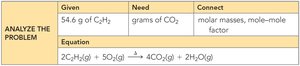
Plan: Convert grams of C2H2 to grams of CO2 using molar masses and mole–mole factor.

Mole–Mole and Molar Mass Factors:
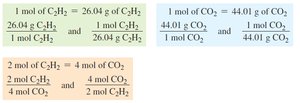
Calculation:

54.6 g C2H2 × (1 mol C2H2 / 26.04 g C2H2) × (4 mol CO2 / 2 mol C2H2) × (44.01 g CO2 / 1 mol CO2) = 185 g CO2
Mass Calculations: Grams of Reactant from Grams of Reactant
To find the mass of a reactant required to react with a given mass of another reactant, use the same conversion steps: grams → moles → moles → grams.
Given | Need | Connect |
|---|---|---|
22.5 g C7H16 | grams of O2 | molar masses, mole–mole factor |

Plan: Convert grams of C7H16 to grams of O2 using molar masses and mole–mole factor.

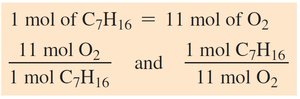
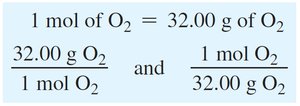
Mole–Mole and Molar Mass Factors:
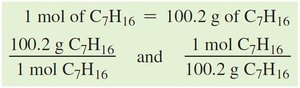
Calculation:

22.5 g C7H16 × (1 mol C7H16 / 100.2 g C7H16) × (11 mol O2 / 1 mol C7H16) × (32.00 g O2 / 1 mol O2) = 79.1 g O2
Learning Check: Mass of Potassium Required for KCl Production
Given the mass of KCl produced, calculate the mass of potassium required using the balanced equation and conversion factors.
Equation: 2K(s) + Cl2(g) → 2KCl(s)
Given: 36.0 g KCl
Need: grams of K
Plan: Convert grams of KCl to grams of K using molar masses and mole–mole factor.
Mole–Mole and Molar Mass Factors:
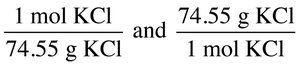
Calculation:
36.0 g KCl × (1 mol KCl / 74.55 g KCl) × (2 mol K / 2 mol KCl) × (39.10 g K / 1 mol K) = mass of K required
Summary: Mass Calculations for Chemical Reactions
To calculate the mass of a substance produced or required in a chemical reaction:
Use the molar masses of the substances.
Apply mole–mole factors from the balanced equation.
Convert grams to moles, use the mole ratio, then convert moles back to grams.
Additional info: These concepts are foundational for understanding stoichiometry, quantitative analysis, and predicting yields in chemical reactions.
