 Back
BackChemical Reactions and Chemical Quantities: Chapter 4 Study Guide
Study Guide - Smart Notes
 Tailored notes based on your materials, expanded with key definitions, examples, and context.
Chemical Reactions and Chemical Quantities
Introduction to Chemical Reactions
Chemical reactions are fundamental processes in chemistry where substances are transformed into new compounds. These reactions occur when particles interact, often involving the transfer or sharing of electrons. Understanding chemical reactions also requires knowledge of stoichiometry, which deals with the numerical relationships between reactants and products.
Chemical Reaction: A process in which one or more substances are converted into different substances.
Stoichiometry: The quantitative relationship between reactants and products in a chemical reaction.
Example: Formation of water from hydrogen and oxygen.
Greenhouse Gases and Global Warming
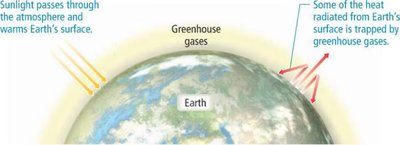
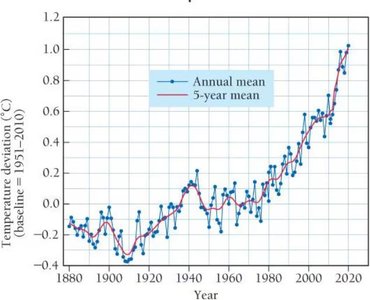
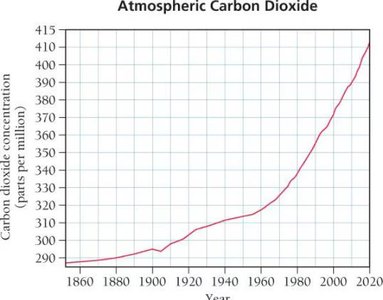
Greenhouse gases in the atmosphere act as a filter, allowing sunlight to warm the Earth's surface while trapping some of the heat radiated back from the surface. This balance determines the average temperature of the planet. An increase in greenhouse gases, such as CO2, leads to higher average temperatures, a phenomenon known as global warming.
Greenhouse Effect: Sunlight passes through the atmosphere, warms the surface, and some heat is trapped by greenhouse gases.
Global Warming: Rising atmospheric CO2 increases the atmosphere's ability to retain heat, causing temperature increases.
Chemical Equations
Chemical equations are symbolic representations of chemical reactions. Reactants are written on the left, products on the right, separated by an arrow. The physical state of each substance is indicated in parentheses. Equations must be balanced to obey the law of conservation of mass.
Reactants: Substances consumed in the reaction (left side).
Products: Substances formed in the reaction (right side).
States: (g) for gas, (l) for liquid, (s) for solid, (aq) for aqueous.
Balanced Equation: Number of each atom is equal on both sides.
Balancing Chemical Equations
Balancing equations ensures the conservation of matter. Only coefficients (not subscripts) are changed to balance the number of atoms of each element.
Write a skeletal equation.
Balance atoms in complex substances first.
Balance free elements last.
Clear fractional coefficients by multiplying all coefficients by the denominator.
Verify balance by counting atoms on both sides.
Example:
Reaction Stoichiometry
Stoichiometry uses balanced equations to relate the amounts of reactants and products. The coefficients indicate the relative number of moles involved.
Mole-to-Mole Conversion: Use stoichiometric ratios to determine product or reactant amounts.
Example:
Mass-to-Mass Conversions
To convert between masses of reactants and products, use molar masses and stoichiometric ratios.
Convert mass to moles using molar mass.
Use stoichiometric ratio to find moles of product.
Convert moles of product to mass using molar mass.
Example:
Limiting Reactants
The limiting reactant is the substance that determines the maximum amount of product that can be formed. It is completely consumed in the reaction, while other reactants may be in excess.
Limiting Reactant: Produces the least amount of product.
Excess Reactant: Not completely consumed.
Example: If 1 mol of A reacts with 3 mol of B, and you have 12 mol of B, you need 4 mol of A for complete reaction.
Yields in Chemical Reactions
Yield refers to the amount of product formed in a reaction. Theoretical yield is the maximum possible, actual yield is what is obtained, and percent yield measures efficiency.
Theoretical Yield: Maximum product from limiting reactant.
Actual Yield: Product actually obtained.
Percent Yield:
Combustion Reactions
Combustion reactions involve a substance reacting with oxygen to form oxygen-containing compounds, often releasing heat. Hydrocarbons typically produce carbon dioxide and water.
General Pattern: Carbon forms CO2, hydrogen forms H2O.
Example: Combustion of butane:
Alkali Metal Reactions
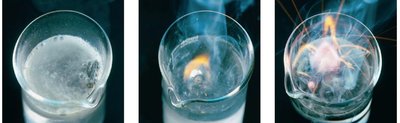
Alkali metals react vigorously with nonmetals, especially halogens, often producing heat and sparks. The general reaction is:
Reactivity increases down the group.
Reactions can be highly exothermic and explosive.
Halogen Reactions
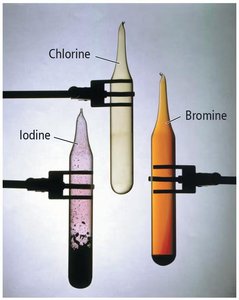
Halogens are highly reactive nonmetals. They react with metals to form ionic metal halides, and with hydrogen to form covalent hydrogen halides, which become acids in water. Halogens also react with each other to form interhalogen compounds.
Metal Halides:
Hydrogen Halides: Covalent bonds, form acids in water.
Interhalogen Compounds: Covalent bonds between different halogens.
Summary of Key Concepts
Chemical reactions are represented by balanced equations.
Stoichiometry allows calculation of reactant and product quantities.
Limiting reactant determines maximum product yield.
Percent yield measures reaction efficiency.
Combustion, alkali metal, and halogen reactions follow characteristic patterns.
