 Back
BackChemical Reactions and Chemical Quantities: Chapter 4 Study Guide
Study Guide - Smart Notes
 Tailored notes based on your materials, expanded with key definitions, examples, and context.
Chemical Reactions and Chemical Quantities
Introduction to Chemical Reactions
Chemical reactions are fundamental processes in chemistry where substances are transformed into new compounds. These reactions occur when particles interact, often involving the transfer or sharing of electrons. Understanding chemical reactions also requires knowledge of stoichiometry, which deals with the numerical relationships between reactants and products.
Chemical Reaction: A process in which one or more substances are converted into different substances.
Stoichiometry: The study of quantitative relationships between reactants and products in a chemical reaction.
Example: Formation of water from hydrogen and oxygen.
Greenhouse Gases and Global Warming
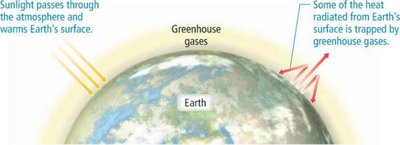
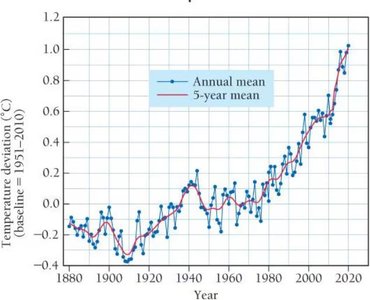
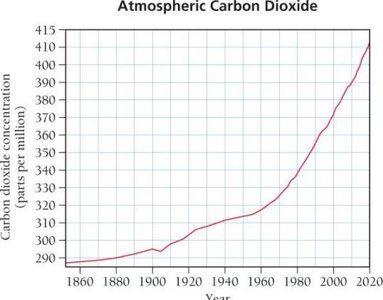
Greenhouse gases play a crucial role in regulating Earth's temperature by trapping heat. The concentration of these gases, especially carbon dioxide, has increased due to human activities, leading to global warming.
Greenhouse Gases: Gases in the atmosphere that allow sunlight to pass through but trap heat radiated from Earth's surface.
Global Warming: The increase in Earth's average temperature due to rising levels of greenhouse gases.
Primary Source: Burning of fossil fuels.
Chemical Equations
Chemical equations are symbolic representations of chemical reactions. They show reactants and products, their physical states, and must be balanced to obey the law of conservation of mass.
Reactants: Substances consumed in the reaction (left side).
Products: Substances formed in the reaction (right side).
States: Indicated by (g) for gas, (l) for liquid, (s) for solid, (aq) for aqueous.
Balanced Equation: Number of each atom is equal on both sides.
Balancing Chemical Equations
Balancing equations involves adjusting coefficients to ensure the conservation of atoms. Subscripts should not be changed, as they alter the identity of the substance.
Write the skeletal equation.
Balance atoms in complex substances first.
Balance free elements last.
Clear fractional coefficients by multiplying through.
Verify balance by counting atoms on both sides.
Reaction Stoichiometry
Stoichiometry allows chemists to predict the amounts of products formed or reactants needed in a reaction. The coefficients in a balanced equation represent the mole ratios of substances involved.
Mole-to-Mole Conversion: Use stoichiometric ratios to convert between moles of reactants and products.
Mass-to-Mass Conversion: Convert mass to moles using molar mass, apply stoichiometric ratio, then convert moles back to mass.
Example Equations
Combustion of octane:
Photosynthesis:
Neutralization:
Limiting Reactants and Yields
In many reactions, one reactant is used up first, limiting the amount of product formed. Theoretical yield is the maximum possible product, while actual yield is what is actually obtained. Percent yield measures efficiency.
Limiting Reactant: The reactant that produces the least amount of product.
Theoretical Yield: Calculated maximum product based on limiting reactant.
Actual Yield: Amount of product actually obtained.
Percent Yield:
Combustion Reactions
Combustion reactions involve a substance reacting with oxygen to produce water and carbon dioxide, often releasing heat. Hydrocarbons are common reactants in combustion.
General Pattern: Hydrocarbon + O2 → CO2 + H2O
Example: Combustion of butane:
Alkali Metal Reactions
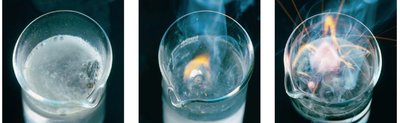
Alkali metals react vigorously with nonmetals, especially halogens, to form ionic compounds. These reactions are highly exothermic and can be explosive.
General Reaction:
Example: Sodium reacts with chlorine to form sodium chloride.
Halogen Reactions
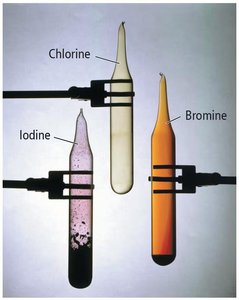
Halogens are highly reactive nonmetals that form compounds with metals and hydrogen. Metal halides are ionic, while hydrogen halides are covalent and form acids in water. Halogens can also form interhalogen compounds.
Metal Halide Formation:
Hydrogen Halide Formation:
Interhalogen Compounds: Formed by reaction between different halogens.
Summary Table: States of Matter Abbreviations
Abbreviation | State |
|---|---|
(g) | Gas |
(l) | Liquid |
(s) | Solid |
(aq) | Aqueous |
In Summation
Chemical reactions are represented by balanced chemical equations.
Stoichiometry allows prediction of product and reactant quantities.
Limiting reactant determines the maximum product yield.
Percent yield measures reaction efficiency.
