 Back
Chemical Reactions and Chemical Quantities: Empirical & Molecular Formulas, Combustion Analysis, Stoichiometry, Limiting Reagents, Percent Yield, and Functional Groups
Study Guide - Smart Notes
 Tailored notes based on your materials, expanded with key definitions, examples, and context.
Chemical Reactions and Chemical Quantities
Empirical Formula
The empirical formula of a compound represents the simplest whole-number ratio of the elements present. It is determined from the mass percentages or masses of the constituent elements using the mole concept.
Empirical Formula: Shows the simplest ratio of atoms in a compound.
Molecular Formula: Shows the actual number of atoms of each element in a molecule.
All formulas must contain whole numbers of each atom, representing the simplest ratio.
Example: C3H6O3 (empirical formula), C12H22O11 (molecular formula).
Calculation Steps:
Write the symbol for each element.
Write the mass (in grams) of each element.
Convert all masses into moles.
Divide each mole value by the smallest mole value to obtain whole numbers.
If values are close to whole numbers (e.g., 0.99 or 1.01), round; otherwise, multiply by a factor to get whole numbers.
Example: Determine the empirical formula for a compound with 57.47% sodium, 40.01% oxygen, and 2.52% hydrogen.
Molecular Formula
The molecular formula gives the actual number of atoms of each element in a molecule. It is determined once the empirical formula and the molar mass are known.
Calculation Steps:
Determine the empirical formula.
Calculate the empirical mass.
Divide the molar mass by the empirical mass to find the n-factor.
Multiply the subscripts in the empirical formula by the n-factor to obtain the molecular formula.
Example: Ibuprofen (M = 206.3 g/mol) with percent composition: 75.70% C, 8.80% H, 15.50% O.
Combustion Analysis
Combustion analysis is an analytical process used to determine the empirical formula of a compound, typically involving hydrocarbons or compounds with C, H, and O. The products are usually CO2 and H2O.
Calculation Steps:
Convert grams of CO2 to grams of carbon.
Convert grams of H2O to grams of hydrogen.
If necessary, subtract the masses from the sample to find the third element.
Convert all masses to moles.
Divide by the smallest mole value to get whole numbers.
Round or multiply to obtain whole numbers.
Example: Combustion of 12.01 g of 2,3-dihydroxysuccinic acid produces 14.08 g CO2 and 4.32 g H2O.
Combustion Apparatus
The combustion apparatus is used to vaporize samples and analyze combustion products in separate chambers.
Chamber A: Vaporizes the sample.
Chamber B: Converts hydrogen to H2O and nonmetals to gases.
Chamber C: Traps water.
Chamber D: Traps gas.
Calculation Steps:
Subtract the mass after combustion from the mass before to find grams of CO2 and H2O.
Convert grams of CO2 to grams of carbon.
Convert grams of H2O to grams of hydrogen.
If necessary, subtract to find the third element.
Convert all masses to moles.
Divide by the smallest mole value to get whole numbers.
Round or multiply to obtain whole numbers.

Example: Combustion of 11.5 g of jet fuel produces changes in CO2 and H2O absorber masses. Find the empirical formula.
Balancing Chemical Equations
Balancing chemical equations ensures the number and type of atoms are equal on both sides. The numbers used are called coefficients.
Set up lists for reactants and products.
Count each element.
Balance each element, sometimes multiplying by a factor to clear fractions.
Example: Balance the equation for combustion of C4H10.
Stoichiometry
Stoichiometry deals with the quantitative relationships between reactants and products in a balanced chemical equation.
Convert the given quantity to moles.
Use mole-to-mole comparison from the balanced equation.
Convert moles of unknown to desired units (grams, molecules, etc.).
Example: How many grams of NO are produced from 15.0 g N2?
Limiting Reagent
The limiting reagent is the reactant that is completely consumed and determines the maximum amount of product. The excess reagent remains after the reaction.
Convert quantities to moles.
Use mole-to-mole comparison for each reactant.
Compare final amounts to determine theoretical yield.
Example: ZnS reacts with HCl to form ZnCl2 and H2S. Find the mass of H2S formed from 12.11 g ZnS and 15.92 g HCl.
Percent Yield
Percent yield measures the efficiency of a chemical reaction, comparing the actual yield to the theoretical yield.
Actual Yield: The amount of product obtained experimentally.
Theoretical Yield: The maximum possible amount calculated from stoichiometry.
No reaction is 100% efficient; actual yield is always less than theoretical yield.
Percent Yield Formula:
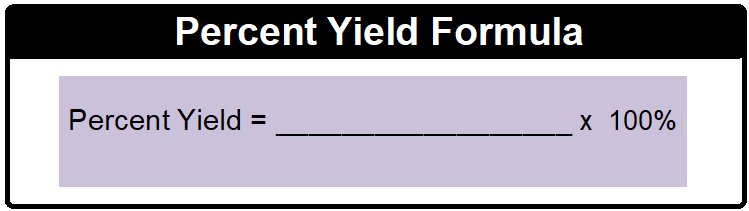
Example: 2.6 g C6H6 reacts to produce 1.25 g H2O. Find the percent yield.
Mass Percent
Mass percent (weight percent) is the percentage of a given element in a compound, calculated using the mass of the element and the total mass of the compound.
Formula:
Example: Calculate the percent composition of nitrogen and oxygen in NO2.
Functional Groups in Chemistry
Functional groups are specific groups of atoms within molecules responsible for characteristic chemical reactions.
Hydrocarbons: Compounds containing only carbon and hydrogen.
Functional Groups without Carbonyls: Recognized by the presence of atoms such as N, O, S, or halogens (F, Cl, Br, I).
Functional Groups with Carbonyls: Contain a carbon double-bonded to oxygen (C=O).
Example: Identify the functional group in CH3CH=CHCH2COOH (contains alkene and carboxylic acid groups).
Example: Identify the functional group in CH3COOCH2CH2OH (contains ester and alcohol groups).
Additional info: These notes cover key concepts from Chapter 4 of a General Chemistry course, including empirical and molecular formulas, combustion analysis, stoichiometry, limiting reagents, percent yield, mass percent, and functional groups. All examples and formulas are provided to reinforce understanding and support exam preparation.
