 Back
BackChemical Reactions and Chemical Quantities: Stoichiometry, Limiting Reactants, and Types of Reactions
Study Guide - Smart Notes
 Tailored notes based on your materials, expanded with key definitions, examples, and context.
Chemical Reactions and Chemical Equations
Definition and Representation of Chemical Reactions
Chemical reactions are processes in which substances (reactants) are transformed into new substances (products) through the breaking and forming of chemical bonds. These changes are represented using chemical equations, which provide information about the identities, quantities, and states of the substances involved.
Chemical Equation: A symbolic representation of a chemical reaction using chemical formulas and symbols.
Reactants: Substances present before the reaction (left side of the equation).
Products: Substances formed as a result of the reaction (right side of the equation).
States of Matter: Indicated by (s) for solid, (l) for liquid, (g) for gas, and (aq) for aqueous solution.
Law of Conservation of Mass
The law of conservation of mass states that matter is neither created nor destroyed in a chemical reaction. Therefore, the number of atoms of each element must be the same on both sides of the equation.
Balancing Chemical Equations
Balancing a chemical equation ensures that the same number of each type of atom appears on both sides. This is achieved by adjusting the coefficients (whole numbers in front of formulas), not the subscripts (which are part of the chemical formula).
Count the number of atoms of each element on both sides.
Adjust coefficients to balance atoms, starting with the most complex molecule.
Check your work to ensure all elements are balanced.
Example: Formation of Water
The reaction between hydrogen and oxygen to form water is:
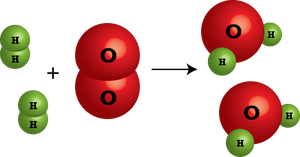
Combustion Reactions
Definition and Characteristics
A combustion reaction is a type of chemical reaction in which a substance reacts with oxygen gas, releasing energy in the form of heat and light, and forming one or more oxygen-containing compounds (often including water and carbon dioxide).
General form: Hydrocarbon + O2 → CO2 + H2O
Combustion reactions are exothermic (release heat).
Example: Combustion of Methane
The balanced equation for the combustion of methane is:
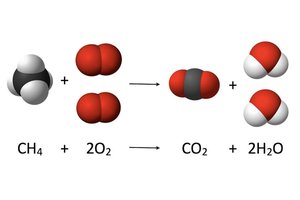
Balancing Combustion Reactions
When balancing combustion reactions, it is important to balance carbon, hydrogen, and then oxygen atoms, in that order. Sometimes, coefficients must be adjusted to ensure all atoms are balanced.
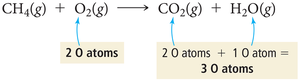
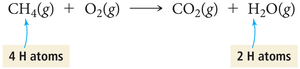
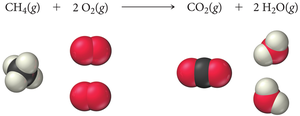
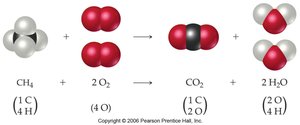
Stoichiometry: Quantitative Relationships in Chemical Reactions
Definition and Importance
Stoichiometry is the area of chemistry that deals with the quantitative relationships between reactants and products in a chemical reaction. It allows chemists to predict the amounts of substances consumed and produced in a given reaction.
Stoichiometric coefficients: Numbers in front of formulas in a balanced equation that indicate the relative number of moles of each substance.
Mole ratios: Used as conversion factors between amounts of reactants and products.
Stoichiometric Calculations
To solve stoichiometry problems, follow these steps:
Write the balanced chemical equation.
Convert given quantities (usually mass) to moles using molar mass.
Use mole ratios from the balanced equation to convert between substances.
Convert moles back to mass if required.
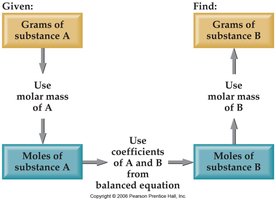

Example: Combustion of Butane
Given the reaction: , calculate the mass of CO2 produced from 1.00 g of butane.
Convert 1.00 g butane to moles using molar mass.
Use the mole ratio (2 mol butane : 8 mol CO2).
Convert moles of CO2 to grams using molar mass.
Limiting Reactant, Theoretical Yield, and Percent Yield
Limiting Reactant
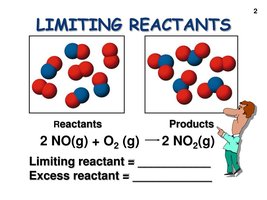
In reactions with more than one reactant, the limiting reactant is the one that is completely consumed first, thus limiting the amount of product formed. The other reactants are in excess.
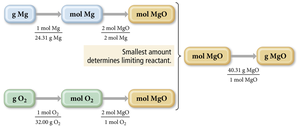
Identify the limiting reactant by comparing the mole ratios of reactants to the coefficients in the balanced equation.
The amount of product formed is determined by the limiting reactant.
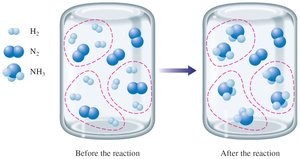
Theoretical Yield
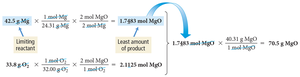
The theoretical yield is the maximum amount of product that can be formed from the limiting reactant, assuming complete reaction and no losses.
Calculated using stoichiometry based on the limiting reactant.
Actual Yield and Percent Yield
The actual yield is the amount of product actually obtained from a reaction. Percent yield is a measure of the efficiency of a reaction, calculated as:
Example: Limiting Reactant Calculation
Given 42.5 g Mg and 33.8 g O2, determine the limiting reactant and theoretical yield of MgO.
Types of Chemical Reactions
Combustion Reactions
As previously discussed, combustion reactions involve a substance reacting with oxygen to produce heat and light, forming CO2 and H2O (for hydrocarbons).
Alkali Metal Reactions
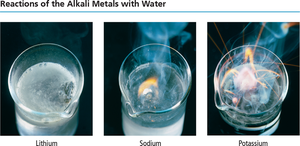
Alkali metals (Group 1) react vigorously with nonmetals and water. With water, they form a hydroxide ion, hydrogen gas, and the corresponding alkali metal ion. The reactivity increases down the group.
Halogen Reactions
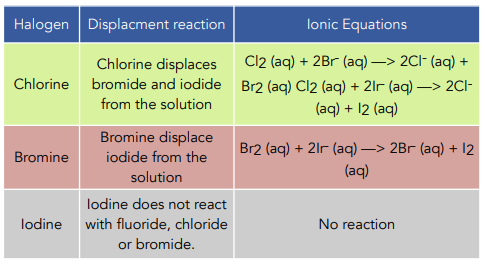
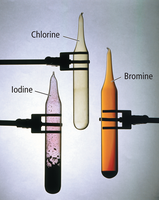
Halogens (Group 17) react with metals to form metal halides, with hydrogen to form hydrogen halides, and with each other to form interhalogen compounds. They can also displace less reactive halogens from their compounds in solution.
Halogen | Displacement reaction | Ionic Equations |
|---|---|---|
Chlorine | Chlorine displaces bromide and iodide from the solution | Cl2(aq) + 2Br-(aq) → 2Cl-(aq) + Br2(aq) Cl2(aq) + 2I-(aq) → 2Cl-(aq) + I2(aq) |
Bromine | Bromine displaces iodide from the solution | Br2(aq) + 2I-(aq) → 2Br-(aq) + I2(aq) |
Iodine | Iodine does not react with fluoride, chloride, or bromide. | No reaction |
Summary Table: Key Stoichiometric Terms
Term | Definition |
|---|---|
Limiting Reactant | The reactant that is completely consumed first and limits the amount of product formed. |
Theoretical Yield | The maximum amount of product that can be formed from the limiting reactant. |
Actual Yield | The amount of product actually obtained from a reaction. |
Percent Yield | The ratio of actual yield to theoretical yield, expressed as a percentage. |
Additional info: This guide covers the core concepts of chemical reactions, stoichiometry, limiting reactants, and the main types of reactions relevant to a general chemistry course. For practice, work through example problems and conceptual questions provided in your textbook or course materials.
