 Back
Chemical Reactions and Chemical Quantities: Study Notes for General Chemistry
Study Guide - Smart Notes
 Tailored notes based on your materials, expanded with key definitions, examples, and context.
Chemical Reactions and Chemical Quantities
Physical and Chemical Changes in Matter
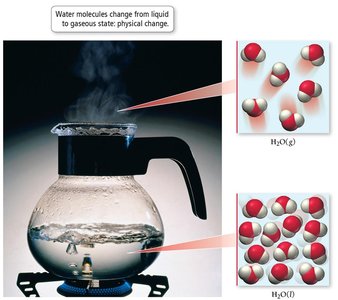
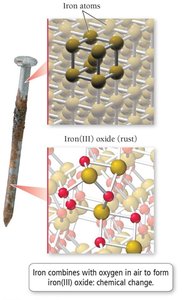
Understanding the distinction between physical and chemical changes is fundamental in chemistry. Physical changes alter only the state or appearance of a substance, without changing its composition, while chemical changes result in the formation of new substances through the rearrangement of atoms.
Physical Change: The identity of the atoms or molecules remains unchanged; only their arrangement or state changes (e.g., melting, boiling).
Chemical Change: The composition of matter is altered, and new substances are formed (e.g., rusting, combustion).
Example: Boiling water is a physical change; rusting iron is a chemical change.
Writing and Balancing Chemical Equations
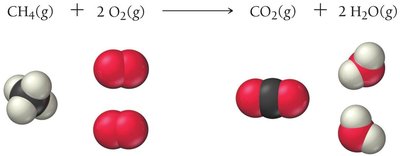
Chemical reactions are represented by chemical equations, which provide information about the reactants, products, their physical states, and the relative quantities involved. Balancing equations ensures the law of conservation of mass is obeyed.
Chemical Equation: A written statement showing reactants and products, their states (g, l, s, aq), and their relative amounts.
Balancing: The number of atoms of each element must be the same on both sides of the equation.
Example:
Conservation of Atoms in Chemical Reactions
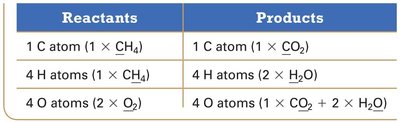
Balanced equations demonstrate that the number of atoms for each element is conserved during a reaction.
Key Point: The number of atoms of each kind must be the same on both sides of the equation.
Reactants | Products |
|---|---|
1 C atom (1 × CH4) | 1 C atom (1 × CO2) |
4 H atoms (1 × CH4) | 4 H atoms (2 × H2O) |
4 O atoms (2 × O2) | 4 O atoms (1 × CO2 + 2 × H2O) |
Stoichiometry: Quantitative Relationships in Chemical Reactions
Stoichiometry is the study of the numerical relationships between reactants and products in a chemical reaction. The coefficients in a balanced equation specify the relative amounts in moles of each substance involved.
Stoichiometric Ratio: The ratio of moles of reactants to products, used as a conversion factor.
Example:
Mole-to-Mole Conversion: Use the stoichiometric ratio to convert between moles of different substances.
Mole-to-Mass and Mass-to-Mass Conversions
Stoichiometric ratios can be used to convert between mass and moles of reactants and products.
Strategy: Mass of A → Moles of A → Stoichiometric ratio → Moles of B → Mass of B
Example: In photosynthesis:
Limiting Reactant and Theoretical Yield
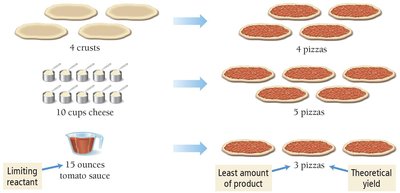
In reactions with multiple reactants, the limiting reactant is the one that is completely consumed first, thus limiting the amount of product formed. The theoretical yield is the maximum amount of product that can be made based on the limiting reactant.
Limiting Reactant: The reactant that produces the smallest amount of product.
Theoretical Yield: The maximum possible amount of product calculated from the limiting reactant.
Example: Pizza analogy: The ingredient that runs out first limits the number of pizzas made.

Percent Yield
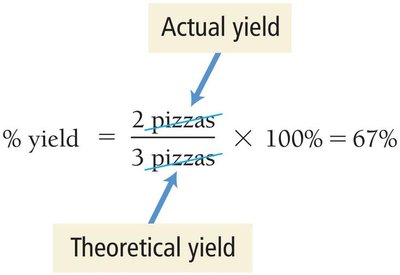
The actual yield is the amount of product actually produced, which is often less than the theoretical yield. Percent yield measures the efficiency of a reaction.
Percent Yield Formula:
Example: If 2 pizzas are made out of a theoretical 3, percent yield is 67%.
Limiting Reactant and Theoretical Yield: Worked Examples
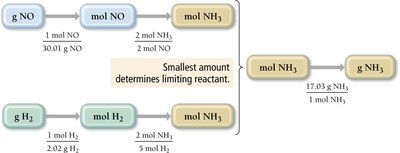
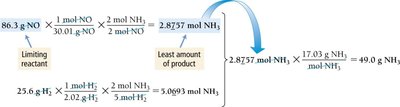
To determine the limiting reactant and theoretical yield, convert the mass of each reactant to moles, use stoichiometric ratios to find the moles of product, and identify the reactant that produces the least product.
Example: Synthesis of ammonia:
Strategy: Convert grams to moles, use stoichiometric ratios, and convert moles of product to grams.
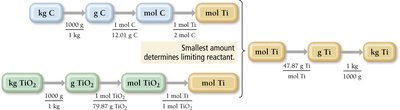
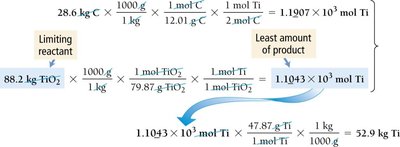
Limiting Reactant and Theoretical Yield: Titanium Extraction Example
When extracting titanium from its oxide, the limiting reactant is determined by comparing the moles of product formed from each reactant. The theoretical yield is calculated from the limiting reactant.
Example:
Strategy: Convert mass to moles, use stoichiometric ratios, and convert moles of product to kilograms.
Excess Reactant Calculation
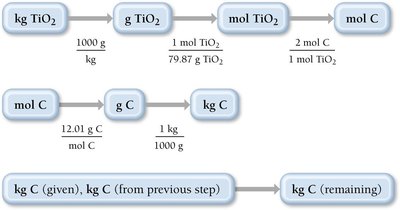
After the reaction has gone to completion, the mass of the excess reactant remaining can be calculated by subtracting the amount consumed from the initial amount.
Strategy: Use the limiting reactant to determine how much of the excess reactant is needed, then subtract from the initial amount.


Combustion Reactions
Combustion reactions involve the reaction of a substance with oxygen to form one or more oxygen-containing compounds, often releasing water and heat.
Example: Combustion of methane:
Alkali Metal Reactions
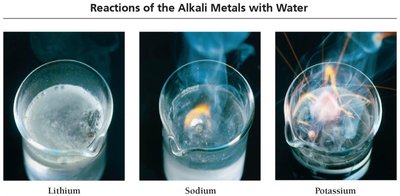
Alkali metals react vigorously with halogens to form ionic compounds and with water to form alkali metal ions, hydroxide ions, and hydrogen gas. These reactions are highly exothermic and can be explosive.
Reaction with Halogens:
Reaction with Water:
Halogen Reactions
Halogens react with metals to form ionic compounds (metal halides) and with hydrogen to form hydrogen halides.
Reaction with Metals:
Reaction with Hydrogen:
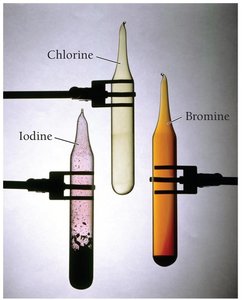
Summary Table: Key Terms and Concepts
Term | Definition |
|---|---|
Physical Change | Change in state or appearance without altering composition |
Chemical Change | Change in composition, forming new substances |
Stoichiometry | Study of quantitative relationships in chemical reactions |
Limiting Reactant | Reactant that is completely consumed, limiting product formation |
Theoretical Yield | Maximum possible amount of product from limiting reactant |
Actual Yield | Amount of product actually produced |
Percent Yield | Efficiency of reaction: (Actual Yield/Theoretical Yield) × 100% |
Additional info: Academic context and examples have been expanded for clarity and completeness.
