 Back
Chemical Reactions and Chemical Quantities: Study Notes
Study Guide - Smart Notes
 Tailored notes based on your materials, expanded with key definitions, examples, and context.
CHAPTER 7: CHEMICAL REACTIONS AND CHEMICAL QUANTITIES
Physical and Chemical Changes
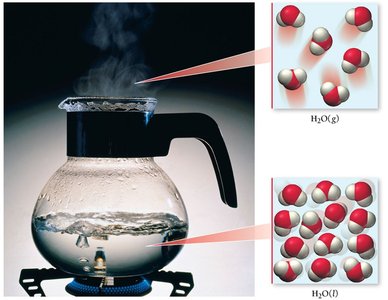
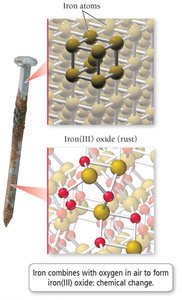
Understanding the distinction between physical and chemical changes is fundamental in chemistry. Physical changes affect only the state or appearance of a substance, while chemical changes alter its composition.
Physical Change: The atoms or molecules retain their identity; only the physical state changes (e.g., melting, boiling).
Chemical Change: The atoms rearrange, resulting in new substances with different properties.
Example: Boiling water is a physical change; rusting iron is a chemical change.
Writing and Balancing Chemical Reactions
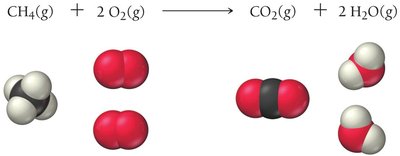
Chemical reactions are written statements that describe the transformation of reactants into products. Balancing equations ensures the law of conservation of mass is obeyed.
Chemical Equation: Shows reactants, products, their physical states, and relative quantities.
Example:
Balancing: Adjust coefficients to ensure equal numbers of each atom on both sides.
Chemical Equations: Information Provided
Chemical equations provide molecular or ionic formulas, physical states, and relative numbers of reactant and product molecules. They are essential for calculating reactant and product masses.
States: (g) for gas, (l) for liquid, (s) for solid, (aq) for aqueous.
Quantities: Coefficients indicate ratios in moles.
Quantities in a Chemical Reaction
Every substance in a chemical reaction is used and made in a set ratio, governed by the law of conservation of mass. Balancing equations is crucial for accurate calculations.
Law of Conservation of Mass: The total mass of reactants equals the total mass of products.
Stoichiometry: The study of numerical relationships between chemical quantities.
Balancing Equations: Practice
Balancing equations involves adjusting coefficients to ensure equal numbers of each atom on both sides. Practice with common reactions:
Reaction Stoichiometry
Stoichiometry uses the coefficients in a balanced equation to relate the amounts (in moles) of reactants and products. This is analogous to making sandwiches: the ratio of ingredients determines how many sandwiches can be made.
Example: If you have 4 pieces of bread, you can make 2 sandwiches (assuming 2 pieces per sandwich).


Mole-to-Mole Conversion
Stoichiometric ratios act as conversion factors between moles of reactants and products. These ratios can be used for reactant-to-product, reactant-to-reactant, or product-to-product conversions.
Example:
Stoichiometric ratios: 2 mol C8H18 : 16 mol CO2, 2 mol C8H18 : 25 mol O2, 16 mol CO2 : 18 mol H2O
Stoichiometry: Practice
Apply stoichiometric ratios to solve problems:
Example: How many moles of CO2 are formed if 22 moles of C8H18 are combusted?
Set up:
Ratio: 2 moles C8H18 : 16 moles CO2
Mole-to-Mass and Mass-to-Mass Conversion
Stoichiometric ratios can be used to convert between mass and moles of reactants and products. The process involves converting mass to moles, using the stoichiometric ratio, and then converting moles to mass.
Strategy: Mass of A → Moles of A → Moles of B → Mass of B
Limiting Reagent and Theoretical Yield
The limiting reagent is the reactant that runs out first, limiting the amount of product formed. Excess reagents are not fully consumed. The theoretical yield is the maximum product that can be made based on the limiting reagent.
Example: In sandwich making, the ingredient that makes the least sandwiches is the limiting reagent.


Percent Yield
Percent yield measures the efficiency of a reaction, comparing the actual yield to the theoretical yield.
Percent Yield Formula:
Example: If a chemist produces 14.3 g of CO2 when the theoretical yield is 15.7 g, percent yield is
Terminology Summary
Limiting Reactant: Completely consumed, limits product formation.
Excess Reactant: Present in greater quantity than needed.
Theoretical Yield: Maximum possible product from limiting reactant.
Actual Yield: Amount of product actually produced.
Percent Yield: Ratio of actual to theoretical yield, expressed as a percentage.
Combustion Reactions
Combustion reactions involve a substance reacting with O2 to form oxygen-containing compounds, often producing CO2, H2O, and heat.
Example:
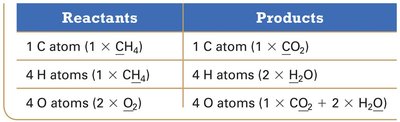
Summary Table: Atom Conservation in Methane Combustion
Reactants | Products |
|---|---|
1 C atom (1 × CH4) | 1 C atom (1 × CO2) |
4 H atoms (1 × CH4) | 4 H atoms (2 × H2O) |
4 O atoms (2 × O2) | 4 O atoms (1 × CO2 + 2 × H2O) |
