 Back
BackChemical Reactions and Chemical Quantities: Study Notes
Study Guide - Smart Notes
 Tailored notes based on your materials, expanded with key definitions, examples, and context.
Chapter 4: Chemical Reactions and Chemical Quantities
Writing Chemical Equations
Chemical equations use formulas and symbols to describe chemical reactions, showing the transformation of reactants into products. The general format is:
Reactants: Substances present at the start of the reaction.
Products: New substances formed as a result of the reaction.
General equation:
Chemical Equation Symbols
→: Produces or yields (separates reactants and products)
Δ: Heat is applied
NR: No reaction
(s): Solid
(l): Liquid
(g): Gas
(aq): Aqueous (dissolved in water)
Example: Acetic acid reacts with baking soda:
Balancing Chemical Equations
Balancing equations ensures the law of conservation of mass is obeyed: the number of atoms of each element must be equal on both sides of the equation. Use coefficients (numbers in front of formulas) to balance equations, never change subscripts.
Balance the most complex formula first.
Balance polyatomic ions as a unit if present on both sides.
Balance elements in compounds without oxygen before those with oxygen.
Leave elements present in more than two formulas for last.
Use the smallest set of whole number coefficients possible.
Example:
Balancing Equations: Examples
Potassium and bromine:
Calcium nitrate and potassium phosphate:
Stoichiometry
Stoichiometry is the numerical relationship between chemical quantities in a balanced equation. It allows prediction of product amounts based on reactant quantities.
Example:
For every 3 moles of H2, 2 moles of NH3 are produced.
For every 1 mole of N2, 2 moles of NH3 are produced.
For every 3 moles of H2, 1 mole of N2 is required.
Mole–Mole Relationships
Stoichiometric coefficients provide conversion factors between reactants and products.
Example Calculation: If you have 3 moles of N2 and excess H2:
Mass–Mass Stoichiometry Problems
To convert between masses of reactants and products, follow these steps:
Convert mass of given substance to moles (using molar mass).
Use the mole ratio from the balanced equation to find moles of unknown.
Convert moles of unknown to mass (using molar mass).
Example:
Limiting Reactant Concept
When reactants are not present in exact stoichiometric amounts, the limiting reactant determines the maximum amount of product formed. The other reactants are in excess.
Calculate the amount of product formed from each reactant.
The reactant that produces the least amount of product is the limiting reactant.
Analogy: Making sandwiches with 5 slices of cheese and 8 slices of bread (1 cheese + 2 bread → 1 sandwich): cheese is the limiting reactant.
Percent Yield
Percent yield compares the actual amount of product obtained to the theoretical maximum (from stoichiometry):
Actual yield: amount of product actually obtained in the lab.
Theoretical yield: calculated maximum amount of product possible.
Percent yield should never exceed 100%.
Combustion Reactions
Combustion reactions involve a substance reacting with oxygen to form one or more oxygen-containing compounds, often releasing heat. Hydrocarbons typically produce CO2 and H2O.
Example: Ethanol combustion:
Alkali Metal Reactions
Alkali metals react vigorously with nonmetals and water. With water, they form dissolved alkali metal ions, hydroxide ions, and hydrogen gas. Reactivity increases down the group.
General reaction with water:
Where M = alkali metal (e.g., Li, Na, K)
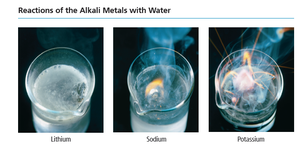
Observation: The reaction becomes more vigorous from lithium to potassium, with potassium producing sparks and flames.
Halogen Reactions
Halogens react with:
Many metals to form metal halides (e.g., NaCl, KBr).
Hydrogen to form hydrogen halides (e.g., HCl, HF).
Other halogens to form interhalogen compounds (e.g., ClF, BrCl).
