 Back
Chemical Reactions & Chemical Quantities: Study Notes for General Chemistry
Study Guide - Smart Notes
 Tailored notes based on your materials, expanded with key definitions, examples, and context.
Chapter 4: Chemical Reactions & Chemical Quantities
What Are Chemical Equations?
Chemical equations are a concise way to represent chemical reactions, showing the transformation of reactants into products. They must be balanced to reflect the conservation of mass and charge.
Formulas of reactants and products: Indicate the substances involved.
States of reactants and products: Denoted by (s) for solid, (l) for liquid, (g) for gas, and (aq) for aqueous.
Stoichiometric coefficients: Numbers in front of formulas showing relative amounts.
Mass and charge balance: Ensures the equation follows the law of conservation of matter.
Quantitative relationships: Used to determine the amounts of substances consumed and produced.
Balanced Chemical Equations & Conservation of Matter
Balanced equations are fundamental in chemistry, ensuring the same number of each atom on both sides of the equation. This reflects the law of conservation of matter, which states that matter cannot be created or destroyed in a chemical reaction.
Law of Conservation of Matter: The total mass remains constant during a reaction.
Stoichiometry: The study of quantitative relationships in chemical reactions, based on balanced equations.
Stoichiometric Coefficients & Physical States
Stoichiometric coefficients specify the relative amounts of reactants and products. Physical states are indicated to clarify the form of each substance.
Example:
Interpretation: 4 moles of iron react with 3 moles of oxygen to produce 2 moles of iron(III) oxide.
Aqueous (aq): Means dissolved in water.
Chemical Equilibrium & Reaction Reversibility
Some reactions reach equilibrium, where the forward and reverse reaction rates are equal. This is indicated by a double arrow in the equation.
Equilibrium: No net change in concentrations of reactants and products.
Example:
Balancing Chemical Equations
Balancing equations ensures the law of conservation of mass is obeyed. Each atom must appear the same number of times on both sides.
Steps: List atoms, adjust coefficients, check balance.
Practice: Balance equations for combustion, decomposition, and precipitation reactions.
Empirical Formula Determination
The empirical formula is the simplest whole-number ratio of atoms in a compound. It can be determined from combustion data.
Example: Combustion of a compound yields CO2 and H2O; use masses to calculate moles of C and H, then deduce O.
Reaction Stoichiometry: Mole-to-Mole Conversions
Stoichiometry uses balanced equations to relate the amounts of reactants and products. The coefficients act as conversion factors between moles.
Example:
Conversion: Use ratios to calculate moles of products from moles of reactants.
Example Calculation:
If 22.0 moles of octane () are burned, how many moles of CO2 are produced?

Limiting Reactant, Theoretical Yield, and Percent Yield
In reactions with multiple reactants, the limiting reactant is the one that is completely consumed first, thus determining the maximum amount of product (theoretical yield). The actual yield is what is obtained experimentally, and percent yield measures efficiency.
Limiting Reactant: Reactant that restricts the amount of product formed.
Excess Reactant: Reactant present in greater quantity than needed.
Theoretical Yield: Maximum possible product from limiting reactant.
Actual Yield: Amount of product actually obtained.
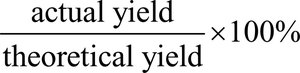
Percent Yield:
Combustion Reactions
Combustion reactions involve a substance reacting with oxygen to produce one or more oxygen-containing compounds, often releasing heat.
Example:
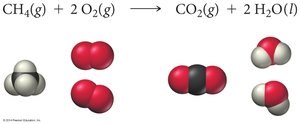
Limiting Reactant Example: Combustion of Methane
To determine the limiting reactant, calculate the amount of product each reactant can produce. The reactant producing the least product is limiting.
Step 1: Calculate CO2 from CH4:
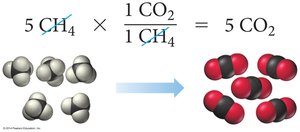
Step 2: Calculate CO2 from O2:
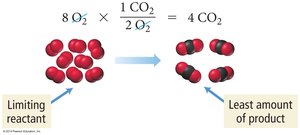
O2 is the limiting reactant; theoretical yield is 4 CO2 molecules.
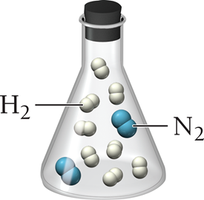
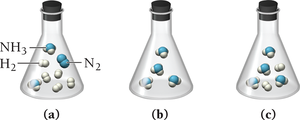
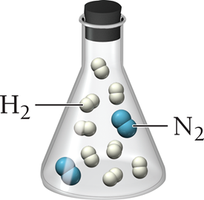
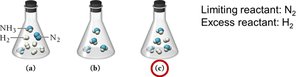
Conceptual Connection: Nitrogen and Hydrogen Reaction
Nitrogen and hydrogen react to form ammonia. The limiting reactant and excess reactant can be visualized using molecular models.
Calculating Limiting Reactant and Yield from Masses
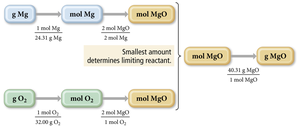
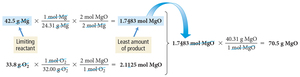
In laboratory settings, reactant quantities are often measured in grams. To determine the limiting reactant and theoretical yield, convert grams to moles, use stoichiometric ratios, and compare possible product amounts.
Step 1: Convert grams to moles.
Step 2: Use stoichiometric ratios to find moles of product.
Step 3: The smallest amount of product determines the limiting reactant.
Combustion and Alkali Metal Reactions
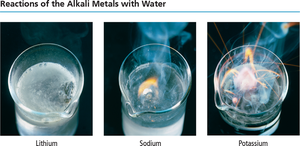
Combustion reactions are exothermic and produce CO2 and H2O. Alkali metals react vigorously with water, forming hydroxide ions and hydrogen gas. The reactivity increases down the group.
Halogen Reactions
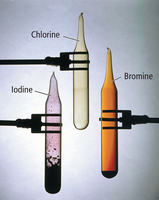
Halogens react with metals to form metal halides, with hydrogen to form hydrogen halides, and with each other to form interhalogen compounds.
Summary Table: Key Stoichiometric Concepts
Concept | Definition | Example |
|---|---|---|
Balanced Equation | Same number of each atom on both sides | |
Limiting Reactant | Reactant that determines maximum product | O2 in methane combustion |
Theoretical Yield | Maximum product from limiting reactant | 4 CO2 molecules |
Percent Yield | Efficiency of reaction |
