 Back
Back4 PP
Study Guide - Smart Notes
 Tailored notes based on your materials, expanded with key definitions, examples, and context.
Chapter 4: Chemical Reactions and Chemical Quantities
Writing and Balancing Chemical Equations
Chemical reactions are represented by chemical equations, which show the transformation of reactants into products. Balancing these equations is essential to obey the Law of Conservation of Mass, ensuring that the number of atoms for each element is the same on both sides of the equation.
Reactants are the starting substances; products are the substances formed.
Coefficients indicate the relative number of molecules or moles involved.
State symbols: (g) = gas, (l) = liquid, (s) = solid, (aq) = aqueous (dissolved in water).
Balance atoms in complex substances first; balance free elements last.
If fractional coefficients are used, multiply all coefficients by the denominator to obtain whole numbers.
Example: Combustion of methane:
Unbalanced: CH4(g) + O2(g) → CO2(g) + H2O(g)
Balanced: CH4(g) + 2 O2(g) → CO2(g) + 2 H2O(g)

Practice: Balancing Equations
Balancing equations often involves adjusting coefficients to ensure equal numbers of each atom on both sides. Polyatomic ions are counted as units if they remain unchanged during the reaction.
Example: Aluminum reacts with oxygen: 4 Al(s) + 3 O2(g) → 2 Al2O3(s)
Example: Aluminum reacts with acetic acid: 2 Al(s) + 6 HC2H3O2(aq) → 2 Al(C2H3O2)3(aq) + 3 H2(g)
Stoichiometry: Quantities in Chemical Reactions
Stoichiometry is the study of the numerical relationships between chemical quantities in a reaction. The coefficients in a balanced equation specify the relative amounts in moles of each substance involved.
Example: 2 C8H18(l) + 25 O2(g) → 16 CO2(g) + 18 H2O(g)
Stoichiometric ratios: 2 mol C8H18 : 25 mol O2 : 16 mol CO2 : 18 mol H2O
Mole-to-Mole Conversions
The ratio of coefficients acts as a conversion factor between the amount in moles of reactants and products. This is analogous to recipes, where the ratio of ingredients determines the amount of product.
Example: If 22.0 moles of C8H18 are burned, how many moles of CO2 are produced?
Use the stoichiometric ratio:
Calculation:

Mass-to-Mass Conversions
To relate masses of reactants and products, use molar masses and stoichiometric ratios. The process involves converting mass to moles, using the balanced equation to convert between substances, and then converting moles back to mass.
Step 1: Convert mass of reactant to moles using molar mass.
Step 2: Use stoichiometric ratio to find moles of product.
Step 3: Convert moles of product to mass using molar mass.


Limiting Reactant, Theoretical Yield, and Percent Yield
In reactions with multiple reactants, the limiting reactant is the one that is completely consumed first, thus determining the maximum amount of product (theoretical yield). The actual yield is the amount of product actually obtained, and percent yield measures the efficiency of the reaction.
Limiting Reactant: The reactant that produces the smallest amount of product.
Theoretical Yield: The maximum amount of product that can be made from the limiting reactant.
Actual Yield: The amount of product actually produced.
Percent Yield:
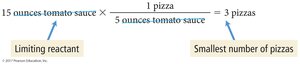
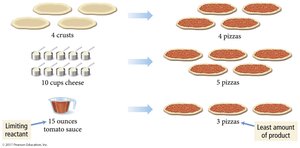
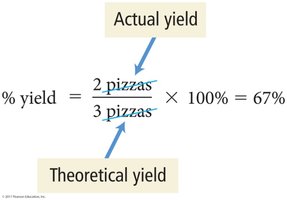
Calculating Limiting Reactant, Theoretical Yield, and Percent Yield
To determine the limiting reactant and theoretical yield, calculate the amount of product that can be formed from each reactant. The reactant that produces the least amount of product is the limiting reactant.
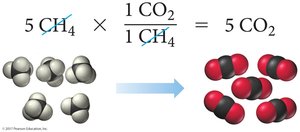
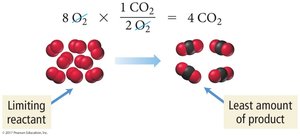
Example: Combustion of methane: CH4(g) + 2 O2(g) → CO2(g) + 2 H2O(g)
If 5 molecules of CH4 and 8 molecules of O2 are available, calculate CO2 produced from each:
From CH4:
From O2:
O2 is the limiting reactant; theoretical yield is 4 CO2 molecules.
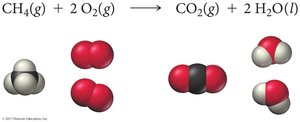


Limiting Reactant and Yield from Reactant Masses
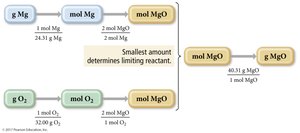
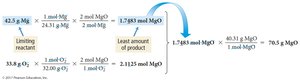
When reactant quantities are given in grams, convert to moles, use stoichiometric ratios, and determine which reactant produces the least amount of product.
Example: 42.5 g Mg and 33.8 g O2 react: 2 Mg(s) + O2(g) → 2 MgO(s)
Convert grams to moles, use stoichiometric ratios, and identify limiting reactant.
Practice: Percent Yield Calculation
Percent yield is calculated by comparing the actual yield to the theoretical yield.
Formula:
Example: If 4.61 g of N2 are made from a reaction with a theoretical yield of 5.00 g, percent yield is

Summary Table: Key Stoichiometric Concepts
Concept | Definition | Formula/Example |
|---|---|---|
Balanced Equation | Equal number of atoms for each element on both sides | CH4 + 2 O2 → CO2 + 2 H2O |
Stoichiometric Ratio | Ratio of coefficients in balanced equation | 2 C8H18 : 16 CO2 |
Limiting Reactant | Reactant that produces the least product | O2 in CH4 combustion |
Theoretical Yield | Maximum product from limiting reactant | 4 CO2 molecules |
Percent Yield | Efficiency of reaction |
Additional info: The pizza analogy is used throughout to help visualize limiting reactant and yield concepts. Polyatomic ions are treated as units when balancing equations if they remain unchanged. The study notes cover all major aspects of Chapter 4, including writing and balancing equations, stoichiometry, limiting reactant, theoretical yield, and percent yield, with relevant examples and diagrams.
