 Back
BackChemical Reactions and Stoichiometry: Study Notes
Study Guide - Smart Notes
 Tailored notes based on your materials, expanded with key definitions, examples, and context.
Chemical Reactions and Stoichiometry
Writing and Balancing Chemical Reactions
Chemical equations represent the transformation of reactants into products. Writing and balancing these equations is fundamental to understanding chemical processes.
Identify reactants and products: Place reactants on the left and products on the right of the arrow.
Assign correct chemical formulas and states: Use (s) for solid, (l) for liquid, (g) for gas, and (aq) for aqueous.
Balance the equation: Adjust coefficients to ensure the same number of each atom on both sides. Balance hydrogen and oxygen last, and treat polyatomic ions as units if they appear unchanged on both sides.
Check your work: Count atoms of each element on both sides to confirm balance.
Example: Balancing the synthesis of ammonia:
Unbalanced: N2(g) + H2(g) → NH3(g)
Balanced: N2(g) + 3H2(g) → 2NH3(g)
Classifying Chemical Reactions
Chemical reactions can be classified into several types based on their general patterns:
Combination (Synthesis): Two or more substances combine to form one product. Generic: A + B → C
Decomposition: A single compound breaks down into two or more simpler substances. Generic: C → A + B
Combustion: A hydrocarbon reacts with oxygen to produce carbon dioxide and water. Generic: hydrocarbon + O2(g) → CO2(g) + H2O(l)
Example: Combustion of methane: CH4(g) + 2O2(g) → CO2(g) + 2H2O(l)
Calculating Formula Weights and Molecular Weights (Molar Mass)
The formula weight (for ionic compounds) and molecular weight (for molecular compounds) are calculated by summing the atomic masses of all atoms in the formula.
Count the number of each atom in the formula.
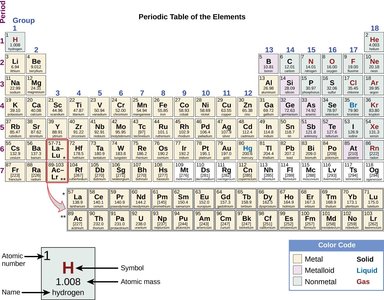
Multiply by the atomic mass (from the periodic table).
Sum the total mass.
Example: For NaCl: Na (22.99 amu) + Cl (35.45 amu) = 58.44 amu
Example: For Ca(OH)2: Ca (40.08 amu) + 2 × [O (16.00 amu) + H (1.008 amu)] = 74.10 amu
Example: For N2O4: 2 × N (14.01 amu) + 4 × O (16.00 amu) = 92.02 amu
Avogadro’s Number and the Mole Concept
Avogadro’s number (6.022 × 10²³) is the number of particles (atoms, molecules, or formula units) in one mole of a substance. It allows conversion between microscopic (particles) and macroscopic (grams, moles) scales.
One mole of any substance contains 6.022 × 10²³ particles.
Use the molar mass (g/mol) to convert between grams and moles.
Example: 2.3 g NaCl × (1 mol / 58.44 g) × (6.022 × 10²³ units / 1 mol) = number of formula units
Empirical and Molecular Formulas
The empirical formula gives the simplest whole-number ratio of elements in a compound. The molecular formula gives the actual number of atoms of each element in a molecule.
To find the empirical formula from percent composition:
Assume a 100 g sample (percentages become grams).
Convert grams to moles using atomic masses.
Divide by the smallest number of moles to get ratios.
Assign subscripts to write the empirical formula.
To find the molecular formula:
Calculate the empirical formula mass.
Divide the molecular mass by the empirical formula mass to get a whole number.
Multiply the empirical formula subscripts by this number.
Example: Empirical formula for ascorbic acid (C3H4O3), molecular mass = 176.0 amu, empirical mass = 88.0 amu. Molecular formula: C6H8O6.
Percent Composition by Mass
The percent by mass of an element in a compound is calculated as:
Example: Oxygen in KMnO4: (4 × 16.00 g) / (39.10 + 54.94 + 4 × 16.00) × 100%
Stoichiometry: Mole and Mass Relationships
Stoichiometry involves using balanced chemical equations to relate quantities of reactants and products.
Convert grams to moles: Use molar mass.
Use mole ratios: From the balanced equation, relate moles of one substance to another.
Convert moles to grams: Use molar mass.
Example: How many grams of NH3 are produced from 1.00 g N2?
Convert grams N2 to moles N2:
Use mole ratio:
Convert moles NH3 to grams:
Limiting Reactant and Percent Yield
The limiting reactant is the reactant that is completely consumed first, limiting the amount of product formed. Percent yield compares the actual yield to the theoretical yield.
Identify the limiting reactant by comparing the mole ratios of reactants used and required.
Calculate the maximum amount of product (theoretical yield) from the limiting reactant.
Percent yield:
Example: If 2.5 g NH3 is made but the theoretical yield is 3.0 g, percent yield = (2.5/3.0) × 100% = 83.3%
Important Constants and Equations
Avogadro’s number: particles/mol
Molar mass: (from periodic table)
Percent by mass:
Additional info:
For all calculations, always use the periodic table for atomic masses.
Dimensional analysis is a systematic approach to unit conversions in stoichiometry.
