 Back
BackChemical Reactions and Thermodynamics: Progress, Equilibrium, and Spontaneity
Study Guide - Smart Notes
 Tailored notes based on your materials, expanded with key definitions, examples, and context.
Chemical Reactions
Definition and Basic Concepts
Chemical reactions are fundamental processes in chemistry where substances (reactants) are transformed into new substances (products). These transformations involve the rearrangement of atoms, but atoms themselves are neither created nor destroyed, in accordance with the law of conservation of mass.
Chemical Reaction: A process where substances change into new substances. Example:
Reactants: The starting materials in a reaction.
Products: The substances formed as a result of the reaction.
Example: Neutralization reaction:

Atoms are rearranged, but not created or destroyed.

Examples of Chemical Reactions in Daily Life
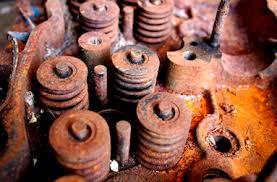
Rusting of iron: Oxidation process where iron reacts with oxygen to form iron oxide.
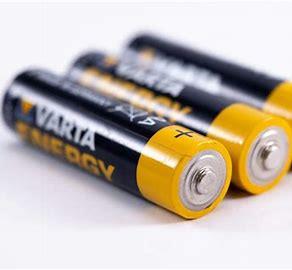
Batteries: Electrochemical reactions generate electrical energy.
Aging of food: Chemical changes lead to spoilage.

Chemical vs. Physical Transformations
Distinguishing Chemical and Physical Changes
It is important to differentiate between chemical and physical transformations:
Chemical Transformation: New substances are formed, and the chemical composition changes.
Physical Transformation: No new substance is formed; only physical properties change (e.g., melting ice).
Example: (melting ice)

Progress of Chemical Reactions
Stoichiometry and Reaction Extent
During a chemical reaction, the progress is tracked by the change in the number of moles of reactants and products, governed by stoichiometric coefficients.
Stoichiometric Coefficients: Numbers in a balanced equation indicating the proportion of each species.
Mass Conservation: Total mass of reactants equals total mass of products.
Balanced Equation Example:
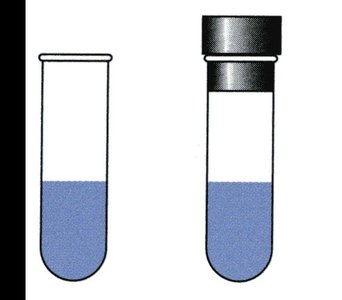
Closed vs. Open Systems
Mass conservation applies strictly to closed systems, where no matter is exchanged with the surroundings. In open systems, mass may appear to change due to exchange.
Reaction Extent (ξ)
The reaction extent (ξ) quantifies the progress of a reaction in terms of moles:
Example: Ammonia synthesis:
Limiting Reagent and Maximum Reaction Extent
The maximum progress (ξmax) is determined by the depletion of the limiting reagent.
Limiting Reagent: The reactant that is completely consumed first, limiting the amount of product formed.
Reaction Yield (τ):
Thermodynamics of Chemical Reactions
First Law of Thermodynamics
The first law states that energy cannot be created or destroyed. The change in internal energy (ΔU) is given by:
q: Heat absorbed (+) or released (−)
w: Work done on (+) or by (−) the system
Types of Work
Mechanical Work: (e.g., gas expansion)
Electrical Work: (e.g., batteries, fuel cells)
Enthalpy (ΔH)
Enthalpy is the heat content at constant pressure. The enthalpy change is:
Exothermic: (heat released)
Endothermic: (heat absorbed)
Entropy (S)
Entropy measures the disorder of a system:
High entropy: More disorder
Low entropy: More order
Second Law: Total entropy of the universe increases for spontaneous processes:
Gibbs Free Energy (G)
Gibbs free energy is a criterion for spontaneity at constant pressure and temperature:
Spontaneous:
Non-spontaneous:

Chemical Equilibrium
Dynamic Equilibrium
At equilibrium, the rates of the forward and reverse reactions are equal, and the composition of the mixture remains constant.
Equilibrium System: Macroscopic properties do not change over time.
Dynamic Equilibrium: Both forward and reverse reactions occur simultaneously.
Equilibrium Constant (KT)
The equilibrium constant relates the concentrations (or activities) of products and reactants:
Activity (a): Effective concentration or pressure, dimensionless.
Standard Gibbs Free Energy:
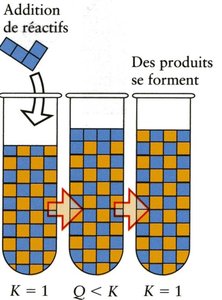
Reaction Quotient (Q) and Direction of Reaction
Q < K: Reaction proceeds forward.
Q = K: System is at equilibrium.
Q > K: Reaction proceeds in reverse.
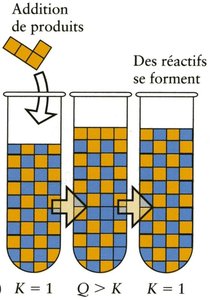
Le Châtelier’s Principle
When a system at equilibrium is disturbed, it shifts in a direction that counteracts the disturbance.
Change in composition: System shifts to restore equilibrium.
Change in temperature: System shifts toward endothermic or exothermic direction depending on the disturbance.
Van't Hoff Relation
The effect of temperature on the equilibrium constant is given by:
Summary Table: Key Thermodynamic Quantities
Quantity | Definition | Criterion for Spontaneity |
|---|---|---|
ΔH | Enthalpy change | ΔH < 0: exothermic |
ΔS | Entropy change | ΔS > 0: disorder increases |
ΔG | Gibbs free energy change | ΔG < 0: spontaneous |
Applications and Examples
Combustion of methane: (ΔH < 0, ΔS > 0, spontaneous)
Dissolving ammonium nitrate: (ΔH > 0, ΔS > 0, spontaneous)
Conclusion
Chemical reactions are governed by principles of mass conservation, stoichiometry, and thermodynamics. Understanding reaction progress, equilibrium, and spontaneity is essential for predicting and controlling chemical processes in both laboratory and real-world contexts.
