 Back
Chemical Reactions: Equations, Classification, and Aqueous Processes
Study Guide - Smart Notes
 Tailored notes based on your materials, expanded with key definitions, examples, and context.
Chapter 5: Chemical Reactions
5.1 Chemical Equations
Chemical equations are symbolic representations of chemical and physical changes. They provide information about the identities and quantities of reactants and products, and must obey the law of conservation of mass.
Reactants: Substances present before the reaction (left side of the equation).
Products: Substances formed as a result of the reaction (right side of the equation).
Law of Conservation of Mass: Atoms cannot be created or destroyed in a chemical reaction; the number of atoms of each element must be the same on both sides of the equation.
Balancing Equations: Adjust coefficients (numbers in front of compounds) to ensure the same number of each atom on both sides. Subscripts (numbers within formulas) indicate the number of atoms in a molecule and must not be changed when balancing.
State Symbols: Indicate the physical state of each substance: (s) solid, (l) liquid, (g) gas, (aq) aqueous (dissolved in water).
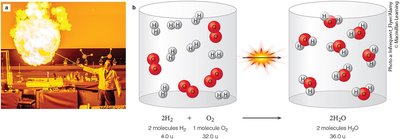
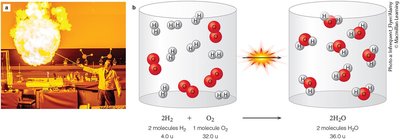
Example: The reaction of hydrogen and oxygen to form water is represented as:
This equation is balanced: 4 H atoms and 2 O atoms on both sides.
5.2 Classifying Chemical Reactions
Chemical reactions can be classified based on the nature of the reactants and products. Understanding these types helps predict the outcomes of reactions.
Combination (Synthesis) Reaction: Two or more reactants form one product. General:
Decomposition Reaction: One reactant breaks down into two or more products. General:
Single Displacement (Replacement) Reaction: An element replaces another in a compound. General:
Double Displacement (Metathesis) Reaction: Exchange of ions between two compounds. General:
Precipitation Reaction: A double displacement reaction where an insoluble solid (precipitate) forms.
Acid-Base Neutralization: An acid reacts with a base to form a salt and water.
Combustion Reaction: A substance reacts with oxygen, releasing energy (often as heat and light), typically forming and if the reactant is a hydrocarbon.
Example: Combustion of methane:
5.2.1 Redox Reactions
Some reactions involve the transfer of electrons between species, known as oxidation-reduction (redox) reactions.
Oxidation: Loss of electrons (increase in oxidation state).
Reduction: Gain of electrons (decrease in oxidation state).
OIL RIG: "Oxidation Is Loss, Reduction Is Gain" (of electrons).
Example: Na is oxidized, Cl is reduced.
5.3 Describing Aqueous Reactions
Many reactions occur in aqueous solution, where ionic compounds may dissolve and dissociate into ions.
Dissolve: The compound enters the solution phase.
Dissociate: The compound separates into its constituent ions.
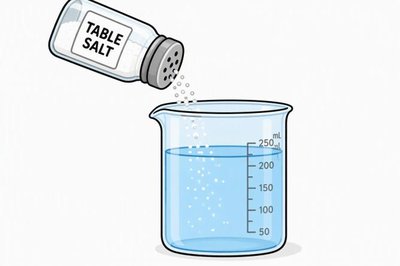
Example: Sodium chloride dissolves and dissociates in water:
5.3.1 Writing Equations for Aqueous Reactions
Molecular Equation: Shows all compounds as neutral species.
Complete Ionic Equation: Shows all strong electrolytes as ions.
Net Ionic Equation: Shows only the species that actually change during the reaction (omits spectator ions).
Example: Precipitation of lead(II) iodide:
Molecular:
Complete Ionic:
Net Ionic:
5.4 Solubility Rules and Precipitation Reactions
Solubility rules help predict whether an ionic compound will dissolve in water. If a product of a reaction is insoluble, it will precipitate out as a solid.
Common Soluble Ions: Nitrate (), acetate (), alkali metal ions, ammonium ().
Common Insoluble Ions: Carbonate (), phosphate (), sulfide (), except with alkali metals or ammonium.
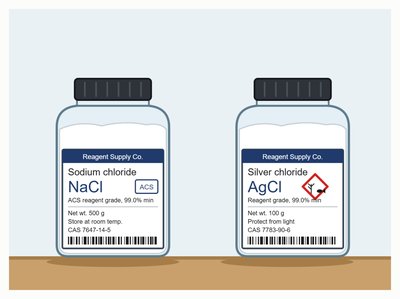
Example: Sodium chloride is soluble in water, while silver chloride is not.
5.5 Acid-Base Neutralization Reactions
Acid-base neutralization is a type of double displacement reaction where an acid reacts with a base to form a salt and water.
Acid: Donates in solution (e.g., , ).
Base: Donates in solution (e.g., , ).
General Equation:
Example:
Net Ionic:
Summary Table: Types of Chemical Reactions
Type | General Form | Example |
|---|---|---|
Combination | ||
Decomposition | ||
Single Displacement | ||
Double Displacement | ||
Combustion | ||
Acid-Base |
