 Back
BackChemical Reactions, Stoichiometry, Solutions, and Gases: Core Concepts in General Chemistry
Study Guide - Smart Notes
 Tailored notes based on your materials, expanded with key definitions, examples, and context.
Chemical Reactions and Chemical Quantities
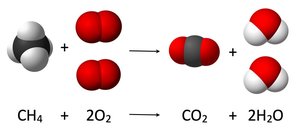
Balancing Chemical Equations
Chemical reactions must be balanced to obey the law of conservation of mass, meaning the number of each type of atom is the same on both sides of the equation. This is achieved by adjusting coefficients in front of chemical formulas.
Reactants are substances present before the reaction; products are substances formed by the reaction.
Coefficients indicate the number of molecules or moles involved.
Example:

Stoichiometry: Mole and Mass Relationships
Stoichiometry involves calculating the quantities of reactants and products in a chemical reaction using balanced equations.
Coefficients in a balanced equation represent both the number of molecules and the number of moles.
Conversions often follow: mass → moles → moles (of another substance) → mass.
Limiting reagent: The reactant that is completely consumed, limiting the amount of product formed.
Theoretical yield: Maximum amount of product possible from given reactants.
Actual yield: Amount of product actually obtained from an experiment.
Percent yield:
Introduction to Solutions and Aqueous Reactions
Solutions: Solute and Solvent
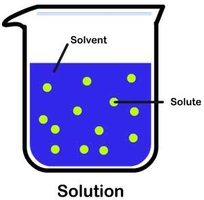
A solution is a homogeneous mixture of a solute dissolved in a solvent. In aqueous solutions, water is the solvent.
Solute: Substance being dissolved (present in lesser amount).
Solvent: Substance doing the dissolving (present in greater amount).
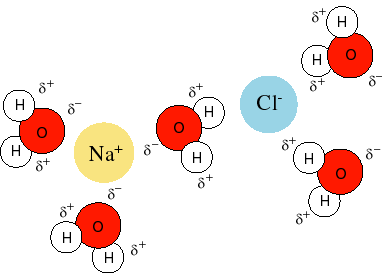
Ions dissociate in water, allowing for electrical conductivity in electrolyte solutions.
Dilute, Concentrated, and Saturated Solutions
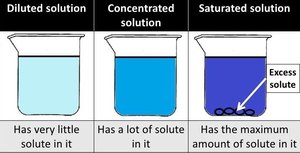
The concentration of a solution describes the amount of solute in a given volume of solvent.
Dilute solution: Contains a small amount of solute.
Concentrated solution: Contains a large amount of solute.
Saturated solution: Contains the maximum amount of solute that can dissolve at a given temperature; excess solute remains undissolved.
Preparing Molar Solutions
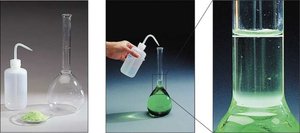
Molarity (M) is the number of moles of solute per liter of solution. Preparing a molar solution involves dissolving a known amount of solute and diluting to a specific volume.
Molarity (M):
To prepare a 1 M solution, dissolve 1 mole of solute in enough solvent to make 1 liter of solution.
Solution Dilution
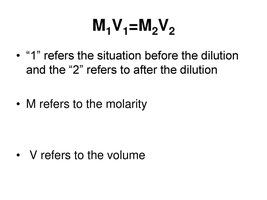
To dilute a solution, use the equation , where the subscripts 1 and 2 refer to the initial and final conditions, respectively.
This equation allows calculation of the volume or concentration needed to achieve a desired dilution.
Electrolytes and Nonelectrolytes
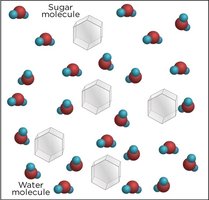
Electrolytes are substances that dissociate into ions in water and conduct electricity. Nonelectrolytes do not produce ions and do not conduct electricity.
Strong electrolytes: Completely dissociate (e.g., NaCl, HCl).
Weak electrolytes: Partially dissociate (e.g., acetic acid).
Nonelectrolytes: Do not dissociate (e.g., sugar).
Strong and Weak Acids and Bases
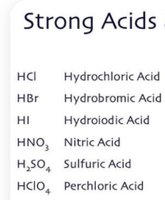
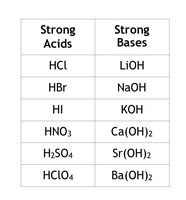
Strong acids and bases dissociate completely in water, while weak acids and bases only partially dissociate.
Strong acids: HCl, HBr, HI, HNO3, H2SO4, HClO4
Strong bases: NaOH, KOH, Ca(OH)2, Ba(OH)2
Weak acids: CH3COOH, HF
Weak bases: NH3
Conjugate Acid-Base Pairs
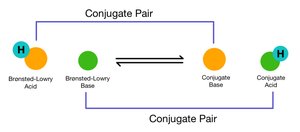
Every acid-base reaction involves the transfer of a proton (H+). The acid donates a proton and becomes its conjugate base; the base accepts a proton and becomes its conjugate acid.
Example:
Types of Chemical Reactions
Classification of Reactions
Chemical reactions can be classified into several types based on the rearrangement of atoms and ions:
Synthesis: Two or more substances combine to form one product.
Decomposition: One substance breaks down into two or more products.
Single Displacement: One element replaces another in a compound.
Double Displacement: Exchange of ions between two compounds.
Precipitation: Formation of an insoluble solid from two aqueous solutions.
Solubility Rules
Solubility rules help predict whether an ionic compound will dissolve in water or form a precipitate.
Most salts of Li+, Na+, K+, NH4+, NO3-, and CH3COO- are soluble.
Chlorides, bromides, and iodides are soluble except with Ag+, Hg22+, or Pb2+.
Sulfates are soluble except with Ca2+, Ba2+, Sr2+, Ag+, or Pb2+.
Most carbonates, phosphates, sulfides, and hydroxides are insoluble except with alkali metals and NH4+.
Net Ionic Equations
Net ionic equations show only the species that actually participate in the reaction, omitting spectator ions.
Write the full ionic equation, then remove ions that appear unchanged on both sides.
Example:
Acid-Base Reactions and Titrations
Acid-Base Neutralization
Acid-base reactions produce water and a salt. The equivalence point is reached when moles of H+ equal moles of OH-.
Polyprotic acids can donate more than one proton (e.g., H2SO4).
Titration
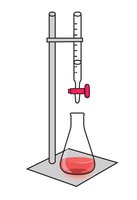
Titration is a laboratory technique to determine the concentration of an unknown solution by reacting it with a solution of known concentration.
Indicator is used to detect the equivalence point, often by a color change.
Gas Laws and Properties of Gases
Atmospheric Pressure and the Barometer
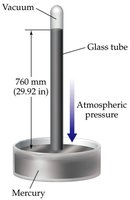
Atmospheric pressure is measured using a barometer. Standard atmospheric pressure at sea level is 760 mm Hg (1 atm).
Simple Gas Laws
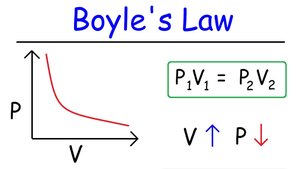
Boyle's Law: (at constant T and n) – Pressure and volume are inversely related.
Charles's Law: (at constant P and n) – Volume and temperature are directly related.
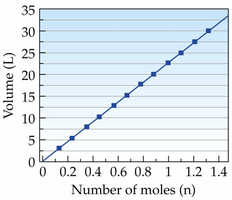
Avogadro's Law: (at constant P and T) – Volume and moles are directly related.
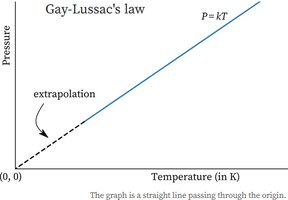
Gay-Lussac's Law: (at constant V and n) – Pressure and temperature are directly related.
Combined Gas Law and Ideal Gas Law
The combined gas law relates pressure, volume, and temperature for a fixed amount of gas:
Combined Gas Law:
Ideal Gas Law: , where R = 0.08206 L·atm/(mol·K)
Standard Temperature and Pressure (STP)
At STP (0°C, 1 atm), 1 mole of any ideal gas occupies 22.4 L.
Gas Density and Partial Pressures
Gas density at STP:
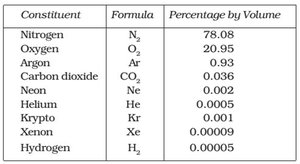
Dalton's Law: Total pressure of a gas mixture is the sum of the partial pressures of each component.
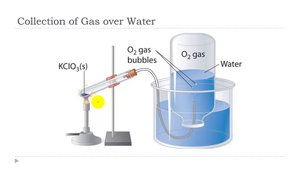
Collecting Gases Over Water
When collecting gases over water, the total pressure includes both the gas and water vapor. Subtract the vapor pressure of water to find the pressure of the collected gas.
Oxidation-Reduction (Redox) Reactions
Redox Concepts and Oxidation States
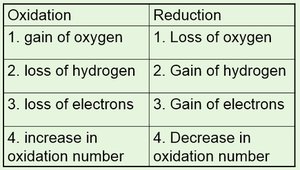
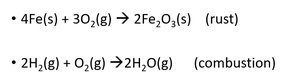
Redox reactions involve the transfer of electrons. Oxidation is the loss of electrons; reduction is the gain of electrons. Oxidation states help track electron transfer.
Oxidation: Increase in oxidation state, loss of electrons.
Reduction: Decrease in oxidation state, gain of electrons.
Rules for assigning oxidation states help identify which species are oxidized or reduced.
Identifying Redox Agents
The substance that is reduced is the oxidizing agent; the substance that is oxidized is the reducing agent.
