 Back
BackChemical Thermodynamics: Spontaneity, Entropy, and Free Energy
Study Guide - Smart Notes
 Tailored notes based on your materials, expanded with key definitions, examples, and context.
Chemical Thermodynamics
Introduction to Thermodynamics
Chemical thermodynamics is the study of energy changes and transfers that occur during chemical reactions and physical transformations. It provides the framework for understanding whether reactions are spontaneous and how energy is distributed between a system and its surroundings.
Energy Conservation: The First Law of Thermodynamics states that energy cannot be created or destroyed; it can only be transferred or converted from one form to another.
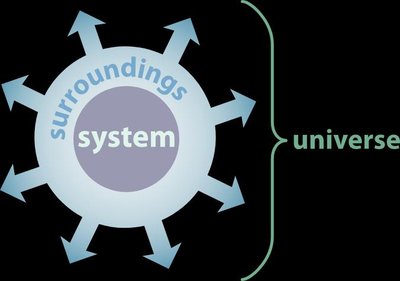
System and Surroundings: The universe is divided into the system (the part under study) and the surroundings (everything else).
Measurement: Energy changes are measured in terms of enthalpy, entropy, and free energy.
Classes of Energy: Enthalpy, Entropy, and Free Energy
Energy in chemical systems is categorized into enthalpy (heat content), entropy (randomness), and free energy (usable energy for work). These concepts are central to predicting reaction spontaneity.
Enthalpy (H): The heat absorbed or released at constant pressure, related to atomic motion.
Entropy (S): A measure of disorder or randomness in a system; higher entropy means more possible arrangements of particles.
Free Energy (G): Combines enthalpy and entropy to determine the spontaneity of a process.
Spontaneous Processes
Definition and Characteristics
A spontaneous process occurs without external intervention. Spontaneity does not imply speed; some spontaneous reactions are slow. Nonspontaneous processes require energy input.
Directionality: If a process is spontaneous in one direction, it is nonspontaneous in the reverse.
Examples: Dropping an egg is spontaneous; reassembling it is not.

Experimental Factors Affecting Spontaneity
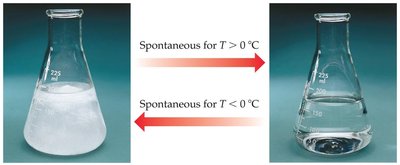
Temperature and pressure can influence whether a process is spontaneous. For example, ice melts spontaneously above 0°C but freezes below 0°C.
Temperature: Changes in temperature can shift the spontaneity of a process.
Pressure: Can affect gas-phase reactions and their spontaneity.
Reversible and Irreversible Processes
Definitions
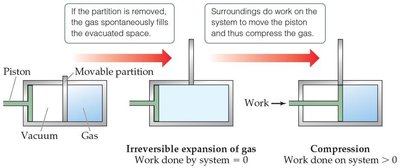
Processes can be classified as reversible or irreversible based on whether the system and surroundings can be restored to their original states.
Reversible Process: Can be reversed by infinitesimal changes, maximizing work done by the system.
Irreversible Process: Cannot be exactly reversed; all real spontaneous processes are irreversible.
Entropy and the Laws of Thermodynamics
Second Law of Thermodynamics
The Second Law states that the entropy of the universe increases in any spontaneous process. Entropy is a state function, meaning its change depends only on initial and final states.
Entropy Change:
Heat Transfer: For a reversible process at constant temperature,
Universe Entropy:
Spontaneous Process:
Third Law of Thermodynamics
The Third Law states that the entropy of a pure crystalline substance at absolute zero is zero, as there is only one microstate.
Boltzmann Equation: where is the number of microstates.
At 0 K: , so
Microstates and Statistical Thermodynamics
Microstates and Entropy
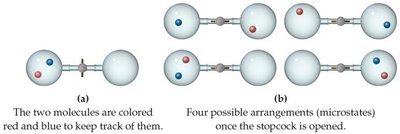
Microstates are specific arrangements of molecules in a system. The greater the number of microstates, the higher the entropy.
Boltzmann Equation:
Entropy Change:
Molecular Motion and Energy
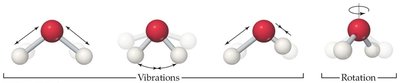
Molecules have several types of motion, each contributing to the number of microstates and thus to entropy.
Translational: Movement from one place to another.
Vibrational: Periodic motion of atoms within a molecule.
Rotational: Rotation about an axis.
Factors Affecting Entropy
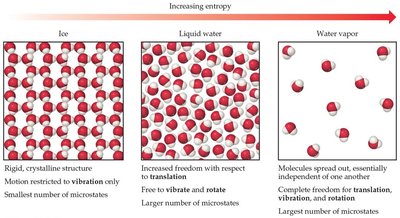
Entropy increases with volume, temperature, and the number of atoms/molecules. Physical state also affects entropy: gases have higher entropy than liquids, which have higher entropy than solids.
Volume: More possible positions for molecules.
Temperature: Greater distribution of molecular speeds.
Number of Atoms: More degrees of freedom.
Physical State:
Entropy Changes in Chemical Reactions
Calculating Entropy Changes
Entropy changes for reactions can be calculated using standard molar entropies () and stoichiometric coefficients.
Formula:
Standard Molar Entropy: Values depend on phase, molar mass, and number of atoms.
Substance | Standard Molar Entropy (J/mol·K) |
|---|---|
H2 (g) | 130.6 |
N2 (g) | 191.5 |
O2 (g) | 205.0 |
H2O (g) | 188.8 |
NH3 (g) | 192.5 |
CH3OH (g) | 237.6 |
C6H6 (g) | 269.2 |
H2O (l) | 69.9 |
CH3OH (l) | 126.8 |
C6H6 (l) | 172.8 |
Li (s) | 29.1 |
Na (s) | 51.4 |
K (s) | 64.7 |
Fe (s) | 27.23 |
FeCl3 (s) | 142.3 |
NaCl (s) | 72.3 |
Entropy Changes in Surroundings
Heat Flow and Entropy
Heat flow into or out of the system changes the entropy of the surroundings. For an isothermal process, the entropy change is:
Formula:
At constant pressure:
Universe Entropy:
Gibbs Free Energy
Definition and Derivation
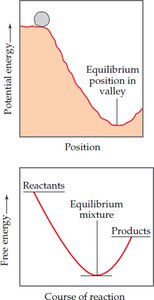
Gibbs Free Energy () combines enthalpy and entropy to predict spontaneity. The change in free energy () determines whether a reaction is spontaneous.
Formula:
Spontaneity: means spontaneous; means equilibrium; means nonspontaneous.
Standard Free Energy of Formation
Standard free energy of formation () is analogous to standard enthalpy of formation. It is used to calculate the free energy change for reactions.
Formula:
Standard State: For elements in their standard state,
State of Matter | Standard State |
|---|---|
Solid | Pure solid |
Liquid | Pure liquid |
Gas | 1 atm pressure |
Solution | 1 M concentration |
Element |
Free Energy and Temperature
The spontaneity of a reaction can depend on temperature, enthalpy, and entropy. The sign and magnitude of and determine .
Reaction Characteristics | Example | ||
|---|---|---|---|
- | + | Spontaneous at all temperatures | |
+ | - | Nonspontaneous at all temperatures | |
- | - | Spontaneous at low T; nonspontaneous at high T | |
+ | + | Spontaneous at high T; nonspontaneous at low T |
Free Energy and Equilibrium
Relationship to Equilibrium Constant
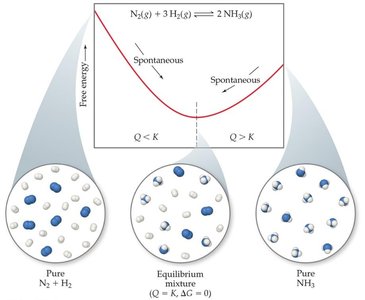
Free energy change is related to the equilibrium constant () and the reaction quotient ().
Formula:
At equilibrium: , , so
Interpretation:
Driving Nonspontaneous Reactions
Coupling Reactions
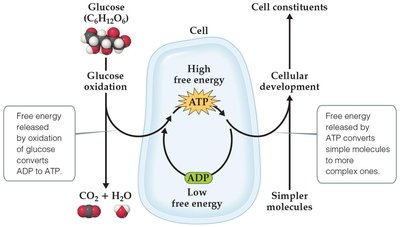
Nonspontaneous reactions can be driven by coupling them to spontaneous reactions, as seen in biological systems like cell metabolism.
Example: ATP hydrolysis is coupled to cellular processes to drive nonspontaneous reactions.
Additional info: These notes cover the core concepts of Chapter 19: Chemical Thermodynamics, including the laws of thermodynamics, entropy, spontaneity, Gibbs free energy, and their applications to chemical reactions and equilibrium. All equations are provided in LaTeX format for clarity and academic rigor.
