 Back
BackChemistry 1120 – Test 3 Study Guidance
Study Guide - Smart Notes
 Tailored notes based on your materials, expanded with key definitions, examples, and context.
Q1. Which of the following salts will produce solutions with a pH of 7.00?
Background
Topic: Acid-Base Properties of Salts
This question tests your understanding of how salts affect the pH of their aqueous solutions, based on the acid-base properties of their constituent ions.
Key Terms and Concepts:
Neutral Salt: Formed from a strong acid and a strong base; solution pH = 7.
Acidic Salt: Formed from a strong acid and a weak base; solution pH < 7.
Basic Salt: Formed from a weak acid and a strong base; solution pH > 7.
Step-by-Step Guidance
Identify the parent acid and base for each salt (e.g., NH4Cl comes from NH3 and HCl).
Determine if the parent acid and base are strong or weak for each salt.
Predict whether the salt will hydrolyze in water to produce acidic, basic, or neutral solutions.
Recall: Only salts from strong acid + strong base will yield a neutral (pH 7) solution.
Try solving on your own before revealing the answer!
Q2. In the titration of a NaOH solution with HCl, which statement is true about the titration curve?
Background
Topic: Acid-Base Titrations
This question tests your understanding of titration curves, specifically for a strong base (NaOH) titrated with a strong acid (HCl).
Key Terms and Concepts:
Initial pH: The pH before any titrant is added.
Equivalence Point: The point where moles of acid equal moles of base.
Strong Acid/Strong Base Titration: Equivalence point pH is typically 7.
Step-by-Step Guidance
Recall that NaOH is a strong base and HCl is a strong acid.
Consider the initial pH: Since NaOH is present, the initial pH will be high (basic).
At the equivalence point, all NaOH has reacted with HCl. For strong acid/strong base titrations, the resulting solution is neutral (pH = 7).
Review the answer choices and match them to these facts.
Try solving on your own before revealing the answer!
Q3. Calculate the pH after adding 25.0 mL of 0.125 M NaOH to 50.0 mL of 0.100 M HCl.
Background
Topic: Acid-Base Neutralization and pH Calculation
This question tests your ability to calculate pH after a partial neutralization reaction between a strong acid and a strong base.
Key Terms and Formulas:
Neutralization Reaction:
pH Calculation:
Step-by-Step Guidance
Calculate the initial moles of HCl and NaOH using (in liters).
Determine the limiting reactant and the amount of HCl remaining after reaction.
Calculate the new concentration of in the total volume after reaction.
Set up the pH calculation using the formula above.
Try solving on your own before revealing the answer!
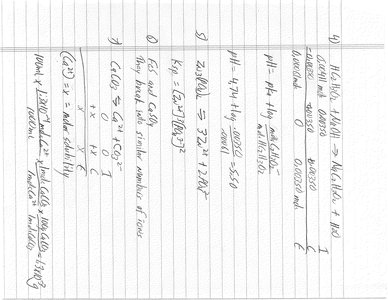
Q4. Calculate the pH after adding 28.0 mL of 0.125 M NaOH to 15.0 mL of 0.274 M HC2H3O2 (acetic acid).
Background
Topic: Weak Acid-Strong Base Titration
This question tests your ability to calculate pH during the titration of a weak acid with a strong base, possibly in the buffer region or after equivalence.
Key Terms and Formulas:
Neutralization Reaction:
Henderson-Hasselbalch Equation:
Step-by-Step Guidance
Calculate the initial moles of acetic acid and NaOH.
Determine the moles of acetic acid and acetate ion after the reaction.
Calculate the concentrations of and in the total volume.
Set up the Henderson-Hasselbalch equation for pH calculation.
Try solving on your own before revealing the answer!
Q5. What is the Ksp equation for Zn3(PO4)2?
Background
Topic: Solubility Product Constant (Ksp)
This question tests your ability to write the Ksp expression for a sparingly soluble salt.
Key Terms and Formulas:
Ksp: The equilibrium constant for the dissolution of a sparingly soluble compound.
General form: For ,
Step-by-Step Guidance
Write the balanced dissolution equation for Zn3(PO4)2 in water.
Identify the ions and their stoichiometric coefficients.
Write the Ksp expression using the concentrations of the ions raised to their coefficients.
Try solving on your own before revealing the answer!
Q6. Which of the following salts would be classified as similar "insoluble" salts?
Background
Topic: Solubility Rules
This question tests your knowledge of which salts are considered insoluble in water based on general solubility rules.
Key Terms and Concepts:
Insoluble Salt: A salt that dissolves only slightly in water (very low solubility).
Common insoluble salts: Most sulfides, carbonates, phosphates, and some sulfates.
Step-by-Step Guidance
Review the solubility rules for each salt listed.
Identify which salts are generally considered insoluble in water.
Compare the answer choices to your list of insoluble salts.
Try solving on your own before revealing the answer!
Q7. The molar solubility of CaCO3 is M. What mass of CaCO3 will dissolve in 100 mL of water?
Background
Topic: Solubility and Mass Calculations
This question tests your ability to convert molar solubility to mass dissolved in a given volume.
Key Terms and Formulas:
Molar Solubility: Moles of solute that dissolve per liter of solution.
Mass Calculation:
Step-by-Step Guidance
Calculate the moles of CaCO3 that dissolve in 100 mL (0.100 L) using the given molar solubility.
Find the molar mass of CaCO3 (Ca = 40.08, C = 12.01, O = 16.00).
Multiply the moles by the molar mass to get the mass in grams.
Try solving on your own before revealing the answer!
Q8. Calculate the solubility of PbCl2 in a 0.100 M HCl solution. Ksp =
Background
Topic: Common Ion Effect and Solubility
This question tests your ability to calculate the solubility of a salt in the presence of a common ion.
Key Terms and Formulas:
Ksp Expression: For PbCl2,
Common Ion Effect: The solubility of a salt decreases in the presence of a common ion.
Step-by-Step Guidance
Let the solubility of PbCl2 be mol/L.
Set up the equilibrium concentrations: , (but is negligible compared to 0.100).
Substitute these values into the Ksp expression and solve for .
Try solving on your own before revealing the answer!
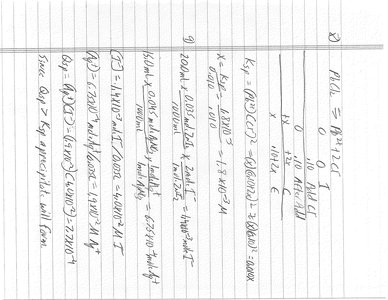
Q9. Will a precipitate form when 20.0 mL of 0.035 M ZnI2 is mixed with 15.0 mL of 0.045 M AgNO3? Ksp for AgI =
Background
Topic: Precipitation and Qsp vs Ksp
This question tests your ability to calculate the ion product (Qsp) and compare it to Ksp to predict precipitation.
Key Terms and Formulas:
Qsp: The ion product, calculated using initial concentrations after mixing.
Precipitation Rule: If Qsp > Ksp, a precipitate forms; if Qsp < Ksp, no precipitate forms.
Step-by-Step Guidance
Calculate the final concentrations of Ag+ and I- after mixing the solutions (use dilution formula).
Calculate Qsp:
Compare Qsp to Ksp to determine if a precipitate will form.
Try solving on your own before revealing the answer!
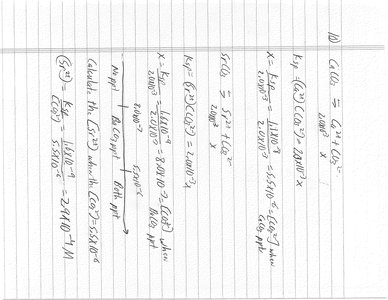
Q10. In selective precipitation, Ca2+ and Sr2+ are being precipitated by Na2CO3. Calculate [Sr2+] when CaCO3 begins to precipitate. Ksp for CaCO3 = , Ksp for SrCO3 =
Background
Topic: Selective Precipitation
This question tests your ability to use Ksp values to determine the concentration of one ion when another begins to precipitate.
Key Terms and Formulas:
Ksp Expression:
Step-by-Step Guidance
Set up the Ksp expression for CaCO3 to find [CO32-] when CaCO3 begins to precipitate.
Use this [CO32-] value in the Ksp expression for SrCO3 to solve for [Sr2+].
Plug in the given Ksp values and initial concentrations as needed.
Try solving on your own before revealing the answer!
Q11. Mark the same answer as in question 10.
Background
This question simply asks you to repeat your answer from Q10.
Try solving on your own before revealing the answer!
Q12. In the Qualitative Analysis Lab, CuS and Bi2S3 were separated from ZnS and FeS by controlling the concentration of which ion?
Background
Topic: Qualitative Analysis and Selective Precipitation
This question tests your understanding of how selective precipitation is used to separate metal sulfides by adjusting ion concentrations.
Key Terms and Concepts:
Selective Precipitation: Using differences in Ksp to separate ions.
Common ions involved: S2-, NH4+, Cl-, etc.
Step-by-Step Guidance
Recall which ion's concentration is manipulated to selectively precipitate certain metal sulfides.
Consider the solubility differences of CuS, Bi2S3, ZnS, and FeS.
Try solving on your own before revealing the answer!
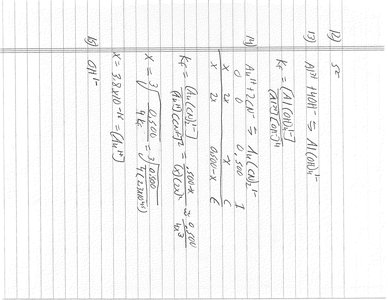
Q13. What is the Kf equation for Al(OH)4-?
Background
Topic: Formation (Complex Ion) Equilibria
This question tests your ability to write the formation constant (Kf) expression for a complex ion.
Key Terms and Formulas:
Formation Reaction:
Kf Expression:
Step-by-Step Guidance
Write the balanced equation for the formation of Al(OH)4- from Al3+ and OH-.
Write the Kf expression using the concentrations of the complex ion and the reactants.
Try solving on your own before revealing the answer!
Q14. Calculate the [Au+] in a 0.500 M [Au(CN)2]- solution. Kf =
Background
Topic: Complex Ion Equilibria
This question tests your ability to use the formation constant (Kf) to calculate the concentration of a metal ion in equilibrium with its complex.
Key Terms and Formulas:
Formation Reaction:
Kf Expression:
Step-by-Step Guidance
Let be the concentration of Au+ at equilibrium.
Express the equilibrium concentrations of [Au(CN)2]- and CN- in terms of .
Substitute these values into the Kf expression and solve for .
Try solving on your own before revealing the answer!
Q15. In the Qualitative Analysis Lab, Zn2+ ions were separated from Fe3+ ions by the addition of which ion?
Background
Topic: Qualitative Analysis and Selective Precipitation
This question tests your understanding of how specific ions are used to selectively precipitate certain metal ions.
Key Terms and Concepts:
Selective Precipitation: Using a reagent to precipitate one ion while leaving another in solution.
Step-by-Step Guidance
Recall which reagent is commonly used to separate Zn2+ from Fe3+ in qualitative analysis.
Consider the solubility of Zn(OH)2 and Fe(OH)3 in the presence of different ions.
Try solving on your own before revealing the answer!
