 Back
BackColligative Properties and Phase Changes in Solutions
Study Guide - Smart Notes
 Tailored notes based on your materials, expanded with key definitions, examples, and context.
Colligative Properties
Definition and Importance
Colligative properties are physical properties of solutions that depend solely on the number of solute particles present, not their identity. These properties are crucial in understanding how solutions behave compared to pure solvents, especially in processes such as boiling, freezing, and vaporization.
Key colligative properties: vapor pressure lowering, boiling point elevation, freezing point depression, and osmotic pressure.
Nonelectrolytes and electrolytes are treated differently because electrolytes dissociate into multiple particles.
Vapor Pressure of Solutions
Dynamic Equilibrium in Pure Solvent
In a pure solvent, molecules at the surface escape into the vapor phase, while vapor molecules return to the liquid. This establishes a dynamic equilibrium, where the rate of vaporization equals the rate of condensation.
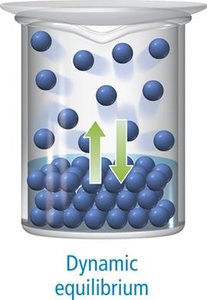
Effect of Solute on Vapor Pressure
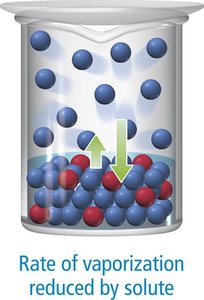
When a nonvolatile solute is added to a solvent, it replaces some solvent molecules at the surface, reducing the rate of vaporization and thus lowering the vapor pressure above the solution.
Nonvolatile solute: does not vaporize, so only solvent molecules contribute to vapor pressure.
Vapor pressure lowering: occurs because fewer solvent molecules are available at the surface to escape into the vapor phase.
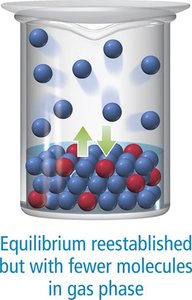
Reestablishment of Equilibrium
After adding solute, equilibrium is reestablished, but with fewer molecules in the gas phase, resulting in a lower vapor pressure compared to the pure solvent.
Raoult’s Law
Raoult’s Law quantifies the vapor pressure of a solvent in a solution. The vapor pressure is proportional to the mole fraction of the solvent:
Formula:
: vapor pressure of solvent in solution
: mole fraction of solvent
: vapor pressure of pure solvent
Since the mole fraction is always less than 1, the vapor pressure of the solvent in solution is always lower than that of the pure solvent.
Vapor Pressure Lowering
The difference between the vapor pressure of the pure solvent and the solution is called vapor pressure lowering:
Formula:
: vapor pressure lowering
: mole fraction of solute
Other Colligative Properties Related to Vapor Pressure Lowering
Boiling Point Elevation and Freezing Point Depression
Vapor pressure lowering affects the boiling and freezing points of solutions:
Boiling point elevation: The temperature required to boil a solution is higher than that of the pure solvent.
Freezing point depression: The temperature required to freeze a solution is lower than that of the pure solvent.
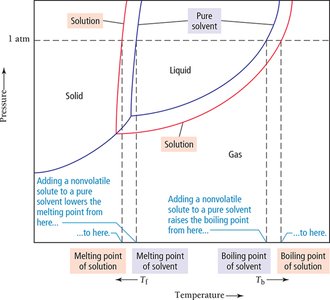
Freezing Point Depression
Quantitative Relationship
The freezing point of a solution is lower than that of the pure solvent. The difference is directly proportional to the molal concentration of solute particles:
Formula:
: freezing point depression
: freezing point depression constant (depends on solvent)
: molality of solute particles
The units of are .
Boiling Point Elevation
Quantitative Relationship
The boiling point of a solution is higher than that of the pure solvent. The difference is directly proportional to the molal concentration of solute particles:
Formula:
: boiling point elevation
: boiling point elevation constant (depends on solvent)
: molality of solute particles
The units of are .
Freezing Point Depression and Boiling Point Elevation Constants
Comparison Table
The freezing point depression constant () and boiling point elevation constant () vary for different solvents. The following table summarizes these values for several common solvents:
Solvent | Normal Freezing Point (°C) | (°C/m) | Normal Boiling Point (°C) | (°C/m) |
|---|---|---|---|---|
Benzene (C6H6) | 5.5 | 5.12 | 80.1 | 2.53 |
Carbon tetrachloride (CCl4) | -22.9 | 29.9 | 76.7 | 5.03 |
Chloroform (CHCl3) | -63.5 | 4.70 | 61.2 | 3.63 |
Ethanol (C2H5OH) | -114.1 | 1.99 | 78.3 | 1.22 |
Diethyl ether (C4H10O) | -116.3 | 1.79 | 34.6 | 2.02 |
Water (H2O) | 0.00 | 1.86 | 100.0 | 0.512 |
Conceptual Applications
Example: Vapor Pressure Calculation
Given a solution with a mole fraction of solute 0.200 and pure solvent vapor pressure of 100.0 torr, the vapor pressure of the solution is:
torr
Correct answer: 80.0 torr
Example: Boiling Point Elevation Comparison
For two 1.0 m solutions with the same nonionic solute, one in water and one in ethanol, the solution with the greater (water: 0.512, ethanol: 1.22) will have a greater increase in boiling point. Thus, ethanol solution will have a greater boiling point elevation.
Correct answer: Solution B (ethanol)
