 Back
BackColligative Properties and Solution Behavior (Ch. 13.6–13.7)
Study Guide - Smart Notes
 Tailored notes based on your materials, expanded with key definitions, examples, and context.
Colligative Properties of Solutions
Introduction to Solutions and Colligative Properties
Solutions are homogeneous mixtures composed of a solvent and one or more solutes. The physical properties of solutions, especially those known as colligative properties, depend primarily on the ratio of solute particles to solvent particles, not on the chemical identity of the solute. Colligative properties include vapor pressure lowering, boiling point elevation, freezing point depression, and osmotic pressure.
Colligative properties depend on the number of solute particles, not their type.
Examples: Salt water freezes at a lower temperature than pure water.
Adding solute "dilutes" the solvent, affecting phase changes.

Enthalpy and Entropy in Solution Formation
The formation of a solution is generally entropically favorable due to increased disorder. The enthalpy of solution () determines whether a solution forms spontaneously:
Exothermic (): Solutions always form (energy-driven).
Athermic (): Solutions always form (entropy-driven).
Endothermic (): Solutions form only if is moderate.
Temperature and pressure also affect solubility:
Increasing temperature increases solubility of solids, decreases solubility of gases.
Increasing pressure increases solubility of gases (Henry’s law: solubility pressure).
Vapor Pressure Lowering
Raoult’s Law and Dilution Effect
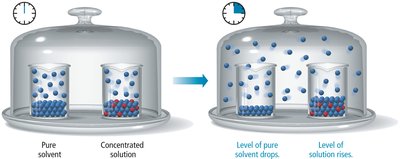
Adding a non-volatile, non-electrolyte solute to a solvent lowers its vapor pressure. The effect is proportional to the mole fraction of the solvent, as described by Raoult’s Law:
Solvent molecules are "diluted" by solute, lowering vapor pressure.
Solute type does not matter; only the number of particles matters.
Raoult’s Law:
Where is the mole fraction of the solvent:
Ideal Solutions and Deviations
In ideal solutions, solvent–solvent, solute–solute, and solvent–solute interactions are identical. Deviations from ideality occur when these interactions differ:
Strong solvent–solute interactions: (evaporation is harder).
Weak solvent–solute interactions: (evaporation is easier).
For mixtures of two volatile liquids, Raoult’s Law applies to both components:
Boiling Point Elevation
Principle and Calculation
Adding a non-volatile solute raises the boiling point of a solvent. This is a direct consequence of vapor pressure lowering, requiring a higher temperature to reach atmospheric pressure.
Boiling point elevation is proportional to solution concentration.
Different solvents have different boiling point elevation constants ().
Boiling point elevation equation:
Where is molality and is the boiling point elevation constant.
Example Table: Boiling Point Elevation Constants
Solvent | Normal b.p. (°C) | Kb (°C / m) |
|---|---|---|
Benzene (C6H6) | 80.1 | 2.53 |
Carbon tetrachloride (CCl4) | 76.7 | 5.03 |
Chloroform (CHCl3) | 61.2 | 3.63 |
Ethanol (C2H5OH) | 78.3 | 1.22 |
Water (H2O) | 100.0 | 0.512 |
Freezing Point Depression
Principle and Calculation
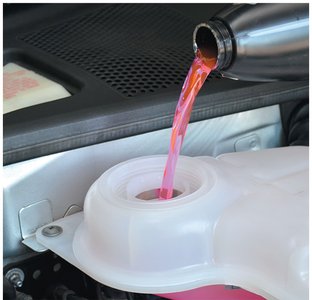
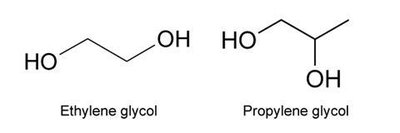
Solutions have lower freezing points than pure solvents. The effect is explained by the dilution of solvent molecules, making it harder for the solid phase to form.
Freezing point depression is proportional to solution concentration.
Different solvents have different freezing point depression constants ().
Freezing point depression equation:
Where is molality and is the freezing point depression constant.
Example Table: Freezing Point Depression Constants
Solvent | Normal f.p. (°C) | Kf (°C / m) |
|---|---|---|
Benzene (C6H6) | 5.5 | 5.12 |
Carbon tetrachloride (CCl4) | -22.9 | 29.9 |
Chloroform (CHCl3) | -63.5 | 4.70 |
Ethanol (C2H5OH) | -114.1 | 1.99 |
Water (H2O) | 0.00 | 1.86 |
Electrolytes and the van’t Hoff Factor
Electrolytes vs. Non-Electrolytes
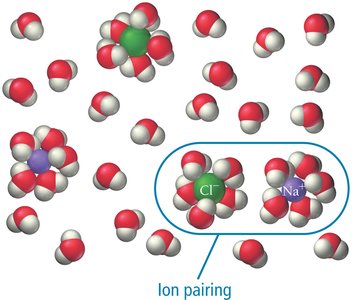
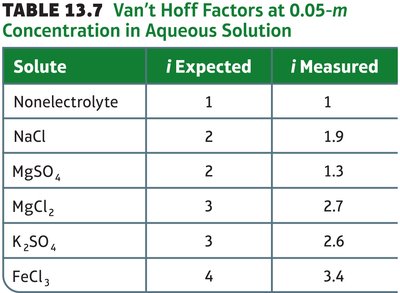
Electrolytes dissociate into ions in solution, increasing the number of solute particles. The van’t Hoff factor () quantifies the effective number of particles produced per formula unit:
Non-electrolytes:
Electrolytes: (depends on dissociation)
Ion pairing can reduce the measured below the expected value.
Van’t Hoff Factor Table
The table below compares expected and measured van’t Hoff factors for various solutes:
Solute | i Expected | i Measured |
|---|---|---|
Nonelectrolyte | 1 | 1 |
NaCl | 2 | 1.9 |
MgSO4 | 2 | 1.3 |
MgCl2 | 3 | 2.7 |
K2SO4 | 3 | 2.6 |
FeCl3 | 4 | 3.4 |
Modified Colligative Property Equations for Electrolytes
For electrolyte solutions, the colligative property equations are modified to include the van’t Hoff factor:
Vapor pressure lowering: with
Boiling point elevation:
Freezing point depression:
Summary of Colligative Properties
Colligative properties depend on the number of solute particles, not their identity.
Key properties: vapor pressure lowering, boiling point elevation, freezing point depression.
Electrolytes increase the effect due to dissociation (van’t Hoff factor).
