 Back
BackColligative Properties of Solutions: Mini-Textbook Study Guide
Study Guide - Smart Notes
 Tailored notes based on your materials, expanded with key definitions, examples, and context.
Colligative Properties of Solutions
Introduction to Colligative Properties
Colligative properties are physical properties of solutions that depend solely on the number of solute particles present, not their chemical identity. These properties are influenced by whether the solute is an electrolyte (dissociates into ions) or a nonelectrolyte (does not dissociate).
Key Colligative Properties: Vapor pressure lowering, boiling point elevation, freezing point depression, osmotic pressure, and the van’t Hoff factor.
Electrolyte vs. Nonelectrolyte: Electrolytes produce more particles in solution, thus affecting colligative properties more strongly than nonelectrolytes.
Vapor Pressure Lowering
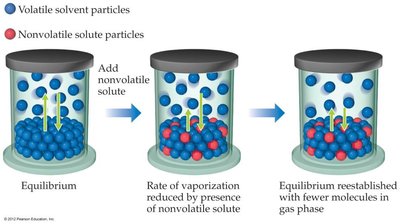
The addition of a nonvolatile solute to a solvent reduces the solvent's vapor pressure. This occurs because fewer solvent molecules are present at the surface to escape into the vapor phase.
Raoult’s Law: The vapor pressure of a solution is given by .
Vapor Pressure Lowering Equation:
Entropy Explanation: The solution is more disordered than the pure solvent, so the tendency for solvent molecules to vaporize is reduced.
Example: Calculating vapor pressure lowering for a solution of glucose in water.
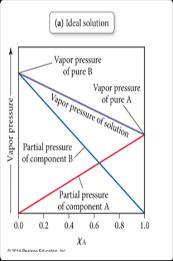
Volatile Solutes: In solutions with two volatile components, both contribute to the vapor pressure. Raoult’s Law applies to each component: , , and .
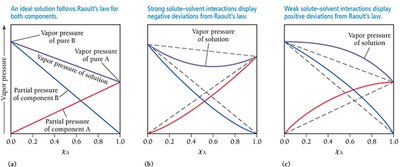
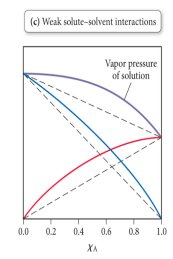
Deviations from Raoult’s Law: Strong solute-solvent interactions cause negative deviations (lower vapor pressure), while weak interactions cause positive deviations (higher vapor pressure).
Boiling Point Elevation
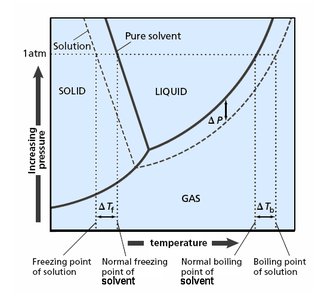
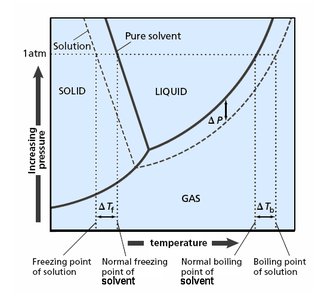
Adding a nonvolatile solute to a solvent decreases its vapor pressure, requiring a higher temperature to reach boiling. The boiling point elevation () is proportional to the solution's molality.
Boiling Point Elevation Equation:
Molal-Boiling-Point-Elevation Constant (): Depends only on the solvent, units are .
Example: Calculating boiling point elevation for a glucose solution in water.
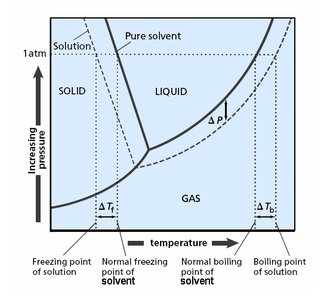
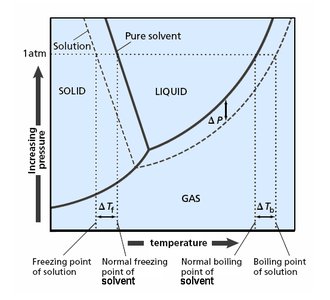
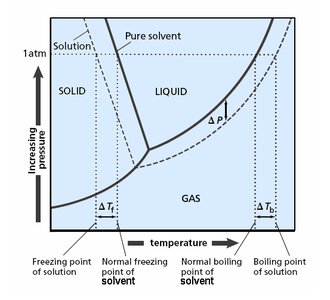
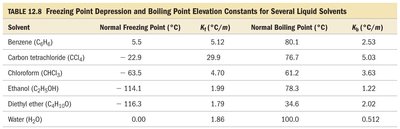
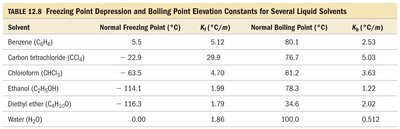
Table: Freezing Point Depression and Boiling Point Elevation Constants
Solvent | Normal Freezing Point (°C) | (°C/m) | Normal Boiling Point (°C) | (°C/m) |
|---|---|---|---|---|
Benzene (C6H6) | 5.5 | 5.12 | 80.1 | 2.53 |
Carbon tetrachloride (CCl4) | -22.9 | 29.9 | 76.7 | 5.03 |
Chloroform (CHCl3) | -63.5 | 4.70 | 61.2 | 3.63 |
Ethanol (C2H5OH) | -114.1 | 1.99 | 78.3 | 1.22 |
Diethyl ether (C4H10O) | -116.3 | 1.79 | 34.6 | 2.02 |
Water (H2O) | 0.00 | 1.86 | 100.0 | 0.512 |
Freezing Point Depression
The addition of a nonvolatile solute lowers the freezing point of a solvent. The freezing point depression () is proportional to the solution's molality.
Freezing Point Depression Equation:
Molal-Freezing-Point-Depression Constant (): Depends only on the solvent, units are .
Example: Calculating freezing point depression for a glucose solution in water.
Application: Cryoscopy is used to determine the molar mass of a solute by measuring freezing point depression.
Osmotic Pressure
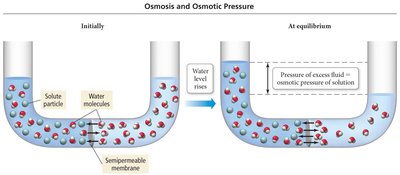
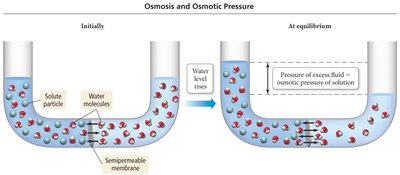
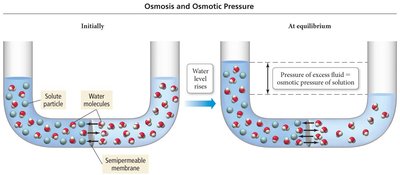
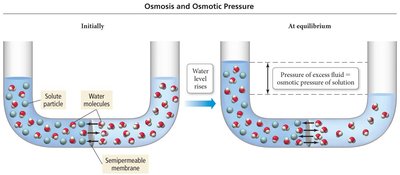
Osmosis is the movement of solvent through a semipermeable membrane to equalize solute concentrations. Osmotic pressure () is the pressure required to stop this flow.
Osmotic Pressure Equation:
Applications: Reverse osmosis is used for desalination; biological cells rely on osmotic pressure for water balance.
Example: Calculating osmotic pressure for a starch solution.
Biological Applications of Osmosis
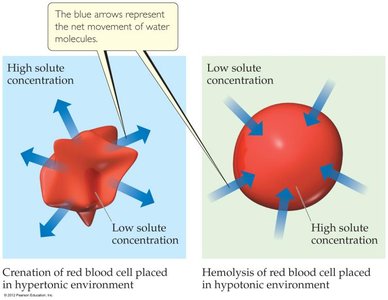
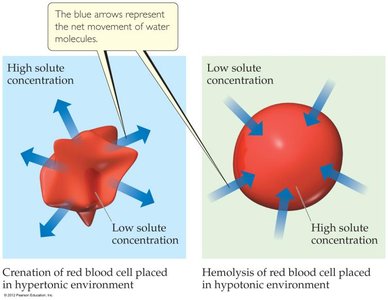
Hypertonic Environment: Water flows out of the cell, causing shrinkage (crenation).
Hypotonic Environment: Water flows into the cell, causing swelling and possible bursting (hemolysis).
Isotonic Environment: No net movement of water; important for intravenous solutions.
van’t Hoff Factor (i)
The van’t Hoff factor () accounts for the number of particles produced by dissociation of electrolytes in solution. Colligative property equations are modified by multiplying by $i$.
Definition:
Examples: NaCl (), CaCl2 (), nonelectrolytes ().
Modified Equations:
Experimental vs. Theoretical i: Actual values are often lower than theoretical due to ion pairing, especially at higher concentrations.
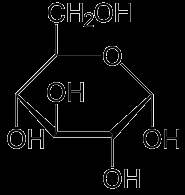
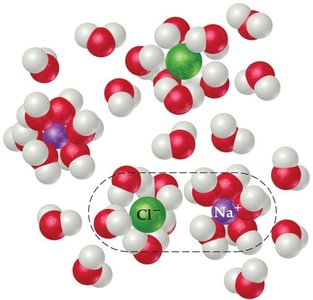
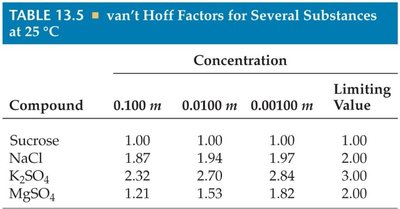
Table: van’t Hoff Factors for Several Substances at 25°C
Compound | 0.100 m | 0.0100 m | 0.00100 m | Limiting Value |
|---|---|---|---|---|
Sucrose | 1.00 | 1.00 | 1.00 | 1.00 |
NaCl | 1.87 | 1.94 | 1.97 | 2.00 |
K2SO4 | 2.32 | 2.70 | 2.84 | 3.00 |
MgSO4 | 1.21 | 1.53 | 1.82 | 2.00 |
Additional info: Ion pairing reduces the effective number of particles in solution, causing deviations from the limiting van’t Hoff factor, especially in concentrated solutions.
