 Back
BackColligative Properties of Solutions: Vapor Pressure, Boiling/Freezing Points, and Osmotic Pressure
Study Guide - Smart Notes
 Tailored notes based on your materials, expanded with key definitions, examples, and context.
Colligative Properties of Solutions
Introduction to Colligative Properties
Colligative properties are physical properties of solutions that depend solely on the number of solute particles present, not their chemical identity. These properties are crucial in understanding how solutes affect the behavior of solvents in solution.
Vapor pressure lowering
Boiling point elevation
Freezing point depression
Osmotic pressure
Vapor Pressure Lowering
Definition and Explanation
When a non-volatile solute is dissolved in a solvent, the vapor pressure of the resulting solution is lower than that of the pure solvent. This occurs because the solute particles occupy surface sites, reducing the number of solvent molecules that can escape into the vapor phase.
Raoult's Law: The vapor pressure of a solution is proportional to the mole fraction of the solvent.
Equation:
Electrolyte solutions: For ionic solutes, the number of particles increases due to dissociation, further lowering vapor pressure.
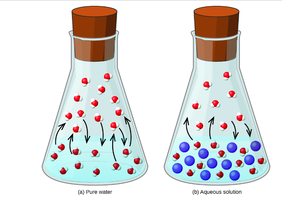
Vapor Pressure Lowering in Solutions of Two Volatile Liquids
When two volatile liquids are mixed, each component contributes to the total vapor pressure according to its mole fraction and pure vapor pressure. The total vapor pressure is the sum of the partial pressures of each component.
Equation:
Application: Used to predict the behavior of mixtures such as benzene and toluene.
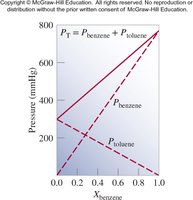
Example Calculation: Vapor Pressure of a Solution
To calculate the vapor pressure of a solution, determine the moles of solute and solvent, calculate the mole fraction of the solvent, and apply Raoult's Law.
Example: Dissolving 200 g of glucose (MW = 180.2 g/mol) in 500 mL of water at 25°C (density = 1.0 g/mL, = 23.76 mmHg).
Steps:
Calculate moles of glucose and water.
Find mole fraction of water.
Apply Raoult's Law to find vapor pressure.
Boiling Point Elevation
Definition and Explanation
The boiling point of a solution is higher than that of the pure solvent. This is because the addition of solute lowers the vapor pressure, requiring a higher temperature to reach atmospheric pressure.
Equation:
Where: = boiling point elevation, = van 't Hoff factor (number of particles per formula unit), = ebullioscopic constant, = molality of solution.
Application: Used in cooking (e.g., adding salt to water) and candy making to control solution concentration and texture.

Example Calculation: Boiling Point Elevation
Example: Adding 100 g NaCl to 2 L of water. for water is 0.52 °C/m.
Steps:
Calculate moles of NaCl and water.
Determine molality and van 't Hoff factor ( for NaCl = 2).
Apply the equation to find the new boiling point.
Freezing Point Depression
Definition and Explanation
The freezing point of a solution is lower than that of the pure solvent. Solute particles disrupt the formation of the solid phase, requiring a lower temperature for freezing to occur.
Equation:
Where: = freezing point depression, = cryoscopic constant.
Application: Used in de-icing roads and making ice cream.
Example Calculation: Freezing Point Depression
Example: How many grams of NaCl are needed to lower the freezing point of 500 mL water to -5°C? for water is 1.86 °C/m.
Steps:
Calculate moles of water.
Determine required molality and solve for grams of NaCl.
Osmotic Pressure
Definition and Explanation
Osmosis is the movement of solvent molecules through a semi-permeable membrane from a region of lower solute concentration to higher solute concentration. Osmotic pressure () is the pressure required to stop this flow.
Equation:
Where: = molarity, = gas constant, = temperature in Kelvin, = van 't Hoff factor.
Biological relevance: Osmotic pressure is critical in maintaining cell shape and function.
Osmotic Pressure and Cell Behavior
Cells respond differently to solutions of varying osmotic pressures:
Isotonic: Equal osmotic pressure; no net movement of water.
Hypotonic: Lower osmotic pressure outside; water enters cell, causing swelling.
Hypertonic: Higher osmotic pressure outside; water leaves cell, causing shrinkage.
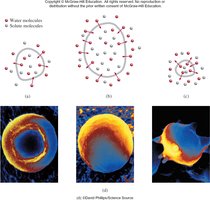
Example Calculation: Osmotic Pressure
Example: The average osmotic pressure of seawater at 20°C is 30 atm. Assuming NaCl is the only solute, calculate the concentration of seawater.
Steps:
Rearrange the osmotic pressure equation to solve for molarity.
Insert values for , , , and (for NaCl, ).
Summary Table: Colligative Property Equations
Property | Equation | Key Variables |
|---|---|---|
Vapor Pressure Lowering | = mole fraction of solute, = vapor pressure of pure solvent | |
Boiling Point Elevation | = van 't Hoff factor, = ebullioscopic constant, = molality | |
Freezing Point Depression | = van 't Hoff factor, = cryoscopic constant, = molality | |
Osmotic Pressure | = van 't Hoff factor, = molarity, = gas constant, = temperature (K) |
