 Back
BackL21 Collision Theory, Activation Energy, and the Arrhenius Equation
Study Guide - Smart Notes
 Tailored notes based on your materials, expanded with key definitions, examples, and context.
Collision Theory and Chemical Kinetics
Principles of Collision Theory
Collision theory explains how chemical reactions occur and why reaction rates vary. It is based on the idea that molecules must collide to react, but not all collisions result in a reaction. Three main postulates define collision theory:
Reaction rate is proportional to the rate of collisions: The frequency of collisions between reactant molecules affects how quickly a reaction proceeds.
Reacting compounds must collide in an orientation that allows contact between the atoms forming new bonds: Only collisions with the correct orientation are effective.
Collisions must occur with sufficient kinetic energy: The energy must be high enough to overcome the activation energy barrier and allow the formation of new bonds.
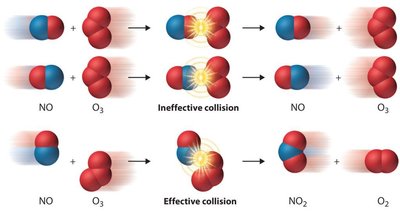
Example: The reaction between NO and O3 demonstrates that only collisions with proper orientation and sufficient energy lead to product formation.
Orientation Factor
The orientation factor describes the fraction of collisions with the correct alignment for reaction. For example, in the reaction CO(g) + O2(g) → CO2(g) + O(g), only collisions where the carbon atom of CO impacts O2 can result in product formation.
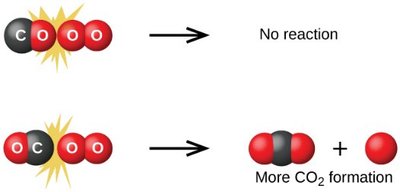
Example: Collisions with incorrect orientation do not lead to reaction, while those with correct orientation increase CO2 formation.
Transition State and Activation Energy
The Transition State
During a reaction, reactants transform into products through a high-energy intermediate called the transition state or activated complex. The transition state is a hybrid structure, existing only momentarily as bonds are breaking and forming.
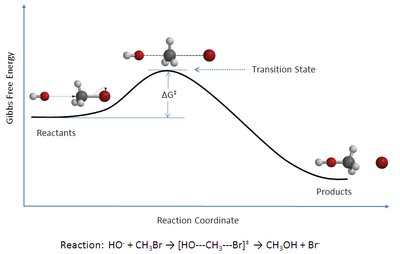
Key Point: Once the transition state is formed, the reaction proceeds to products via unimolecular decay.
Activation Energy (Ea)
Activation energy is the minimum energy required for a reaction to occur. It represents the energy gap between reactants and the transition state. Only collisions with energy equal to or greater than Ea can result in product formation.
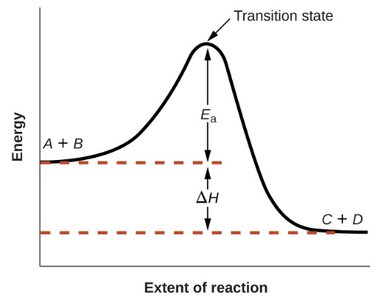
Key Point: The difference in energy between reactants and products is the heat of reaction (ΔHrxn), while the peak represents the activation energy barrier.
Reaction Energy Diagrams
Energy diagrams illustrate the progress of a reaction, showing reactants, products, transition states, and intermediates. Reactions may occur in one or multiple steps, each with its own transition state.
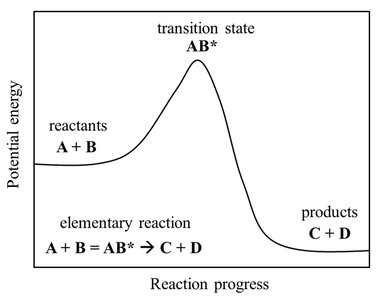
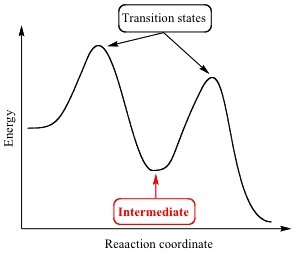
Key Point: Multi-step reactions have intermediates and multiple transition states, affecting the overall reaction rate.
Kinetic Energy Distributions and Temperature Effects
Kinetic Energy and Activation Energy
The distribution of kinetic energies among molecules determines how many collisions have enough energy to overcome the activation energy barrier. As temperature increases, the average kinetic energy rises, and more molecules can react.
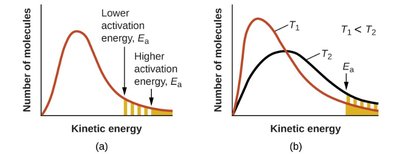
Higher temperature: More molecules have kinetic energy above Ea, increasing reaction rate.
Lower activation energy: More collisions are effective, leading to faster reactions.
Arrhenius Equation
Arrhenius Equation and Rate Constant
The Arrhenius equation quantifies the relationship between reaction rate and temperature:
k: Rate constant
A: Frequency factor (accounts for collision frequency and orientation)
Ea: Activation energy
R: Gas constant (8.3145 J/(mol·K))
T: Temperature in Kelvin
Key Point: The rate constant increases with temperature and decreases with higher activation energy.
Linear Form of the Arrhenius Equation
Taking the natural logarithm yields a linear relationship:
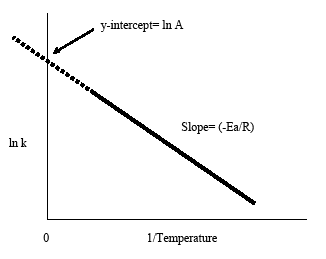
Key Point: Plotting ln k versus 1/T gives a straight line, allowing determination of Ea and A from experimental data.
Two-Point Form of the Arrhenius Equation
Comparing rate constants at two temperatures gives:
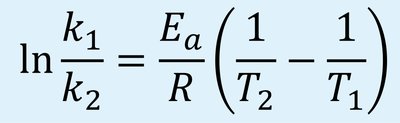
Uses: Calculate Ea from two k,T data points, or predict k at a new temperature.
Summary Table: Collision Theory and Arrhenius Equation
Concept | Definition | Key Equation |
|---|---|---|
Collision Theory | Reaction rate depends on collision frequency, orientation, and energy | — |
Activation Energy (Ea) | Minimum energy required for reaction | — |
Arrhenius Equation | Relates rate constant to temperature and activation energy | |
Linear Form | Allows determination of Ea and A from ln k vs 1/T plot | |
Two-Point Form | Compares k at two temperatures |
Example Application: Using measured rate constants at two temperatures, the activation energy can be calculated using the two-point Arrhenius equation.
Additional info: These notes cover core concepts from Chapter 12 (Kinetics of Chemical Reactions), specifically collision theory, activation energy, and the Arrhenius equation, which are fundamental to understanding reaction rates in general chemistry.
