 Back
Compounds, Chemical Bonding, Molecular Geometry, and Intermolecular Forces: Study Guide
Study Guide - Smart Notes
 Tailored notes based on your materials, expanded with key definitions, examples, and context.
Compounds: Ionic, Molecular, and Acids
Ions and Chemical Bonds
This section covers the formation of ions and the types of chemical bonds that hold atoms together in compounds.
Octet Rule: Representative elements (groups 1A-8A) gain or lose electrons to achieve 8 valence electrons.
Cations: Metals lose electrons to become positively charged ions.
Anions: Nonmetals gain electrons to become negatively charged ions.
Transition Metals: May form multiple ions with variable charges.
Atomic Charge: Calculated as number of protons minus number of electrons.
Monoatomic Ions: Formed from a single atom (e.g., Na+, S2-).
Polyatomic Ions: Groups of atoms with an overall charge (e.g., NH4+, CO32-).
Oxyanions: Polyatomic ions containing oxygen (e.g., NO3-).
Chemical Bonds
Ionic Bonds: Formed by transfer of electrons from metals to nonmetals, resulting in electrostatic attraction between cations and anions.
Covalent Bonds: Formed by sharing electrons between nonmetals or metalloids, resulting in molecular compounds.
Bond Types:
Single bond: 2 shared electrons
Double bond: 4 shared electrons
Triple bond: 6 shared electrons
Formulas and Nomenclature
Understanding how to write and name ionic, molecular, and acid compounds is essential for chemical communication.
Ionic Compounds:
Contain a metal (cation) and a nonmetal (anion).
Overall charge is neutral.
Polyatomic ions are included as groups with a charge.
Transition metals require Roman numerals to indicate charge (except Ag+, Zn2+, Cd2+).
Formulas are made by crisscrossing charges to determine subscripts.
Names: Metal name (unchanged) + nonmetal name ending in "-ide" or polyatomic ion name.
No prefixes used.
Molecular Compounds:
Contain two nonmetals or a metalloid and a nonmetal.
Names: First element unchanged, second element ends in "-ide".
Prefixes indicate the number of each element (mono-, di-, tri-, etc.).
No crisscrossing; formula determined by prefixes.
Acids:
Produce H+ ions in solution (Arrhenius definition).
Binary acids: Use "hydro" prefix and "-ic" ending (e.g., hydrochloric acid).
Oxyacids: No "hydro" prefix; "-ate" becomes "-ic", "-ite" becomes "-ous" (e.g., sulfuric acid, sulfurous acid).
Chemical Bonding and Molecular Geometry
Ionic Bonding
Ionic bonds result from the transfer of electrons between metals and nonmetals, forming cations and anions.
Electrostatic Forces: Strong attraction between oppositely charged ions.
Properties:
High melting points; usually solids at room temperature.
Dissolve readily in water.
Conduct electricity when melted or dissolved.
Covalent Bonding
Covalent bonds involve the sharing of electrons between nonmetals or metalloids.
Bond Strength: Weaker than ionic bonds.
Properties:
Lower melting and boiling points; often liquids or gases.
Insoluble in water.
Poor conductors of electricity.
Bond Formation: Atoms overlap valence orbitals to stabilize the molecule.
Bond Length: Distance between nuclei where potential energy is lowest.
Electronegativity and Bond Types
Electronegativity: Ability of an atom to attract shared electrons.
Bond Types:
Nonpolar covalent: Electronegativity difference < 0.4; electrons shared equally.
Polar covalent: Difference between 0.4 and 1.8; electrons shared unequally.
Ionic: Difference > 1.8; electrons transferred.
Lewis Symbols and Structures
Lewis structures represent the arrangement of valence electrons in molecules.
Lewis Symbols: Chemical symbol with dots for valence electrons.
Lewis Structures: Show sharing of electrons; octet rule applies (except H, which has 2 electrons).
Bond Representation:
Single bond: 2 electrons
Double bond: 4 electrons
Triple bond: 6 electrons
Exceptions:
Free radicals: Odd number of electrons.
Electron-deficient: Central atom has less than 8 electrons (e.g., B in BF3).
Hypervalent: Central atom has more than 8 electrons (period 3 or lower).
Formal Charges and Resonance
Formal charges help identify the most stable Lewis structure; resonance structures show electron delocalization.
Formal Charge:
Resonance Structures: Same skeletal formula, different electron arrangements; double bonds may shift positions.
Molecular Structure and Polarity
VSEPR theory predicts molecular shapes based on electron group repulsion; polarity depends on bond types and molecular geometry.
VSEPR Theory: Electron groups spread out to minimize repulsion, determining bond angles and shape.
Lone Pairs: Affect bond angles by increasing repulsion.
Polarity:
Nonpolar molecules: No charge difference; dipoles cancel.
Polar molecules: Charge difference; dipoles do not cancel.
Advanced Theories of Bonding
Valence Bond Theory
Valence bond theory explains covalent bond formation through atomic orbital overlap.
Orbital Overlap: Covalent bonds form when half-filled atomic orbitals overlap.
Sigma (σ) Bonds: End-to-end overlap of s or p orbitals.
Pi (π) Bonds: Side-to-side overlap of p orbitals.
Coulomb Force:
Dipole Moment:
Hybrid Atomic Orbitals
Hybridization combines atomic orbitals to form new orbitals for bonding.
Hybridization Types:
sp: 2 electron groups
sp2: 3 electron groups
sp3: 4 electron groups
sp3d: 5 electron groups
sp3d2: 6 electron groups
Assignment: Determined by number of electron groups around central atom.
Multiple Bonds
Sigma Bonds: Head-to-head overlap of hybrid orbitals.
Pi Bonds: Side-to-side overlap of unhybridized orbitals.
Double Bond: 1 sigma + 1 pi bond.
Triple Bond: 1 sigma + 2 pi bonds.
Molecular Orbital Theory
Molecular orbital theory describes electrons as delocalized across the molecule.
Molecular Orbitals: Electrons reside in MOs, not just atomic orbitals.
Delocalization: Stabilizes molecules like ozone and benzene.
Magnetic Properties:
Diamagnetic: All orbitals filled; not attracted to magnetic field.
Paramagnetic: Partially filled orbitals; attracted to magnetic field.
Molecular Orbital Energy Diagrams: Electrons fill lower energy bonding MOs first, then higher energy antibonding MOs.
Bond Order:
Band Theory:
Valence band: Occupied bonding MOs.
Conduction band: Unoccupied antibonding MOs.
Conductors: No energy gap (metals).
Semiconductors: Small gap (metalloids).
Insulators: Large gap (nonmetals).
Intermolecular Forces & Properties of Liquids
Intermolecular Forces (IMF)
IMFs are attractions between neutral atoms and molecules, affecting physical properties.
States of Matter:
Increasing kinetic energy: solid < liquid < gas
Increasing IMF: gas < liquid < solid
Types of IMF:
Dispersion forces: Temporary dipoles; present in all compounds; weakest.
Dipole-dipole: Attraction between polar molecules.
Hydrogen bonding: H bonded to F, O, or N; strongest IMF.
Relative Strength: Dispersion < dipole-dipole < hydrogen bonding.
Effect on Properties: Higher IMF increases melting and boiling points.
Properties of Liquids
Viscosity: Resistance to flow; increases with IMF, decreases with temperature.
Surface Tension: Inward force on surface; increases with IMF, decreases with temperature.
Capillary Action: Ability to flow against gravity; due to cohesive and adhesive forces.
Vaporization and Boiling Point
Vaporization: Liquid to gas; increases with temperature, decreases with IMF.
Condensation: Gas to liquid.
Dynamic Equilibrium: Vaporization and condensation occur at same rate.
Vapor Pressure: Pressure exerted by gas in closed system; increases with temperature and surface area, decreases with IMF.
Boiling Point: Occurs when vapor pressure equals atmospheric pressure; increases with IMF and atmospheric pressure.
Common Polyatomic Ions
Polyatomic ions are groups of atoms with an overall charge, commonly found in ionic compounds.
Name | Formula |
|---|---|
Acetate | C2H3O2- |
Ammonium | NH4+ |
Chlorate | ClO3- |
Chlorite | ClO2- |
Perchlorate | ClO4- |
Cyanide | CN- |
Carbonate | CO32- |
Bicarbonate | HCO3- |
Hydroxide | OH- |
Sulfate | SO42- |
Sulfite | SO32- |
Bisulfate | HSO4- |
Bisulfite | HSO3- |
Phosphate | PO43- |
Phosphite | PO33- |
Hydrogen phosphate | HPO42- |
Nitrate | NO3- |
Nitrite | NO2- |
Molecular Geometry and Hybridization
Molecular Geometry Chart
The geometry of a molecule is determined by the number of electron groups around the central atom, which also dictates the hybridization. The chart below summarizes the relationship between electron groups, geometry, and hybridization.
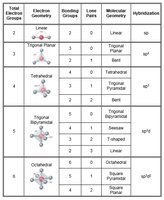
Total Electron Groups | Electron Geometry | Bonding Groups | Lone Pairs | Molecular Geometry | Hybridization |
|---|---|---|---|---|---|
2 | Linear | 2 | 0 | Linear | sp |
3 | Trigonal Planar | 3 | 0 | Trigonal Planar | sp2 |
3 | Trigonal Planar | 2 | 1 | Bent | sp2 |
4 | Tetrahedral | 4 | 0 | Tetrahedral | sp3 |
4 | Tetrahedral | 3 | 1 | Trigonal Pyramidal | sp3 |
4 | Tetrahedral | 2 | 2 | Bent | sp3 |
5 | Trigonal Bipyramidal | 5 | 0 | Trigonal Bipyramidal | sp3d |
5 | Trigonal Bipyramidal | 4 | 1 | Seesaw | sp3d |
5 | Trigonal Bipyramidal | 3 | 2 | T-shaped | sp3d |
5 | Trigonal Bipyramidal | 2 | 3 | Linear | sp3d |
6 | Octahedral | 6 | 0 | Octahedral | sp3d2 |
6 | Octahedral | 5 | 1 | Square Pyramidal | sp3d2 |
6 | Octahedral | 4 | 2 | Square Planar | sp3d2 |
Example: Water (H2O) has 4 electron groups (2 bonding, 2 lone pairs), so its geometry is bent and hybridization is sp3.
Additional info: The chart is essential for predicting molecular shapes and hybridization, which are fundamental for understanding chemical reactivity and physical properties.
