 Back
BackComprehensive Study Notes: Chemical Reactions and Reactions in Aqueous Solutions
Study Guide - Smart Notes
 Tailored notes based on your materials, expanded with key definitions, examples, and context.
Chapter 4: Chemical Reactions
Chemical Reactions and Chemical Equations
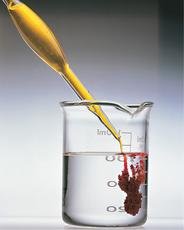
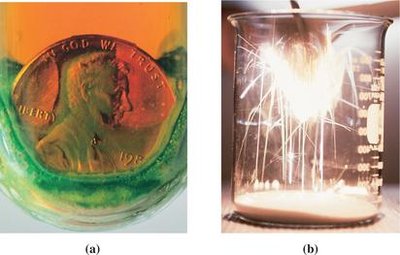
Chemical reactions involve the transformation of reactants into products, often accompanied by observable changes such as color change, precipitate formation, gas evolution, or heat exchange. Chemical equations are symbolic representations of these reactions, showing the identities and quantities of substances involved.
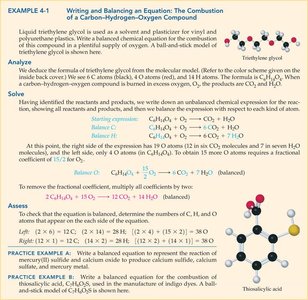
Key Point 1: Balancing Chemical Equations – Chemical equations must be balanced to obey the law of conservation of mass. This is achieved by adjusting coefficients, not subscripts, so that the number of atoms of each element is the same on both sides of the equation.
Key Point 2: States of Matter and Reaction Conditions – States are indicated as (s), (l), (g), or (aq). Reaction conditions (e.g., heat, catalysts) are often written above or below the reaction arrow.
Example: The combustion of triethylene glycol:
Strategy for Balancing Equations
Balancing equations involves a systematic approach:
Balance elements that appear in only one compound on each side first.
Balance free elements last.
Balance unchanged polyatomic ions as groups.
Fractional coefficients are acceptable during balancing and can be cleared by multiplying through at the end.
Chemical Equations and Stoichiometry
Stoichiometry is the quantitative study of reactants and products in a chemical reaction. It uses mole ratios derived from balanced equations to relate amounts of substances.
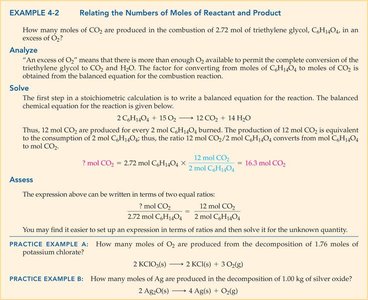
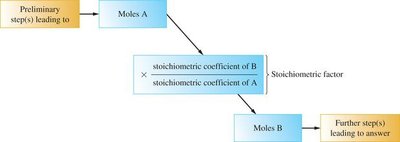
Key Point 1: Mole Ratio – The stoichiometric factor is the ratio of coefficients from the balanced equation, used to convert between moles of different substances.
Example: For , the mole ratio between NO and NO2 is 1:1.
Stoichiometric Calculations
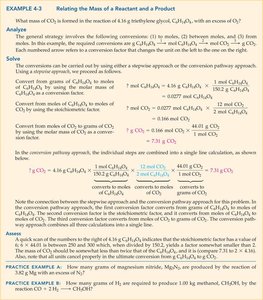
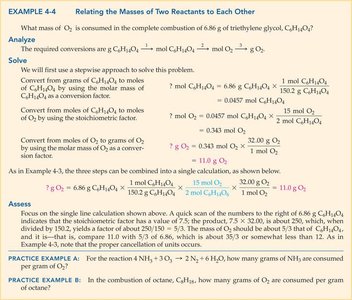
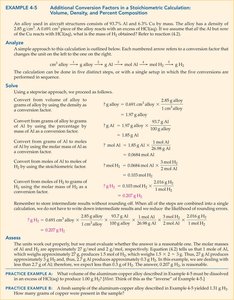
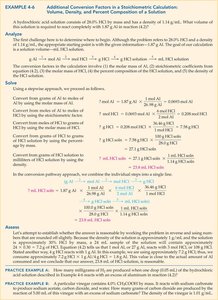
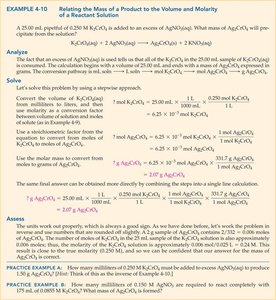
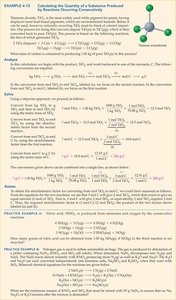
Stoichiometric calculations can relate moles, masses, and volumes of reactants and products. The process involves converting given quantities to moles, using mole ratios, and converting to desired units.
Example: Calculating the mass of CO2 produced from a given mass of triethylene glycol:
Chemical Reactions in Solution
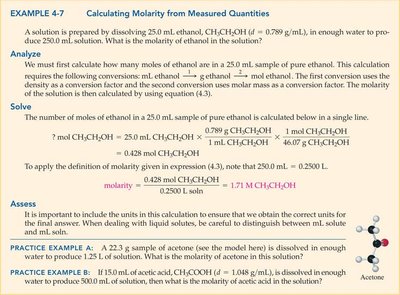
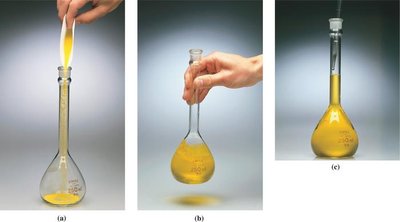
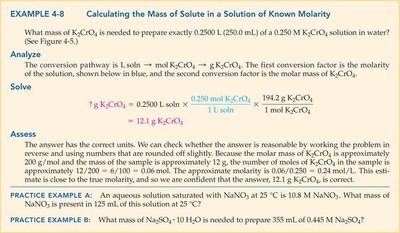
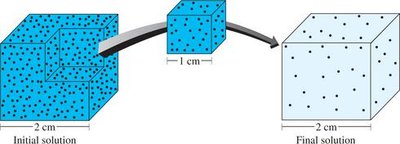
Many reactions occur in aqueous solution, where water acts as the solvent. The concentration of a solution is often expressed as molarity (M), defined as moles of solute per liter of solution.
Formula: , where is moles of solute and is volume in liters.
Example: Dissolving 0.440 mol urea in 1.000 L water gives solution.
Solution Dilution
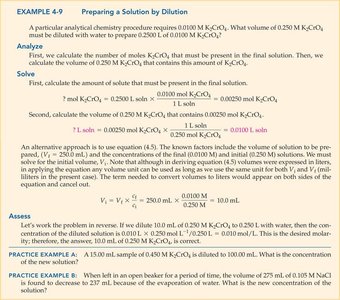
To prepare a solution of lower concentration from a more concentrated stock solution, use the dilution equation:
Formula:
Key Point: The number of moles of solute remains constant before and after dilution.
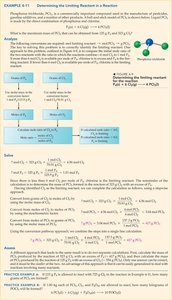
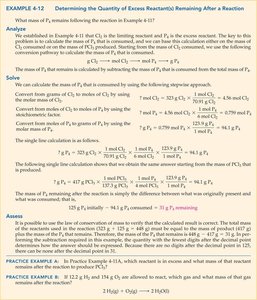
Determining the Limiting Reactant
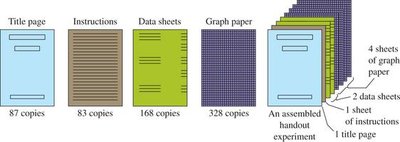
The limiting reactant is the substance that is completely consumed first in a reaction, thus limiting the amount of product formed. The other reactant(s) are in excess.
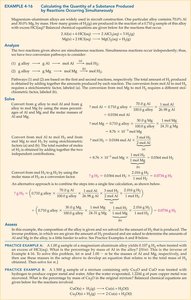
Key Point: To identify the limiting reactant, calculate the amount of product formed from each reactant; the smallest amount indicates the limiting reactant.
Example: If 2 g of an alloy reacts with excess acid, the limiting reactant is the alloy.
Other Practical Matters in Reaction Stoichiometry
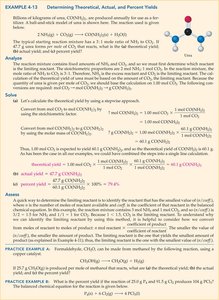
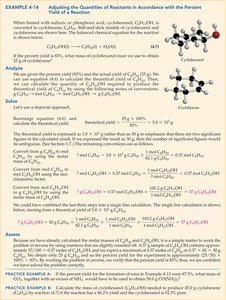
In practical chemistry, yields are often less than theoretical due to side reactions or incomplete reactions. Theoretical yield is the maximum possible amount of product, actual yield is what is obtained, and percent yield is calculated as:
Formula:
Key Point: Consecutive and simultaneous reactions may occur, and intermediates are substances formed and consumed during multistep syntheses.
Chapter 5: Introduction to Reactions in Aqueous Solutions
The Nature of Aqueous Solutions
Water is a universal solvent, capable of dissolving many substances. Solutions can be classified based on their ability to conduct electricity:
Strong Electrolyte: Completely ionizes in solution; good conductor.
Weak Electrolyte: Partially ionizes; fair conductor.
Non-electrolyte: Does not ionize; poor conductor.
Precipitation Reactions
Precipitation reactions occur when soluble ions in solution combine to form an insoluble compound (precipitate). The net ionic equation shows only the species that change during the reaction.
Example:
Solubility Guidelines: Rules for predicting whether an ionic compound will dissolve in water.
Acid–Base Reactions
Acids are substances that donate H+ ions in solution (Brønsted-Lowry definition), while bases accept H+ or provide OH- ions.
Strong acids and bases: Completely ionize in solution.
Weak acids and bases: Partially ionize.
Neutralization: Acid reacts with base to form water and a salt. Net ionic equation:
Oxidation–Reduction (Redox) Reactions
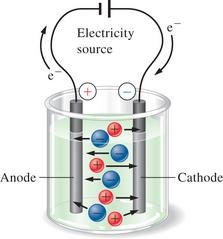
Redox reactions involve the transfer of electrons between substances. Oxidation is the loss of electrons (increase in oxidation state), and reduction is the gain of electrons (decrease in oxidation state).
Half-reactions: Redox reactions can be split into oxidation and reduction half-reactions.
Oxidizing agent: Causes oxidation, is itself reduced.
Reducing agent: Causes reduction, is itself oxidized.
Balancing Oxidation-Reduction Equations
Redox equations are balanced by the half-equation method, ensuring both mass and charge are conserved. In basic solutions, OH- ions are used to balance hydrogen and oxygen.
Stoichiometry of Reactions in Aqueous Solutions: Titrations
Titration is a technique to determine the concentration of a solution by reacting it with a standard solution. The endpoint is detected by a visual change (color, precipitation, pH change).
Key Point: The stoichiometry of the reaction is used to relate the volumes and concentrations of the solutions.
Additional info: These notes cover the core concepts of chemical reactions, stoichiometry, solution chemistry, and introductory aqueous reactions, as outlined in a typical general chemistry curriculum. Worked examples and images are included where they directly reinforce the explanations.
