 Back
BackComprehensive Study Notes for General Chemistry: Redox, Equilibrium, Kinetics, Solutions, and Organic Chemistry
Study Guide - Smart Notes
 Tailored notes based on your materials, expanded with key definitions, examples, and context.
Redox Reactions and Electrochemistry
Oxidation Numbers
Oxidation numbers are used to keep track of electron transfer in chemical reactions. They help identify which elements are oxidized and which are reduced.
P2O5: Assign O as -2, solve for P.
H3PO4: H is +1, O is -2.
P4: Elemental form, so oxidation number is 0.
PO33-: O is -2, total charge is -3.
PH3: H is +1, so
Balancing Redox Reactions in Acidic Solution
Redox reactions are balanced by separating them into oxidation and reduction half-reactions, balancing atoms and charges, and then combining them.
Example: Cu + ClO3- ⟶ Cu2+ + Cl2
Assign oxidation numbers, write half-reactions, balance electrons, and combine.
Electrolysis and Faraday's Law
The mass of a substance deposited or liberated at an electrode during electrolysis is proportional to the quantity of electricity passed through the electrolyte.
Formula:
Faraday's Law: , where
Galvanic Cells and Cell Potentials
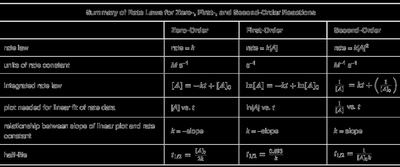
Galvanic cells generate electrical energy from spontaneous redox reactions. The cell potential is calculated using standard reduction potentials.
Cell Notation: Anode | Anode solution || Cathode solution | Cathode
Cell Potential:
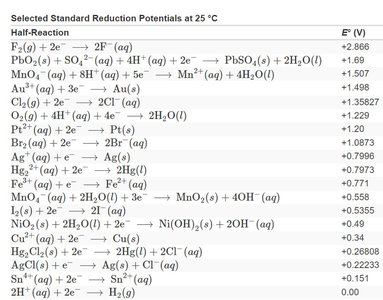
Gibbs Free Energy and Cell Potential
Chemical Equilibrium and Solubility
Solubility Product (Ksp)
The solubility product constant () describes the equilibrium between a solid and its ions in solution.
Molar Solubility: Amount of solute that dissolves to form a saturated solution.
Common Ion Effect: Solubility decreases in the presence of a common ion.
Precipitation and Q vs. Ksp
To predict precipitation, compare the ion product (Q) to :
If , a precipitate forms.
If , no precipitate forms.
Acid-Base Equilibria and Buffers
Buffers resist changes in pH upon addition of small amounts of acid or base. The Henderson-Hasselbalch equation is used to calculate buffer pH.
Chemical Kinetics
Rate Laws and Reaction Order
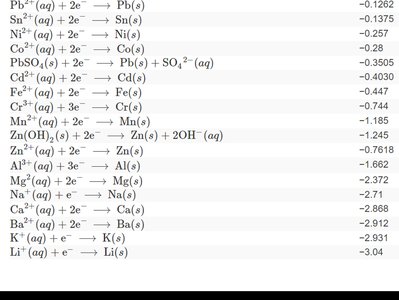
The rate law expresses the relationship between the rate of a reaction and the concentration of reactants.
Zero Order:
First Order:
Second Order: or
Half-Life and Integrated Rate Laws
First Order Half-Life:
Second Order Half-Life:
Thermodynamics
Enthalpy, Entropy, and Free Energy
Thermodynamics predicts the direction and extent of chemical reactions.
If , the reaction is spontaneous.
Solutions and Concentration Units
Concentration Units
Molarity (M):
Molality (m):
Mole Fraction ():
Percent by Mass:
Colligative Properties
Boiling Point Elevation:
Osmotic Pressure:
Acids, Bases, and pH Calculations
pH and pOH
Intermolecular Forces and Properties
Types of Intermolecular Forces
London Dispersion Forces: Present in all molecules, especially nonpolar.
Dipole-Dipole Forces: Present in polar molecules.
Hydrogen Bonding: Occurs when H is bonded to N, O, or F.
Substances with stronger intermolecular forces have higher boiling points and lower vapor pressures. Solubility in water increases with polarity and hydrogen bonding ability.
Organic Chemistry: Structure and Functional Groups
Lewis Structures and Functional Groups
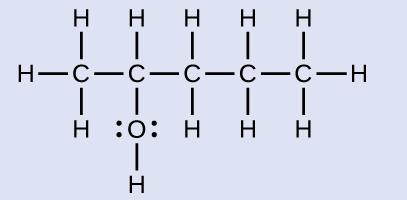
Organic molecules are represented by Lewis structures, showing the arrangement of atoms and electrons. Functional groups determine chemical reactivity.
Alcohols: Contain an -OH group (hydroxyl).
Alkanes: Saturated hydrocarbons with single bonds only.
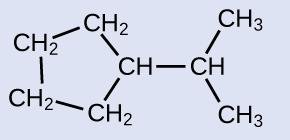
Cycloalkanes: Ring structures of alkanes.
Periodic Table and Periodic Trends
Periodic Table Organization
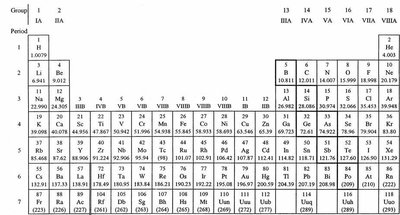
The periodic table arranges elements by increasing atomic number and groups elements with similar chemical properties together.
Groups: Vertical columns with similar valence electron configurations.
Periods: Horizontal rows indicating energy levels.
Periodic Trends
Atomic Radius: Increases down a group, decreases across a period.
Ionization Energy: Decreases down a group, increases across a period.
Electronegativity: Decreases down a group, increases across a period.
Additional info: Where calculations or specific worked examples are requested in the original material, students should apply the formulas and tables provided above to solve the problems step-by-step.
